
She explores representations of the Arctic in literature
At a time of climate change and geopolitical tensions, the Arctic has become a region of growing interest. But how does fiction shape our perceptions of the region? This is the question explored by Lena Leimgruber Haraldsson, a former student of English at the University of Gothenburg who is now a doctoral student at Umeå University.
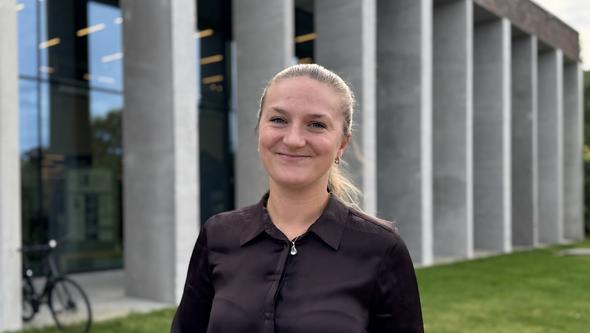
Lena Leimgruber Haraldsson has returned to Humanisten, the Faculty of Humanities building, to present her research at a public seminar. Around Näckrosdammen pond, the trees are beginning to turn yellow and red, but the afternoon is mild enough to go without a jacket. Lena notes that autumn is much further along in Umeå, the city she now calls home.
“Up there, we follow the eight Sámi seasons, and we've now moved from autumn-summer into autumn. I've had plenty of work to do in the garden, clearing up all the fallen leaves.”
Strong cultural ties to the Arctic
Just over two years ago, Lena moved north, leaving Gothenburg to take up a doctoral position in English at Umeå University. Her doctoral research explores representations of the Arctic in contemporary English-language literature, primarily novels but also some poetry and short stories. The move has therefore brought her closer to the region she studies.
"For me, it was important to live close to where I was doing my research, not least to make new friends. And although Umeå is not actually part of the Arctic, it has strong cultural ties to the region. The university is also part of an alliance called Arctic Six, which offers plenty of opportunities for collaboration and exchange.”
According to Lena Leimgruber Haraldsson, there are several different definitions of the Arctic, making it difficult to determine exactly where its boundaries lie. Geographically, however, it is generally defined as the area north of the Arctic Circle. It encompasses the northernmost parts of eight countries, including Sweden, Norway and Finland, as well as the United States (through Alaska) and Russia. Melting sea ice is changing the environment and living conditions, while major world powers are showing growing interest in the region's strategic location and natural resources.
“What happens in the Arctic affects us all. Climate change is one example. It's something that may start there and then, to use a metaphor that fits the Arctic, begin to trickle down to the rest of us. There's a lot of talk about the Arctic these days, but most of it comes from natural scientists rather than humanities scholars. And we need all perspectives.”
What perspectives on the Arctic can literature offer?
“The human perspective, perhaps. Reading a novel can give you a completely different perspective from your own. It might be about a place you've never visited, and perhaps never will, but literature can still give you a little glimpse of it. By reading different stories, we can explore other perspectives and hear different voices. Even though these stories exist on paper, they are in some way connected to a reality that someone is actually living.”
Tailoring her own degree
It was during her postgraduate studies at the University of Gothenburg that Lena Leimgruber Haraldsson became interested in climate fiction, sometimes referred to as cli-fi. This is a literary genre in which climate change and its consequences play a central role in the narrative. She was also drawn to ecocriticism and postcolonial theory, approaches she continues to use in her research today.
“Like many other students, I put together my own one-year Master's degree, followed by a two-year Master's degree. I really enjoyed writing and doing research, and it confirmed that this was what I wanted to pursue.”
When a doctoral position became available at Umeå University, she began considering how her previous experience and knowledge might fit in. She discovered that the university had a strong research environment focused on the Arctic.
“At first, I thought: What does the Arctic have to do with me? But then I realised that there is a colonial history, or several colonial histories if you look at the region as a whole, that I could draw on. I had to familiarise myself with an entirely new field, but at the same time I could build on what I already knew. Sometimes the different pieces of the puzzle just have to fall into place.”
Her advice to anyone interested in pursuing a PhD is to take the initiative, build a network of contacts and get involved. At the same time, it is important to be patient and prepared for the possibility that finding the right position may take time. As for Lena, she is certain that she wants to stay in academia and continue doing research after completing her PhD.
“Hopefully, I'll find a position somewhere in Sweden, or at least in Scandinavia. We'll see, but it would be really nice to come back to the University of Gothenburg.”
Text: Janna Roosch
Recommended reading: Four novels about the Arctic
For anyone interested in exploring the Arctic through fiction, here are four novels featured in Lena's doctoral research.
- Dan Simmons, The Terror (2007)
- Ian McGuire, The North Water (2016)
- Sam J. Miller, Blackfish City (2018)
- Michelle Min Sterling, Camp Zero (2023)
Recommended courses
English: Introductory Course. Literary and Cultural Studies, 15 hp
English: Climate Change Fiction, 7,5 hp
Faculty Course: The Imagined Arctic 7,5 hp (online course offered at Umeå University in the spring semester)