Frida wants to work at the intersection of users and AI products
Frida Piscator Pettersson is in her second year of the Master’s programme in Human-centered Artificial Intelligence. She is seeing more and more job descriptions asking for the skills the programme provides.
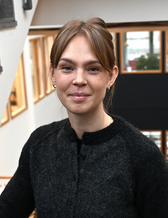
During her Bachelor’s degree in Cognitive Science in Linköping, Frida first came across artificial intelligence (AI), including in courses related to interaction design. She knew she wanted to continue working in the field of human–machine interaction.
When she discovered the Master’s programme in Human-centered Artificial Intelligence (HCAI), it caught her interest. She saw it as an opportunity to build on her background in cognitive science.
“When it comes to AI, there are additional layers of complexity in the interaction between technology and people. Studying HCAI allowed me to stay in the technical field. I want to work closely with technology, but I also think it is very important to keep the human perspective.”
Frida believes what she is studying now will be valuable in her future career.
“I see more and more role descriptions looking for someone who can act as a link between a technical or AI product and its users. Those of us who have studied HCAI have the advantage of understanding the technology, while also having the human perspective needed to speak the language of users and customers.”
The many discussions during the programme have helped her form a clearer view of AI.
“I really feel that the programme helps me understand how to think about and navigate AI-related issues. In the course ‘Fairness, Accountability and Transparency in AI’, for example, we had many interesting discussions and debates about when and how AI should be used, and what the consequences might be. It helped me understand the complexity of the subject, but also how important these discussions are.”
Her classmates come from a range of backgrounds. Many, like Frida, have studied cognitive science, while others come from information systems or computer science. Their focus areas also vary.
“We work a lot on projects, which means you have to make your own decisions about what direction to take, whether you want to focus more on technical or qualitative work. Some are interested in law and regulation related to AI, many are interested in AI in healthcare, and others want to work more technically. Many, like me, want to be somewhere in between complex technology and user requirements.”
Early in the programme, the HCAI students visited AI Sweden. That contact turned out to be important, as Frida and one of her classmates got the opportunity to work there the following summer, engaging in a cybersecurity project for the Västra Götaland Region.
Alongside her HCAI studies, Frida worked with fellow students from Chalmers to develop an IVF app. This led to an invitation to Stanford University the summer after their first year. None of them had developed an app before, but through interdisciplinary collaboration and support from AI tools, they built it using the Flutter framework. She believes her human-centered perspective from the programme was very helpful.
“When you work with anything human-centered, you go through design processes. You are used to understanding users, for example by creating personas that reflect their needs. I definitely brought that with me. I also have a background in interaction design and I am interested in making things user-friendly.”
Together with students from the Master’s programme in Digital Leadership, Frida and her classmates started a student initiative called “Neural Networkers”. Frida’s role focuses on company contacts and career-related activities. So far, they have organised social events and quiz nights. The plan is to hand the initiative over to other interested students.
For anyone considering HCAI, Frida says it is important to be prepared for a high level of independence. The field is broad and relatively new, and students need to make their own decisions about what to focus on. She sees this as a benefit, as it has allowed her to reflect on what she is truly interested in.
“We talk a lot about ethics – what is ethical, and for whom. It can become quite philosophical. You need to be prepared for a broad and complex subject, but that also means you gain the tools to discuss these issues properly. You have to keep an open mind and see it as a way to find your own place within the HCAI field.”
Interview by Agnes Ekstrand