The professor who stopped explaining and started exploring
What happens to human judgement as AI and digital technologies take on an increasingly prominent role in our working lives? For newly appointed Professor Dina Koutsikouri, this is a central question. Her research explores how people, technology and organisations interact, and how digitalisation can be designed to support, rather than replace, human experience, responsibility and decision-making.
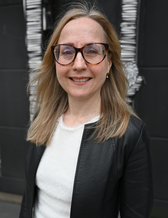
Dina Koutsikouri, What drives your research?
– Curiosity! A strong desire to understand something in depth and to explain what is happening around us all the time, often without us even noticing it. I am particularly interested in what happens when new technologies are introduced into organisations. How do you lead organisations through uncertainty and learning? How do we create work environments where technology supports people, rather than the other way around? And how do we help people cultivate good judgement?
What do you hope your research contributes to?
– I hope my research can contribute to a better understanding of the value and role of human beings in an increasingly digitalised world. Human relationships are essential to our wellbeing, both at work and in everyday life. At the same time, we see digital technologies changing how we meet and collaborate. That is why I think it is important to continue discussing how technology can be developed and used in ways that strengthen rather than weaken human relationships.
Is there a particular responsibility in the role of professor that you consider especially important?
– To me, being a professor is very much about contributing to the development of others and creating hope that change is possible. An important part of the role is supporting doctoral students and early-career researchers, but also being a good colleague. You never stop learning, and I think that is character-building.
For me, it is also important to stay close to practice. To remain “in the field”; interviewing, observing and understanding people’s everyday lives in organisations. That is where the truly interesting questions are. Last, but certainly not least, I believe it is important to contribute to long-term and sustainable research environments, while also helping to formulate new research questions, particularly within my areas of interest.
Has there been a particular experience or period in your career that pointed out the direction of your research?
– My time as an industrial PhD student had a profound impact on me. That was when I discovered how rewarding and challenging it is to conduct ethnographic fieldwork and understand how people interact in complex work environments. At the same time, I struggled to find the right methodological approach.
We often try to understand and explain things too early, instead of curiously investigating what is actually happening and what people themselves experience as problems and challenges.
My supervisors arranged a meeting with a researcher working with "grounded theory", and it became a real Eureka moment for me. Suddenly, I started to see patterns in my material in a completely new way. I also had the opportunity to meet Barney Glaser, the founder of "grounded theory".
I particularly remember when he interrupted me in the middle of explaining my research and said: “Stop talking – just go and find out what is going on.”
At first, I was taken aback, but over time I realised how important that advice was. We often try to understand and explain things too early, instead of approaching them with curiosity and investigating what is actually happening and what people themselves experience as problems and challenges.
What questions do you want to continue exploring as a professor?
– At the moment, I have started two very exciting collaborations.
One focuses on minute-by-minute scheduling in home care services and is connected to GPCC – the Centre for Person-Centred Care at the University of Gothenburg. Researchers from the Department of Applied Information Technology contribute expertise on systems transformation, digital infrastructures, and how technology, management and practice need to evolve together to enable person-centred care.
The second collaboration concerns automated decision-making in the public sector. In this work, we are trying to broaden the understanding of the concept of human-in-the-loop, with a particular focus on the citizen’s perspective. That is, the people affected by automated decisions.
Describe something you have researched that you think we need to understand better.
– I believe that human judgement in relation to AI and automated decision-making is one of the most important issues of our time. The more advanced technologies become and the more they are integrated into our organisations, the more important it is to understand what human judgement actually means.
Judgement involves taking the whole situation into account. It is not only about facts or rules, but also about lived experience, intuition, situational awareness and responsibility. In healthcare, for example, people sometimes speak of the clinical gaze, the ability to perceive things that cannot always be measured or expressed through data.
Human beings often need to make decisions despite having incomplete information. AI can sometimes create a sense of control and certainty, but it is important to remember that intelligent systems also have limitations. Machines cannot sense and understand a situation in the same way that people can.
Technology can be a valuable source of support, but it can never fully replace human experience, empathy and judgement.
Interview by Agnes Ekstrand