
Reza Ardeshir Mokhtari: Interaction between biomaterials and biological healing promotes integration of dental implants
The research in Reza Ardeshir Mokhtari’s thesis focuses on how the surface of dental implants can be modified using the drug zoledronate to stimulate osseointegration – the ability of titanium implants to heal into bone. The aim is to optimize treatment outcomes and prognosis for patients with impaired bone quality who receive dental implants.
REZA ARDESHIR MOKHTARI
Dissertation defense: 3 June 2026 (click for details)
Doctoral thesis: On osseointegration of Zoledronate coated oral implants in bone.
Research area: Biomaterials
Sahlgrenska Academy, The Institute of Clinical Sciences
Replacing missing teeth with dental implants is an established and successful treatment method. However, there are still situations where bone healing is insufficient or where bone quality is impaired due to various local or systemic factors, such as metabolic bone diseases. Drugs containing bisphosphonates have long been used in healthcare to influence bone turnover and increase bone mass in patients with different skeletal disorders.
“In my research, I have investigated whether local treatment of titanium implants with zoledronate, the most potent bisphosphonate, can improve osseointegration by increasing local bone mass and creating stronger biomechanical anchorage of the dental implant in the bone,” says Reza Ardeshir Mokhtari, senior consultant and specialist in oral and maxillofacial surgery. He works at the ENT and Oral and Maxillofacial Surgery Clinic within NU Hospital Group in Trollhättan, at the Brånemark Clinic, and is a doctoral student at the Institute of Clinical Sciences.
The thesis includes both experimental and clinical studies investigating biological mechanisms, bone healing, and potential treatment benefits for patients receiving jawbone-anchored implants.
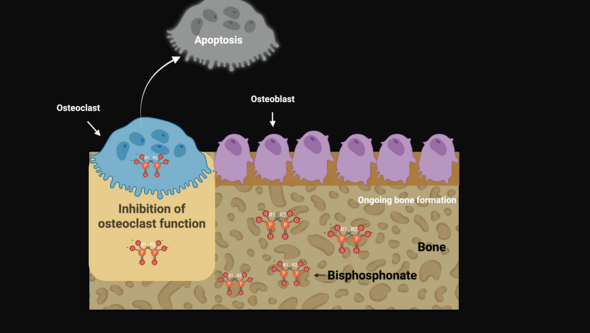
Figure 2 from thesis: Mechanism of action of bisphosphonates in bone. Bisphosphonates accumulate in bone matrix and are internalized by osteoclasts during resorption, inhibiting osteoclast activity and promoting apoptosis, resulting in reduced bone resorption and increased bone mass. (Created with BioRender.com)
Zoledronate inhibits the breakdown of bone tissue
The results show that zoledronate-treated implants can increase bone mass by locally inhibiting the ability of osteoclasts* to resorb bone. The treatment is safe for patients and causes no negative side effects, but it will likely require a longer healing period to achieve optimal biomechanical anchorage in bone.
Under the right conditions, this drug-coated titanium implant approach could offer a safer and more predictable implant treatment alternative for patients who are currently unable to receive oral implants.
“Our observations also show that the full potential of zoledronate’s osseointegrative effect will likely require longer observation periods in order to fully clarify the biological behavior of the drug.”
What has been the most rewarding and the most challenging part of the doctoral project?
“The most rewarding part has been combining clinical work with research and working at the intersection of biomaterials science and patient care. It has also been very inspiring to collaborate with researchers from different fields and backgrounds, as well as to attend conferences and present our research. The greatest challenge has been conducting long-term studies in parallel with clinical work while also keeping the entire project together over many years.”
Text: Susanne Lj Westergren
Osteoclasts: In a healthy skeleton, there is a balance between the formation and breakdown of bone tissue, which keeps bone mass constant. Bone is built up by a type of cell called osteoblasts, while another type of cell, osteoclasts originating from the bone marrow, is responsible for bone resorption. (Source: gu.se)