
Louise Mövik: Risk models for radiotherapy of lung cancer
Research in Louise Mövik’s thesis focuses partly on developing so-called dose–response models to estimate the risk of early respiratory-related death following radiotherapy for lung cancer. It also addresses a practical challenge: that collecting and preparing data manually is very time-consuming for large-scale studies of dose–response relationships.
LOUISE MÖVIK
Dissertation defense: 24 April 2025 (click for details)
Doctoral thesis: : Predicting early respiratory-related mortality after lung cancer radiotherapy: Automated radiotherapy data preparation and risk modeling
Research area: Medical Radiation Sciences
Sahlgrenska Academy, The Institute of Clinical Sciences

Radiotherapy is an important treatment for lung cancer. However, it’s crucial to achieving the right balance between delivering a sufficiently high radiation dose to treat the tumor while keeping the dose to healthy organs at an acceptable level to protect them from complications.
To optimize this balance, dose–response models are needed to describe how radiation doses to different organs are linked to treatment outcomes—that is, the results of the treatment. The problem is that there is a lack of such risk models, especially for rare but serious complications.
“My research focuses on developing risk models for the rare outcome early respiratory-related death following radiotherapy for lung cancer, says Louise Mövik, medical physicist at the Department of Therapeutic Radiation Physics at Sahlgrenska University Hospital and a doctoral student at the Institute of Clinical Sciences.
Automated methods for collecting radiotherapy data
To develop these models for a rare outcome, large amounts of radiotherapy data are required - and collecting such data manually is very time-consuming.
“That is why my research has also focused on developing automated methods for preparing radiotherapy data. Using these methods, I prepared data from several hospitals, which were then used to build dose-response models”.
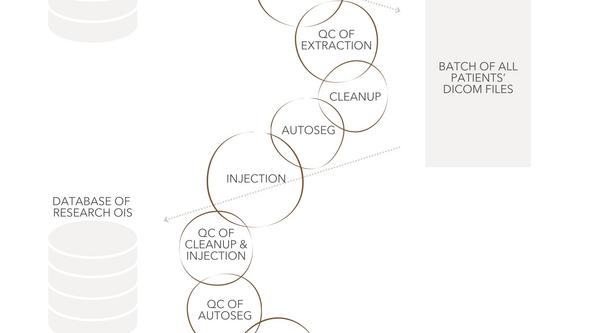
Illustration from thesis: An automated workflow for preparing radiotherapy data that can then be used to develop risk models. See the thesis for a more detailed description.
Age and lung radiation dose can predict the risk of early respiratory-related death
One result from the research presented in the thesis was the development of risk models to estimate the risk of early respiratory-related death following radiotherapy for lung cancer.
“We found that the patient’s age and the radiation dose to healthy lung tissue are important factors in estimating this risk. In the long term, such risk models could be used to assess individual patients’ risk of early respiratory-related death”.
The methods developed for automatically preparing radiotherapy data can also be used to efficiently prepare large datasets for other studies, which may facilitate future research.
What has been the most rewarding and challenging part of your PhD project?
"One particularly rewarding aspect of this project has been that it consisted of many different components, each challenging in its own way, but together making it possible to complete the final study."
Text: Susanne Lj Westergren