
Interdisciplinary collaborations open new pathways for research
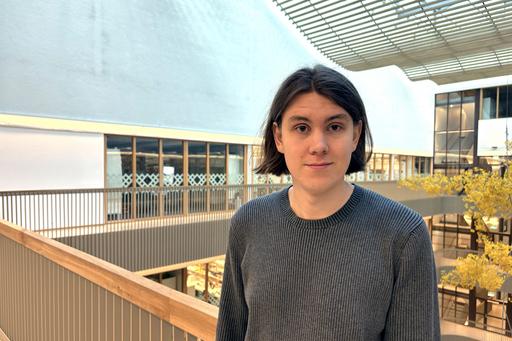
In his research, PhD student Hampus Nyström develops chemical tools that make it possible to follow specific proteins in living cells. Through collaborations across disciplinary boundaries, his work has led to unexpected findings that may, in the long term, benefit heart patients.
Researchers study proteins in cells to better understand diseases and develop more precise treatments. To follow a protein inside a living cell, however, it first needs to be labelled. Many established methods for studying proteins rely on genetic modifications, such as altering a cell’s DNA to make a protein glow. Hampus Nyström’s research group aims to minimise the impact on the cell.
“Using chemical methods, we can label proteins without genetic modification. What is particularly important in our project is that the protein continues to function normally even after it has been labelled,” says Hampus Nyström, PhD student in chemical biology.
He designs and synthesises molecules that bind to a specific protein target and label it with a fluorescent group so that it lights up. This makes it possible to see where the protein is in the cell and how it behaves. The labelling approach allows researchers to better understand how a protein functions and where it is found in the cell, which in turn may provide clues to new ways of targeting the protein.
Surprising results after an unexpected detour
Although Hampus Nyström is based at the Department of Chemistry and Molecular Biology, collaboration with a co-supervisor at the Sahlgrenska Academy has given him the opportunity to culture and work with living cells in which his chemical tools can be tested. It was during one such test that an unexpected detour emerged when a molecule did not behave as planned. In addition to binding to its intended target, the molecule turned out to be highly selective for a different protein.
“We provided the molecule to researchers at the Sahlgrenska Academy, who in tests on heart cells observed that it affects how the cells use fat as an energy source,” says Hampus Nyström.
The finding has led to further studies at Sahlgrenska in collaboration with scientists in France to investigate whether the mechanism could be relevant for recovery after a heart attack.
For Hampus Nyström, the discovery illustrates how fundamental research can take unexpected turns, as well as the importance of proximity between disciplines.
“For someone working in medicinal chemistry, the connection to the Sahlgrenska Academy is very important. Here, chemistry, biology and medicine are closely linked, making it easy to collaborate across subject boundaries.”
Varied and social days as a PhD student
In his daily life as a PhD student in chemistry, no two days are the same. One day he could be working in the laboratory, and the next supervising master’s students or attending seminars with fellow doctoral students at the department.
“It’s quite social being a PhD student at the department. We work closely together, discuss problems and help each other move forward.”
At the same time, research requires persistence, Hampus Nyström explains. It is not uncommon to spend two months developing a molecule, only to have to start over when it does not work as expected.
“It takes many hours in the lab to make progress. But that’s how research works”.
After completing his PhD, Hampus Nyström hopes to continue in academia and sees a postdoctoral position, preferably abroad, as a possible next step.
“It would be exciting to live abroad for a while, experience other research environments and learn new techniques that I could eventually bring back to Sweden”.
Text: Natalija Sako
Age: 26
From: Skövde
Interests:Orienteering, running, cycling, cooking and playing board games
Fun fact:Has more than 1,000 orienteering maps sorted at home in the apartment from trainings and competitions across Sweden and also abroad