
Exploring Greenland’s unique underwater world
In the Ikkafjord in Greenland, columns of the rare mineral ikaite rise from the seabed. It is home to a unique ecosystem with species found nowhere else. Geologist and geochemist Gabrielle J. Stockmann has studied the area for over 30 years and is now observing how climate change may threaten this unusual underwater world.
From the bottom of the Ikka Fjord in south-west Greenland around one thousand strange columns reach up through the water in formations that look like the ruins of ancient monuments. These unique structures are up to 20 meters in height and about 8 meters wide, comprising a very rare mineral called ikaite.
– Plants and animals thrive among the columns. There are also bacteria that cannot be found anywhere else on Earth, says geologist and geochemist Gabrielle J. Stockmann.
30 years of research in the Ikkafjord
Ikkafjord has been a central part of Gabrielle’s research career. While still a student in Copenhagen, she had the opportunity to take part in an expedition to the area. What began as a single trip developed into three decades of research as part of the IKKA project.
The project is a partnership between the universities in Gothenburg, Aarhus, Copenhagen, Stockholm, Reykjavik and Imperial College London. The research explores how these unique ikaite columns form and how they respond to changes in climate and environmental conditions.
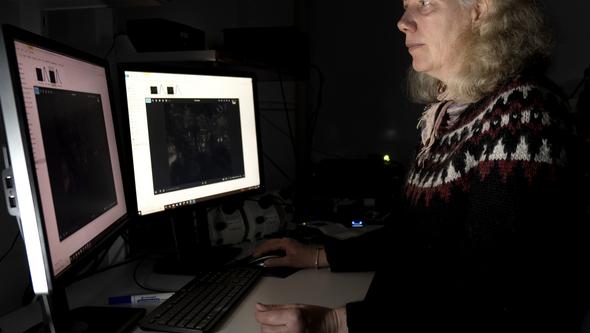
With the help of the specialised IceLab facility at the University of Gothenburg, researchers can study how the ikaite columns are affected by warmer water, Gabrielle explains.
– Ikaite can only exist in sea water that is colder than around 6 degrees. In 2019 the water temperature in the fjord exceeded this critical limit and life on the pillars seemed to be in danger. But in the summer of 2024 the water had turned colder again. So we are hoping that this unique underwater world can be preserved, despite changes to the climate and the environment.
Climate change is affecting the research
The effects of climate change are clearly visible in Ikkafjord. Shifting temperatures are impacting both the ecosystem and the conditions for research.
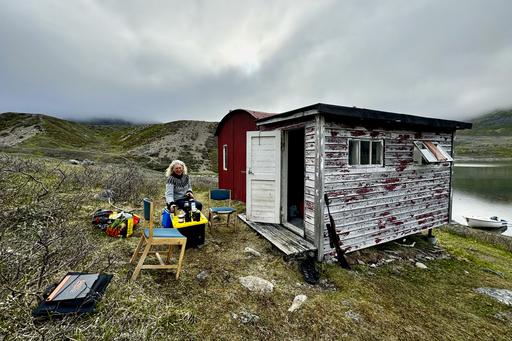
– Previously the researchers could stay in simple tents, but now we require proper cabins and guns. This is due to the area being more frequently visited by polar bears on drifting ice floes that have broken off because of the heat.
Research for future climate solutions
In addition to the IKKA project, Gabrielle has also been involved in research on methods for capturing carbon dioxide from industrial emissions. In collaboration with the company Carbfix, she is exploring how CO₂ can be captured and converted into minerals in the bedrock.
– It uses a lot of ground water so the method is not suitable everywhere. In our new experiments we are trying sea water instead; the method could contribute to solving one of the greatest environmental problems of our time.
Gabrielle J. Stockmann has also worked at the Danish “Dansk Polarcenter”, she was a doctoral student in Reykjavik and Toulouse and also conducted research at Stockholm University and the University of Iceland. She frequently works side by side with her husband, Erik Sturkell, Professor of Geophysics at the University of Gothenburg.
From childhood in Greenland to a research career
Her doing her research on Greenland is no coincidence.
– I was born in Denmark but lived in Nuuk between the ages of nine and twelve. My mother is a nurse and was encouraged to work there at the end of the seventies as the wages were high and taxes were low. Occasionally she would work on a ship transporting patients that sailed to and from Nuuk, up and down the west coast of the island; and I got to accompany her. The years on Greenland were the happiest in my life and have affected my entire life. The schooling was in Danish, but I also studied Greenlandic and English. And because there were so many American troops there, all children spoke some kind of mix between all three languages.
Nuuk is covered in snow from September to May and winters are long but not dark. The snow and the magical northern lights provides light and temperatures rarely fall below 10 degrees below zero. Leaving a wintry climate for rainy Copenhagen was difficult for twelve-year-old Gabrielle.
– It was awful going from a life in the open outdoors to living in a claustrophobic city. But I decided to return; so I trained as a geologist, because what else do you do if you have lived in a country with some of the oldest rocks on earth?
Today, that curiosity has led to 30 years of research in Ikkafjord. Work that contributes to a deeper understanding of one of the world’s most unique marine environments and how vulnerable its ecosystem is to climate change.
Profession: Geochemist and geologist, affiliated researchers at the University of Gothenburg. Involved in the IKKA Project.
Family: Husband Erik Sturkell, Professor of Geophysics at the University of Gothenburg, and two Smooth Collies.
Lives in: Landala Egnahem.

