What kinds of futures are worth striving for—and how can artistic research help imagine them? These questions framed the first annual symposium of the Centre for Art and the Political Imaginary (CAPIm), held in Gothenburg in August.
"CAPIm is an infrastructure with several responsibilities: to gather those invested in the political imaginary from across the field of artistic research, and to maintain a rigorous, practice-based conversation about the nature of artistic research today—both in Sweden and internationally" – Professor Natasha Llorens.
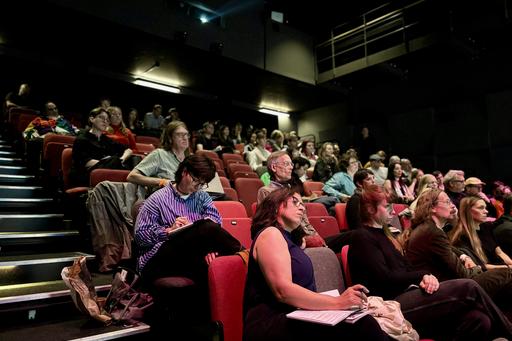
During two days in late August, the Centre for Art and the Political Imaginary (CAPim) held their first annual symposium in Gothenburg. Local, national and international artists, researchers and educators gathered at Skeppet GBG and Kulturhuset Bergsjön to discuss how art, politics and imagination might shape the futures worth striving for – or warn us against those we fear.
CAPIm, Sweden's first Centre of Excellence in Artistic Research, is co‑chaired by Professor Mick Wilson, HDK-Valand, and Professor Natasha Marie Llorens, Kungl. Konsthögskolan. The centre is committed to interdisciplinary practice and research in the meeting between contemporary art and the future of politics. The Centre’s aim is to facilitate connections between research and education through an engagement with experimental approaches.
Image
Photo: Susanne Jansson
Rehearsing political imagination
The symposium featured keynote speeches, presentations, panel discussions, and receptions.
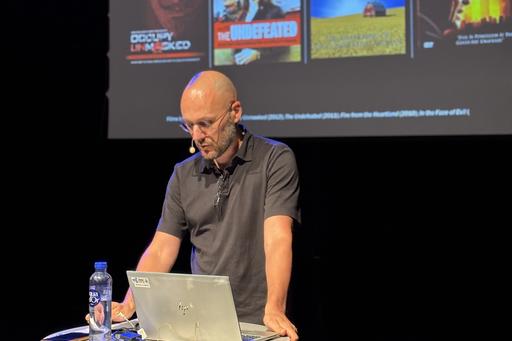
Among the presenters were CAPIm’s senior guest researchers Jonas Staal, who examines the entanglements of art, democracy, and propaganda with his research project Shadow Art World: Rehearsing Genocide.
During his presentation, Jonas Staal introduced us to the main topic of his research: the shadow art world, a term he uses to describe the cultural workers and artists that are employed by the military-industrial complex, far-right regimes, or fascist organizations. One example that Staal discussed was the game designers employed by the US Army to develop the video game Americas Army, a first-person shooting game launched in 2002 intended to inform, educate and recruit prospective soldiers. Staal also referred to US Army training camps, where set designers, actors and screenwriters create immersive simulations for military training.
But Staal also emphasized the important work of imagining new forms of institutions, spaces where stories of life and solidarity are propagated. Such as utopian training camps where international campaigningand protest, redistributionof love and decolonizing of society is rehearsed.
"I would say that the Center for Art and the Political Imaginary is such a rare space, to train and practice the imaginaries that we need to thrive" – Jonas Staal.
Image
Jonas Staal
Photo: Susanne Jansson
With their first annual symposium, CAPIm has positioned themselves as a vital platform for artists, thinkers, and researchers working at the edge of political imagination.
“CAPIm’s first annual symposium was a collaborative effort, combining the existing research and alumni contributions of the two institutions in Gothenburg and Stockholm” – Professor Mick Wilson.
Other activities at the symposium
The symposium featured keynotes by María Galindo and Stefan Jonsson, presentations by Jonas Staal, Liv Bugge, Elof Hellström & Sebastian Dahlqvist, Alexandra Papademetriou, Azadeh E. Zaghi and Reyhaneh Mirjahani, as well as a workshop with Valentina Desideri, Kerry Guinan, and Michele Masucci.