
Super-exciting “Hack a Truck” competition goes down to the wire
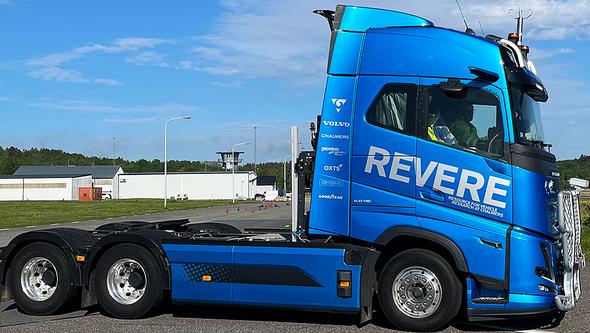
After managing to secure one of the spots, one team from the University of Gothenburg and two teams from Chalmers University of Technology finally got to compete in the hackathon "Hack a Truck" at Stora Holm. The task they had to accomplish was to maneuver an impressive 14-ton test vehicle from Revere Lab, just by using their own code.
33 teams applied for the competition
An amazing total of 33 teams applied to participate in Hack a Truck, but the competition had unfortunately just room for three of them. Each team consisted of three students, and they had one day to spend to figure out how to interact with the truck’s systems. The sun flooded over the test tracks, the safety vests were glowing in the sun, and both the truck and the sky were very blue.
The competition turned out to be remarkably close, and the final decision would not be made until the very end of the day. All three teams performed very well in this competition.
How Hack a Truck at Stora Holm worked:
After each 20-minute testing session in the truck, the teams were given another hour to fine-tune their code while the other two teams took turns running their own tests in the truck. After the work indoors it was time to head back out onto the test track with a new version of their software. It was excitement in the driver's cabin every time – would the truck respond to the new commands or not?
Srijita Basu, hackathon manager, comments:
“The hackathon was about far more than just writing code. To make the truck move, the participants first had to understand the truck’s software interface and the network messages required to control the accelerator, brake, and steering. That combination of software, systems understanding, and real-world testing made the experience especially rewarding."
"One of the most memorable moments came when a team managed to control the truck using a guitar they had been programming. For a while, it looked like they might take the win with their creativity alone. But in the end, another team stood out for a different reason, their engineering mindset."
"The winning team identified a very concrete problem in their interaction with the truck during the hackathon and developed a practical solution. They discovered that a programming-language-dependent timing delay was affecting the communication with the truck, and they solved it by making the truck listen to the kernel clock instead. Exactly the kind of clear, effective engineering solution that makes complex systems work in practice."
"That, perhaps, was the most important lesson from the hackathon. At a time when agentic AI can generate code and automate programming tasks, real engineering still matters. The ability to observe a problem, understand its cause, and design a simple but robust solution remains a uniquely valuable skill."
Words from the winning team:
“The most challenging part was the timing. We were working directly with the truck's real control system, and one detail in particular gave us hours of trouble. The truck would respond to our steering commands but refused to accelerate. It turned out the truck has a strict timing requirement on its accelerator's messages, and the standard way of sending those messages wasn't precise enough. The truck required a millisecond-level accuracy. Once we built a custom solution that locked the timing down with high precision, the truck finally drove. That moment when it started moving under our code for the first time is something none of us will forget."
"The most rewarding part was seeing all four of our modes work on the real truck on demo day. We had autonomous forward and reverse driving, a closed-loop GPS circle, straight-line cruise, and full manual drive off a PS4 controller. The judges asked us to demonstrate all the four modes, and every one ran cleanly. There's something genuinely strange about writing software on your laptop one day, and watching a 14-ton truck move because of your code on the next."
"As for the feeling now, mostly pride in the team. The three of us worked really well together and the win felt earned. Big thanks to Miroslaw Staron, Srijita Basu, and everyone at REVERE for making this kind of event possible. It's rare to get hands-on with hardware at this scale as a student.”
The winning team from University of Gothenburg:
Riad Santir
Valentina Rrustem
Wesam Al-Zoainat
Professor Miroslaw Staron, the organizer of Hack a Truck:
"I put time to organize these Hackathons because this is crucial for our students, universities and industry. When my colleagues from our automotive companies saw what we are doing, they expressed that they want more of this kind of student challenges to ensure that they get the best employees they can. We also need to provide more of these Hackathons to let students know what they sign up for when they start working. It is a form of career planning, if you think about it."
"For me, personally, this is the coolest part of the job – to see how young people grow in one day – from zero to hero in truck programming, that does not happen at every job!"
Text: Catharina Jerkbrant

The team from Software Engineering and Management, BSc:
Valentina Rrustem
Wesam Al-Zoainat
Riad Santir
The team from Chalmers, MSc:
Jennie Edlund
Paul Soukup
Jonathan Lind
The team from Chalmers, BSc:
Miranda Thörnblom
Carl Harrison
Josephine Athena
The Department of Computer Science and Engineering which is responsible for Hack a Truck, is joint between Chalmers University of Technology and the University of Gothenburg and teaches in all the educations mentioned above.