
Nordic initiative advances AI for improved cardiac diagnostics
In a Nordic collaboration, researchers will develop artificial intelligence to analyze cardiac CT scans. The aim is to automate the analysis of cardiac structures, particularly the coronary arteries, to improve diagnosis and prognostication. The project will develop open AI, meaning that the knowledge and tools will be made broadly accessible for the benefit of all.
The initiative is funded by the Novo Nordisk Foundation with 34 million Danish kroner and is based on an imaging dataset comprising more than 120,000 examinations from multiple countries. The scale of the data makes it possible to train and compare AI models on a large scale.
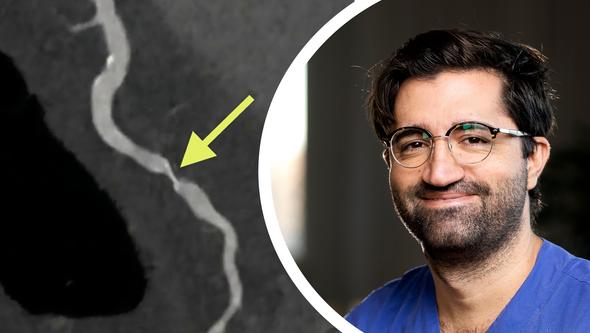
Araz Rawshani is an adjunct professor of cardiology with a focus on artificial intelligence at the Sahlgrenska Academy, University of Gothenburg, and a practicing cardiologist at Sahlgrenska University Hospital:
“This is an important initiative, as substantial investments in AI are needed in the Nordic region if we are to keep pace with the rapid developments in the field. By aggregating large volumes of imaging data and building open models that can be tested across multiple countries, we can develop tools that are more robust, comparable, and clinically useful,” says Araz Rawshani, whose group contributes AI expertise and data from Västra Götaland, including just over 18,000 cardiac examinations.
Shared reference dataset
The collaboration is led from Denmark and, in addition to Sweden, also includes researchers in Norway. Together, they will develop AI models for analyzing CT images of the heart and coronary arteries. The models will be made openly available so that other researchers can use, evaluate, and further develop them.
A central component of the project is the creation of a benchmark dataset, that is, a shared reference dataset against which different AI models can be tested using the same imaging material. This will make it easier to compare methods and improve algorithms over time.
The researchers will train and test AI models on CT images of the heart and coronary arteries. The results will then be compared with clinical examinations, registry data, and follow-up of patients’ cardiac health. The expectation is that, over time, these tools will provide better support in the assessment of cardiovascular disease.
“Sweden is at the forefront of AI in medical imaging, largely thanks to the successes of SCAPIS, and with this initiative we further strengthen our capabilities in this important area,” says Araz Rawshani.