
New technology reveals hidden shipwrecks in the Baltic Sea
Four previously unknown shipwrecks – one possibly dating back to the Middle Ages. During an expedition aboard the University of Gothenburg's research vessel Skagerak, maritime archaeologist Brendan Foley and his research team made discoveries that exceeded their expectations.
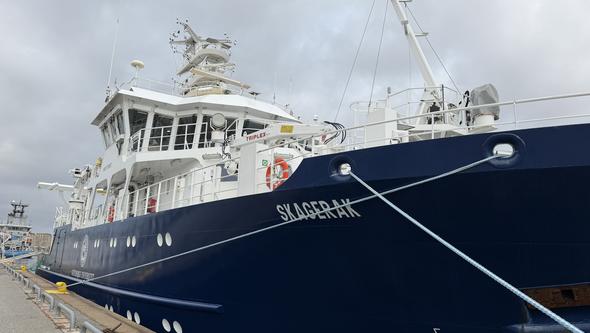
R/V Skagerak is moored in Karlskrona after two intensive weeks at sea, with strong winds at times.
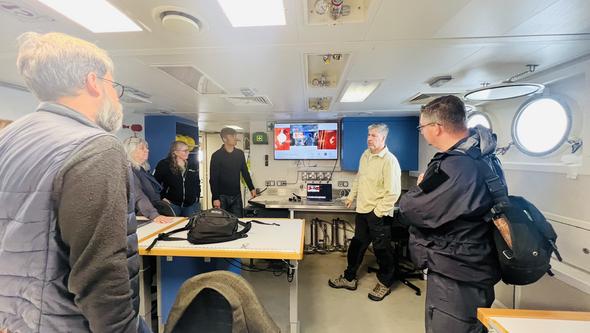
Maritime archaeologist Brendan Foley from Lund University admits to feeling a little tired, but his face lights up as he talks about the expedition aboard the University of Gothenburg's research vessel.
“The discoveries we've made have far exceeded my expectations,” he says, sitting in the large laboratory aboard R/V Skagerak.
Together with researchers from Stockholm University, the Norwegian University of Science and Technology (NTNU) and other higher education institutions, Brendan Foley has explored parts of the seabed in the central Baltic Sea, between Sweden and Poland.
Using advanced sonar systems and underwater robots, the team discovered what are believed to be four previously unknown shipwrecks, one of which may date back to the Middle Ages.
"This is huge!" says Brendan Foley.
A largely unexplored sea
Brendan Foley has always been fascinated by what lies beneath the surface of the water.
"I can't look at a body of water without wondering what's underneath," he says.
Although people have been travelling across the Baltic Sea for thousands of years, large areas have never been systematically surveyed for historical remains. At the same time, conditions on the seabed make the Baltic Sea particularly interesting from a maritime archaeological perspective.
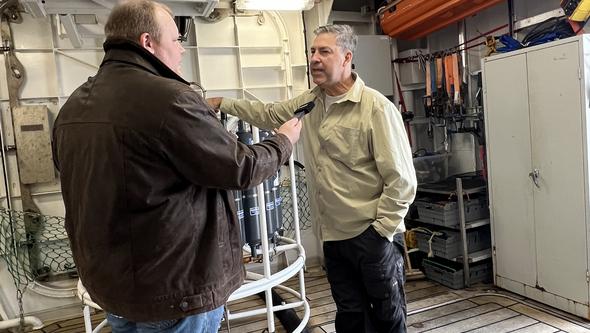
During the expedition, measurements showed that temperatures could drop sharply within just a few metres of depth, while oxygen levels near the seabed were almost non-existent.
"In these oxygen-free environments, the organisms that normally break down wood cannot survive. This means that old wooden shipwrecks can be exceptionally well preserved," explains Brendan Foley.
Underwater robots open up new possibilities
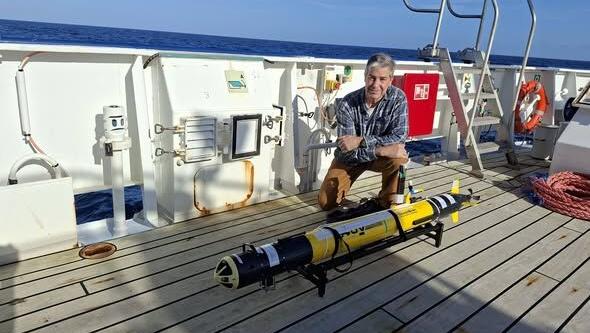
The researchers combined R/V Skagerak's hull-mounted multibeam echo sounder with autonomous underwater vehicles (AUVs) and remotely operated vehicles (ROVs). The echo sounder helps them identify potential wreck sites, which can then be examined in greater detail using high-resolution sonar and cameras.
"In these oxygen-free environments, the organisms that normally break down wood cannot survive."
Deploying and operating underwater vehicles far out at sea places considerable demands on both the vessel and its crew. During the expedition, the research team and crew refined their procedures for launching and recovering the vehicles, even in challenging conditions.
For Brendan Foley, this was one of the highlights of the expedition – seeing technology, research and teamwork come together.
Just the beginning
The four shipwreck discoveries are the first results of what the researchers hope will become a multi-year project. The aim is to systematically map traces of human presence and activity in the Baltic Sea throughout history.
With modern underwater technology and research platforms such as R/V Skagerak, new opportunities are emerging to explore a part of our history that still lies hidden on the seabed.
Read and listen to more: Four new shipwrecks discovered in the Baltic Sea – Sveriges Radio P4 Blekinge


