Kasper Bågmark receives the WASP Postdoctoral Scholarship
Kasper Bågmark, PhD student at the Department of Mathematical Sciences, has been awarded the WASP Postdoctoral Scholarship. This will provide him with a two-year postdoctoral position at Vrije Universiteit Amsterdam, followed by two years of funding upon his return to Sweden. Awarded by the Knut and Alice Wallenberg Foundation, the scholarship is intended to help researchers establish an independent research profile.
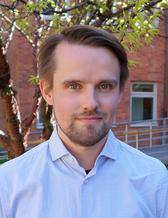
“Receiving this scholarship is a great honour, and very exciting. The project felt inspiring even as we were writing the application, so it’s particularly rewarding to now have the opportunity to carry it out. It’s also a fantastic chance for me to develop as a researcher and apply my background in numerical analysis, statistics, and machine learning to a new field,” says Kasper.
In his upcoming postdoc project, Kasper will develop new mathematical and machine learning methods for understanding brain activity from uncertain and incomplete data.
“Many brain processes cannot be observed directly. Instead, researchers often only have access to noisy and partial measurements, for example from brain imaging or neural recordings. At the same time, mathematical models of brain activity contain many uncertain parameters, such as how different regions of the brain interact. This creates a major challenge: how can we combine models and data in a reliable way, while also keeping track of uncertainty?” says Kasper.
The project focuses on computational models called neural field equations, which describe brain activity at a larger spatial scale.
“I will develop methods for estimating hidden brain states and model parameters from data, for predicting how uncertainty affects brain stimulation models, and for learning uncertain connectivity patterns between brain regions.”
The long-term goal is for the research to contribute to more reliable simulation-based approaches in neuroscience, where computer simulations can support the study of brain dynamics, experimental design, and potentially the development of future diagnostic and treatment strategies.