
International Master's students gather at Tjärnö every summer
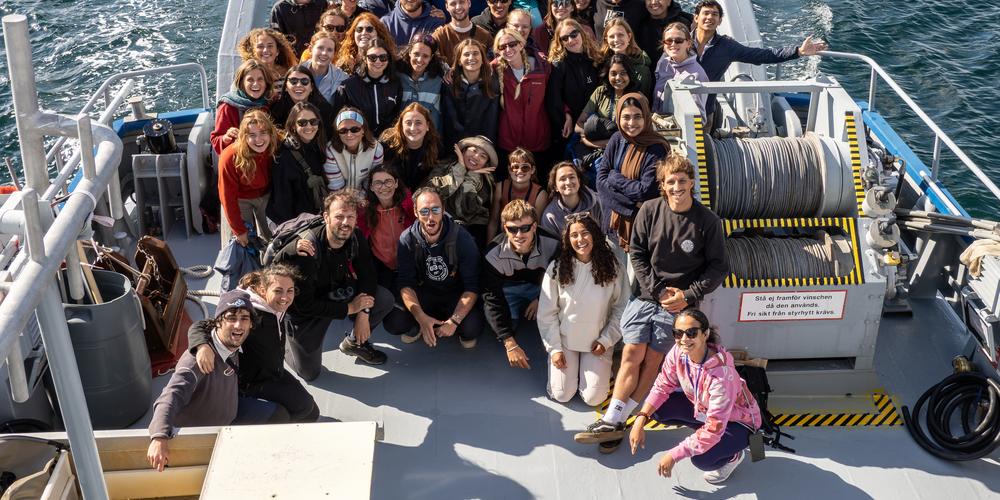
It may be summer, and a quiet time at most universities across Europe, but Tjärnö Marine Laboratory is buzzing with activity. Around 70 international Master's students are taking part in IMBRSea's annual summer school – and according to the programme's main academic coordinator, there are several reasons why they return to Tjärnö year after year.
"We haven't found another place that has all of this," says Dr Luana Monteiro, Main Academic Coordinator of IMBRSea and based at Ghent University in Belgium.
The students arrive at Tjärnö in two groups, starting in mid-July. At the marine station they are divided into smaller teams and spend two weeks carrying out a scientific research project, from the initial idea to the final presentation.
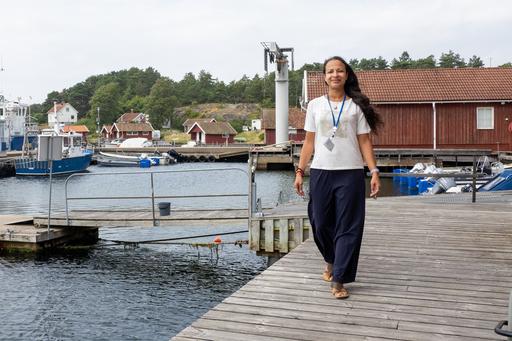
According to Luana Monteiro, the strengths of Tjärnö Marine Laboratory include its proximity to the sea, the possibility of combining fieldwork with laboratory experiments, and the fact that everything is within walking distance. She also highlights the availability of accommodation and meals.
"This is the perfect place for our summer school," she says.
Important part of education
Before arriving at Tjärnö, the students have completed the first year of the two-year IMBRSea Master's programme, studying at different partner universities across Europe. The summer school is a compulsory part of the programme, and for many of the students it is the first time they meet in person. It is also an important part of their continued education.
Luana Monteiro describes the summer school as a research camp rather than a traditional summer school.
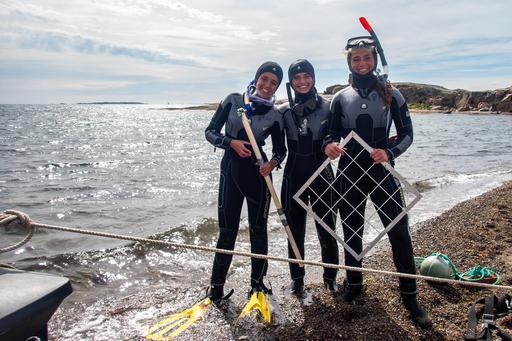
"The summer school prepares the students for their Master's thesis. We clearly see that the experience they gain here stays with them throughout the rest of the programme," she says.
This year's research projects cover a wide range of topics. One group is investigating how tiny parasites affect the behaviour of shore crabs, another is studying public attitudes towards commercial seaweed farming in the surrounding area, while a third is focusing on eelgrass. In addition to their scientific work, the students communicate their projects through social media and produce a short film about their work.
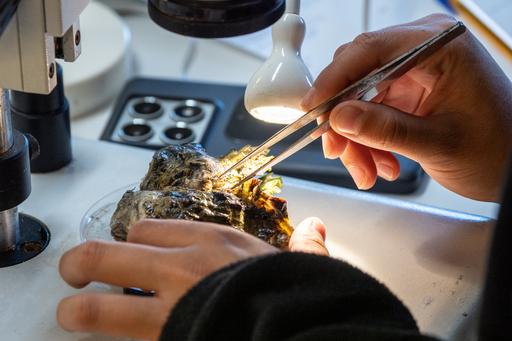
"They learn how to manage their time, how to work with limited resources, and how to adapt their ideas. It is also about personal development – learning how to collaborate with people from completely different backgrounds, cultures and environments," says Luana Monteiro.
IMBRSea's predecessor, EMBC+, held its first course at Tjärnö in 2014. When IMBRSea was launched in 2018, Tjärnö naturally became the home of the new programme's summer school. With the exception of the pandemic years, the programme has returned every year since.
More than just a marine laboratory
Another important advantage is the station's secluded location, far from the distractions of large cities. This makes it easier for the students to focus on their work.
Luana Monteiro also believes that the natural surroundings contribute to the students' motivation and energy.
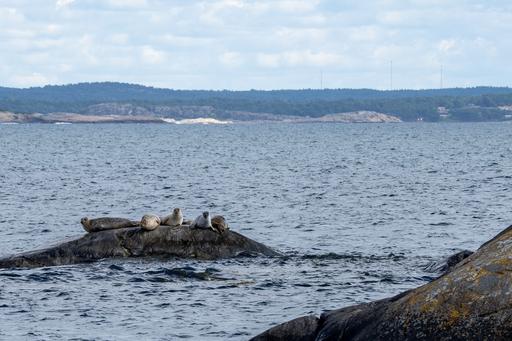
"It is a very intense period. The students work from nine in the morning until nine in the evening, sometimes until half past nine. But they can still enjoy the daylight, go for a walk or take a swim. This is all part of the package. I'm sure that if we were in a different setting than beautiful Tjärnö, the students might not have the same level of energy to go through this very intense course," she says, adding that the welcoming atmosphere at the station is just as important.
"If we didn't feel welcome, perhaps we wouldn't keep coming back. It's not only about the facilities. It's also about the people."
Text: Mikael Andersson
IMBRSea (International Master of Science in Marine Biological Resources) is a two-year international Erasmus Mundus Master's programme in Marine Biological Resources.
Students study at a minimum of two partner universities in Europe and also complete a professional internship, a joint summer school and a Master's thesis.
The summer school at Tjärnö Marine Laboratory is a compulsory course during the second year of the programme.
Partner universities:
Ghent University (Belgium), Sorbonne University (France), University of Algarve (Portugal), University of Oviedo (Spain), Atlantic Technological University (Ireland), University of the Basque Country (Spain), Marche Polytechnic University (Italy), University of Bergen (Norway), University of Western Brittany (France), Université Côte d'Azur (France), and the University of Gothenburg (Sweden).
Read more: www.imbrsea.eu
