
Courses explores new ways to organise art
How can artists across art’s subjects create their own contexts when established systems are not enough? Two courses at HDK-Valand explore how self-organisation, collaboration, entrepreneurship and collective practices can become part of artistic practice.
Many art students are taught how to navigate existing art systems. But what happens if you want to change them – or build something different?
– Artists make art and want to share it as a priority. But to create environments, systems, conditions and resources to support that for others, is central to self-organisation practices and might be considered as an expanded form of practice, says Jason E. Bowman, Senior Lecturer at HDK-Valand and responsible for the new course.
Self-organisation has a long history within the arts and is one of the most pressing issues for artists today. Yet Jason E. Bowman believes it remains surprisingly obscured in art educational contexts.
With the new course, he wants to create conditions for self-organisation both as a practice and as a field of knowledge.
– We need a more expanded understanding of what artistic practice is. One that is not only about producing objects, but also about shaping the conditions through which art can emerge and be shared. That can mean starting independent exhibition spaces, building networks, creating new forms of distribution, or developing support structures that do not yet exist.
The course is delivered online and brings together participants from different geographical and artistic contexts. In this way it creates a platform for discussing the conditions for artistic organisation in different parts of the world.
– The ambition is that participants leave the course with both practical tools and deeper perspectives. I hope they gain greater agency and feel that they do not only have to adapt to existing structures but can also help create new ones.
From hobby to business
Nada ElKateb is an architect working as an urban planner. She has always had a strong interest in making things with her hands, and for several years she and her husband have shared a hobby of designing lamps. Through a course in creative entrepreneurship at HDK-Valand she was able to turn this hobby into a business.
– At that time, we had already designed several lamps for our own home, and I began to see the potential to produce them for sale. During the course I was able to develop the idea further, start a company, streamline the production process and work through several technical challenges. By the end of the year, I was nearly ready to begin selling the lamps on a small scale.
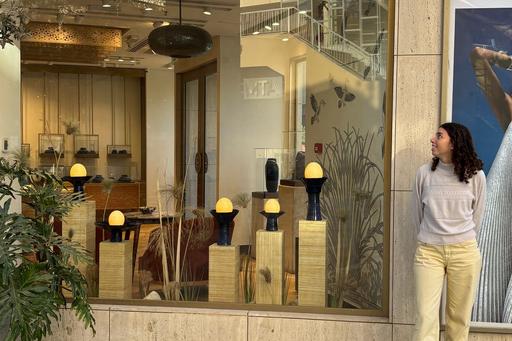
The course is aimed at people with a bachelor’s degree in craft, design or art who want to develop their own practice or business. Establishing oneself as a creative practitioner is not easy, so participants are given the opportunity to build networks while also gaining support and practical tools.
– Many artists and designers work independently and need to create their own structure and direction. That requires discipline and the ability to set your own goals so the work keeps moving forward. The weekly tutorials in the course were extremely valuable. They created rhythm and accountability, and it was also helpful to have an external perspective that could challenge ideas and help keep the project on track.
What did you take away from the course?
– A company! Another very valuable thing was the community. The course brought together a fantastic and diverse group of makers and designers who are an important network for me. Some of us still meet about once a month to share what we are working on and support each other.
Read more about the courses
- Creative Entrepreneurship for Material-Based Craft and Design Innovation
- Self-organisation in Contemporary Arts
The Swedish Higher Education Authority (UKÄ) has been commissioned by the government to follow up on how artistic education contributes to skills supply within the cultural and creative industries. The strategy highlights, among other things, the importance of ensuring a strong skills base in these sectors and providing those working within them with good opportunities for lifelong learning and professional development.
Expressions of interest are invited for an upcoming conference and exhibition project in November 2026 on global artist-led practices and organising, to be held at Exhibition Research Lab Gallery, Liverpool School of Art and Creative Industries.
The project is co-organised by James Schofield (Liverpool John Moores University), Dave Beech (University of the Arts, London), Jason E. Bowman, (HDK-Valand) and Julie Crawshaw (Northumbria University).
Read more: Between Dissent and Professionalisation: Debating Artist-Led Self-Organisation