
Better Biomarkers for Metabolic Diseases
Using advanced mass spectrometry at the Proteomics Core Facility (PCF), researchers have analyzed blood samples from individuals with the disorder PMM2-CDG and compared the results with samples from healthy individuals. The aim was to identify additional biomarkers with the potential to improve the diagnosis and monitoring of patients with this rare disease.
Jonas Nilsson, Associate Professor and researcher specializing in glycoproteomics at the Proteomics Core Facility, and Maria Blomqvist, Associate Professor at the Department of Biomedicine and Chief Clinical Chemist in Clinical Chemistry at Sahlgrenska University Hospital, have been part of an international research collaboration focused on congenital disorders of glycosylation (CDG).
The project was also carried out in collaboration with researchers in Nijmegen, the Netherlands. Another key collaborator is Erik Eklund, Associate Professor, researcher, and senior consultant physician at Skåne University Hospital in Lund. He is Sweden’s leading expert on CDG.
CDG is a group of inherited metabolic disorders that include several different conditions. One of these is PMM2-CDG, a rare disease affecting only around thirty individuals in Sweden.
Currently, the diagnosis of PMM2-CDG is based primarily on a blood test measuring protein transferrin. However, this test does not detect all abnormalities present in the blood, which in some cases may result in a missed diagnosis. The researchers therefore sought to identify more reliable blood-based biomarkers for this patient group.
In the study, blood samples from seven patients with PMM2-CDG were compared with samples from healthy individuals. Using advanced mass spectrometry, the researchers examined how sugar molecules were attached to different proteins in the blood. The analyses reveal clear patterns in individuals with PMM2-CDG, where the proteins often carried incompletely formed sugar chains. Certain immature glycan structures were found much more frequently in patients than in healthy individuals. In addition, many proteins were missing sugar chains at their normal glycosylation sites, indicating an impaired ability to fully glycosylate proteins.
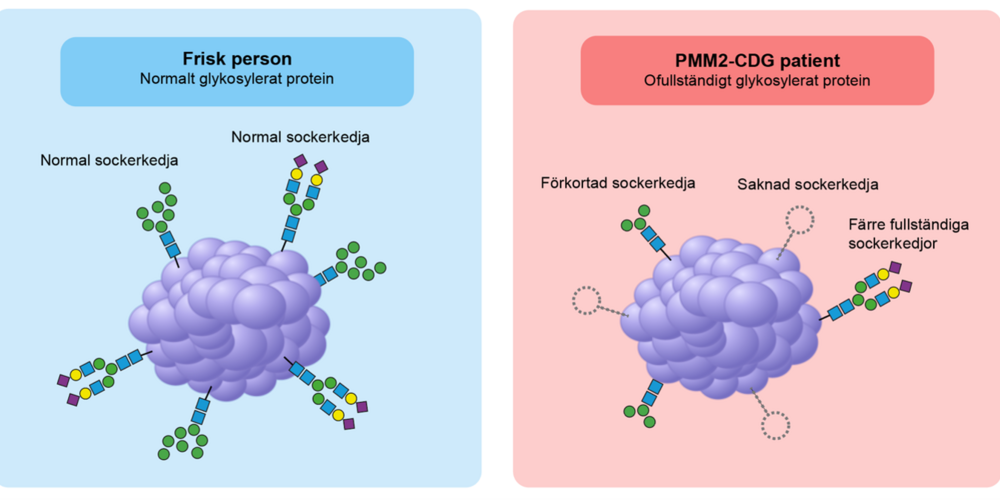
The researchers identified particularly pronounced alterations in several blood proteins, including complement proteins, which are involved in the coagulation system, as well as alpha-2-macroglobulin. These changes could potentially serve as new biomarkers for the disease.
By using glycoproteomic analyses, which allow the simultaneous study of many different glycoproteins rather than focusing solely on transferrin, the researchers were able to obtain a much more detailed picture of the disease.
A Step Forward for Precision Medicine
The researchers hope that these findings will lead to more accurate diagnostics and that the methodology can be expanded to identify biomarkers for different types of N-glycosylation disorders within the CDG group. This approach may also improve understanding of disease progression and disease severity in individual patients.
“We want to continue developing our glycoproteomic methodologies to identify additional biomarkers, not only for PMM2-CDG but also for other forms of CDG,” says Jonas Nilsson.
“The long-term goal is for these new methods to be implemented in healthcare nationwide, ensuring that patients born with CDG-related metabolic disorders receive the correct diagnosis and access to personalized care and, ultimately, targeted treatments,” says Maria Blomqvist.
PMM2-CDG is an inherited disorder belonging to the group of Congenital Disorders of Glycosylation (CDG), classified as inborn errors of metabolism. The disease is caused by mutations in the PMM2 gene, leading to defects in the body's glycosylation process, the process by which sugar molecules (glycans) are attached to proteins and lipids. This modification is essential for many proteins and lipids to acquire the correct structure and function required for normal cellular metabolism.
Because glycosylation occurs in virtually all cells of the body, PMM2-CDG can affect multiple organs and body systems simultaneously. Clinical manifestations vary considerably between individuals, ranging from mild to severe forms of the disease. Most individuals with PMM2-CDG require long-term medical follow-up, habilitation services, and individually tailored support interventions.