Bastian Rake new Associate Professor in Innovation and Entrepreneurship
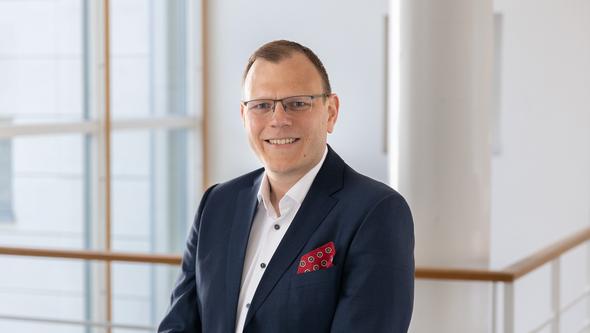
Bastian Rake has been appointed Associate Professor (docent) in Innovation and Entrepreneurship at the School of Business, Economics and Law at the University of Gothenburg.
Congratulations! What does this appointment as Associate Professor mean to you?
Being appointed as Associate Professor is a very important milestone in my academic career, as it represents recognition of my contributions to research, teaching, and academic service. At the same time, it reflects the many stimulating discussions and intellectual exchanges I have had with colleagues, students, and research partners over the years, who have challenged and debated ideas, research methods, and pedagogical approaches. These constructive intellectual challenges have played a very important role in my development as a scholar.
Being appointed as Associate Professor also encourages me to further develop my research agenda, continue improving our curricula and pedagogical approaches together with and for our students, and contribute to the ongoing development of the University of Gothenburg, the School of Business, Economics and Law, the Department of Economy and Society, and the Unit for Innovation and Entrepreneurship.
What is your main research interest?
Because new knowledge is often the foundation for new ideas and innovations, I am particularly interested in understanding how knowledge is created, combined, and transformed into innovation. My research focuses on innovation processes in knowledge-intensive industries such as pharmaceuticals and biotechnology, as well as the collaboration networks that connect firms, universities, and other organizations. A further area of interest is how knowledge is generated and shared across national borders, helping us better understand innovation as an international phenomenon in an interconnected world. More recently, I have begun studying how existing technologies, knowledge, and products can be repurposed for new applications, particularly in healthcare and medicine. This research explores how existing solutions can be adapted to address new challenges more quickly and efficiently.
How can your research be used in society?
We often think of innovation as the work of a lone genius who comes up with a brilliant idea that transforms society or drives economic development. In reality, however, most innovation emerges from collaboration between individuals, companies, universities, and other organizations. My research contributes to a better understanding of how such collaborations can be made more effective, particularly collaborations between academia and industry, and how scientific knowledge can be translated into practical applications. I have also had the opportunity to work on some of these topics together with industry partners, whose perspectives are invaluable for understanding how innovation happens in practice.
Knowledge transfers can develop innovative and resource-efficient responses
Another focus of my research is how existing knowledge, technologies, and resources can be applied in new ways to address societal challenges. This is particularly relevant in healthcare, where there is a need to find solutions for unmet medical needs, and in sustainability, where the resources required for innovation can be reduced through adapting and recombining existing solutions rather than developing entirely new ones. By understanding how knowledge can be transferred across organizational and disciplinary boundaries, we can improve our ability to develop innovative and resource-efficient responses to complex societal problems.
What can you say about your future research?
I am currently working with colleagues in Ireland on a project that aims to improve our understanding of how knowledge generated in academia is used in policymaking. Through this work, we seek to better understand the many ways in which academic research can contribute to addressing societal challenges and inform evidence-based decision-making.
Repurposing as an innovation strategy
At the same time, I will continue to contribute to research within my core areas of expertise, particularly innovation, knowledge generation, and collaboration. One research stream that I am especially interested in developing further concerns innovation through repurposing. While it is intuitively appealing to use existing technologies, products, or knowledge for new purposes - for example, by identifying new therapeutic uses for existing medicines—we still know relatively little about how and when repurposing occurs, or about the challenges organizations face when pursuing repurposing as an innovation strategy. The lack of knowledge and empirical evidence extends well beyond the pharmaceutical and biotechnology industries. A better understanding of repurposing could help organizations innovate more efficiently by building upon existing knowledge and resources rather than starting from scratch. At the same time, repurposing may open up opportunities for addressing unmet needs.
More collaborative research
Looking ahead, I am also keen to expand my engaged scholarship activities and collaborative research with partners from outside academia. In particular, I am interested in further exploring academia–industry collaborations to better understand how such partnerships are established, what factors contribute to their success, and how they can be effectively managed in an era increasingly shaped by digitalization and artificial intelligence.