An unusually creative student collaboration resulted in Lighthouse++
A group of six students from three different bachelor's degree programs are behind the thesis project Lighthouse++. The project proved to be both demanding and highly educational, and their hard work truly paid off. Together, the six bachelor's students developed an entirely new extension for the open-source tool Google Lighthouse.
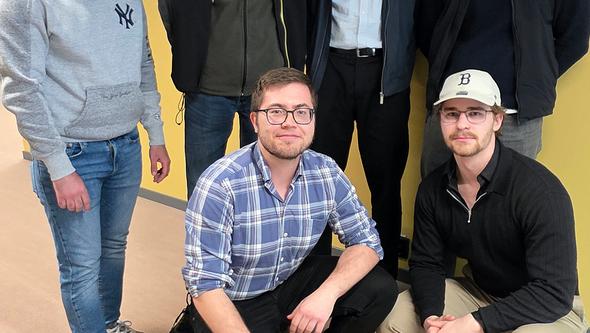
On a sunny morning in May, after many weeks of hard work, the students gathered to present their bachelor’s thesis project in the building close to Mossen at Campus Johanneberg.
Three of the students are from the University of Gothenburg and three are from Chalmers University of Technology. It is quite unusual to have such a diverse group of students working together on the same project, but in this case, it might have been an advantage.
The group consists of Yousef Noufal, Simon Johansson, and Kevin Pettersson from the BSc program in Computer Science at the University of Gothenburg, Daniel Alm-Eriksson and Mohammad Hamdan from the D-program, and Adam Jöeärr from the IT-program, both programs given by Chalmers University of Technology. The project was supervised by Lecturer Haroon Elahi.
What have you been developing in your thesis project?
‘We have been working on the open-source tool Google Lighthouse, which analyzes how websites rank in terms of search engine optimization (SEO). It evaluates factors such as performance, accessibility, color contrast, loading speed, and readability. The results influence how highly a website appears in Google search results.’
‘The main problem with the existing Google Lighthouse tool is that when developers run an analysis and see their ranking, there is no concrete guidance on what they actually need to do to improve the underlying code of the website. To address this, we developed an extension for Lighthouse that analyzes the reports generated by the tool.’
‘In our extension, we combine AI with more traditional technologies to identify exactly where issues are located within the code.’
’We also developed an additional component that considers the growing number of searches conducted through chatbots and ChatGPT rather than through Google. The component evaluates how a website performs from a ChatGPT perspective, including how well the content matches common search queries from the users. Our tool provides concrete recommendations for improvements based on the specific goals the website owner wants to achieve.’
What are your main takeaways from the project?
‘We have learnt so much from working on this project. It has certainly been challenging, but also a lot of fun. We often had to work independently for various reasons, but we successfully addressed most of the challenges through persistence, initiative, and creative problem-solving. It was also we in the student group that came up with the idea on which specific problem we wanted to try to solve in our bachelor’s thesis.’
‘Working in this group has been one of the most rewarding aspects of the project. It is probably not so common to have team members from three different degree programs – and in our case from two different universities – working together on the same thesis project. However, it worked extremely well, and we complemented each other’s strengths.’
‘The next step we would like to take is to conduct some user testing so we can evaluate how our extension of Google Lighthouse performs in practice and identify opportunities for further improvement.’
‘We would also like to take this opportunity to thank Haroon for his supervision, support, and dedication throughout the project, as well as for the valuable feedback he provided along the way.’

Supervisor Haroon Elahi comments:
‘In this bachelor’s thesis project, the students successfully leveraged artificial intelligence to develop new functionality for the Lighthouse tool, addressing critical limitations in current search engine optimization (SEO) tools used in both industry and academia. Together, the group created new methods for systematically testing, analyzing, and improving websites, while also designing a framework to measure the effectiveness of their own optimization system.’
‘This work represents a substantial contribution from both an academic and scientific perspective and is an exceptional achievement for an undergraduate-level project. The project demonstrates the remarkable expertise, dedication, and ambition of these students at the bachelor’s level.’
‘The students’ enhanced version of the tool also has significant commercial potential for millions of web developers and e-commerce businesses seeking to maximize their online visibility.’
Text: Catharina Jerkbrant