
An exciting AI evening in the spirit of creativity
Author Lydia Sandgren met researchers from different fields at Chalmers University of Technology and the University of Gothenburg in a panel discussion on the theme “How can AI affect us – as individuals, as professionals, and as a society?”
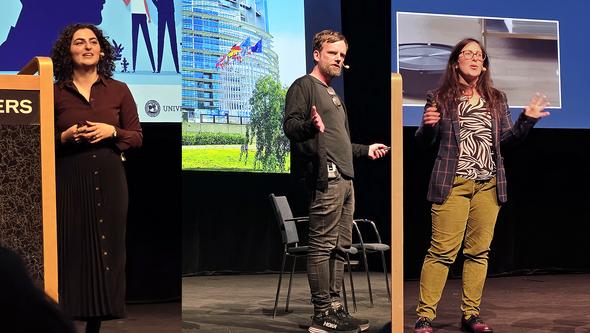
Three Chalmers' researchers started the event by presenting their recent research: Negin Hashmati, Karl de Fine Licht, and Ilaria Torre. The presentations ranged from AI as a friend and partner, to AI and ethics when used as a tool in exercise of public authority, to how we perceive robots in more human-like forms. What are the benefits, what are the problems – what to expect in the future?
The evening’s panel consisted of Lydia Sandgren, author, psychologist and winner of the August Prize 2020; Ola Sigurdson, philosopher and theologian; Anders Rosengren, physician and researcher in diabetes medicine; and Robert Feldt, professor of software engineering and applied AI. The discussion became long, flowing, and extremely interesting.
To be continued!
Where can AI truly serve as a source of knowledge, and perhaps also encourage and support us as human beings, and where does current AI simply fall flat? And what happens to the abilities we have acquired if we let AI take over much of the work?
Assessing people’s competence has become more difficult. AI is causing major problems when evaluating research papers and applications – where even weak research now can appear credible with the help of AI. It is sometimes now almost impossible to determine what constitutes students’ own knowledge, and a return to in-person written exams has become increasingly common.
The debate was dominated by what distinguishes human creativity. Does AI understand irony? Can AI write poetry that actually works as poetry for us humans, or will the result just be a line of words? What happens if you prompt a text idea and let AI write a chapter in your next book? Does AI have the capacity to produce something that is not generic?
The panel compared AI to having access to “an extremely competent librarian” who can come up with great suggestions and guide you further , or maybe a “a super-efficient secretary.”
After many reflections from the panel, Lydia Sandgren offered the following summary: Everything that truly matters in life requires great effort – such as creating, parenting, love… Effort and meaning go hand in hand; without one, there is not the other. This is something worth reflecting on in relation to how AI enters our life as something meant to make it easier.
The exclamation “To be continued!” concluded the AI evening. In the meantime, we reflect on the big question: What is uniquely human, and what is intelligence – really?
Text: Catharina Jerkbrant
"We who develop these technologies have a responsibility to step outside our labs and think together with the rest of society about their effects on us all — this evening showed how rewarding that conversation can be."