
An appeal for the importance of human and social contexts in technological research
Technical advances and scientific breakthroughs are all well and good – but have we lost sight of the inherent ethical, social and cultural dimensions? During a workshop on the place of humanities and social sciences in research excellence for groundbreaking technologies, a multi-disciplinary gathering of scientists prepared a paper arguing why you can’t – or shouldn’t – have one without the other.
The manuscript was prepared in collaboration between natural scientists and researchers from Humanities. Seven VR-funded cluster initiatives participated in a workshop "The Place of Humanities and Social Sciences in Research Excellence for Groundbreaking Technologies" held in Gothenburg in January.
In the resulting article, which has now been published as a preprint, the researchers elaborate on why technological excellence must include human and social context. Breakthrough technologies are not just technical achievements, they increasingly shape social institutions, economic systems, and political futures. Yet research excellence associated with such technologies often prioritizes technical performance, scalability, and short-term innovation metrics while its ethical, social, and cultural aspects are considered secondary.
Language expertise increasingly important
The authors propose a broader understanding of excellence that combines technical rigor with ethical robustness, social intelligibility, and long-term societal relevance. The rapid emergence of artificial intelligence further underscores this argument. As technological systems increasingly operate through language, interpretation, and normative alignment, expertise traditionally cultivated in the humanities and social sciences becomes integral to the design, governance, and responsible deployment of technologies.
Five ways forward
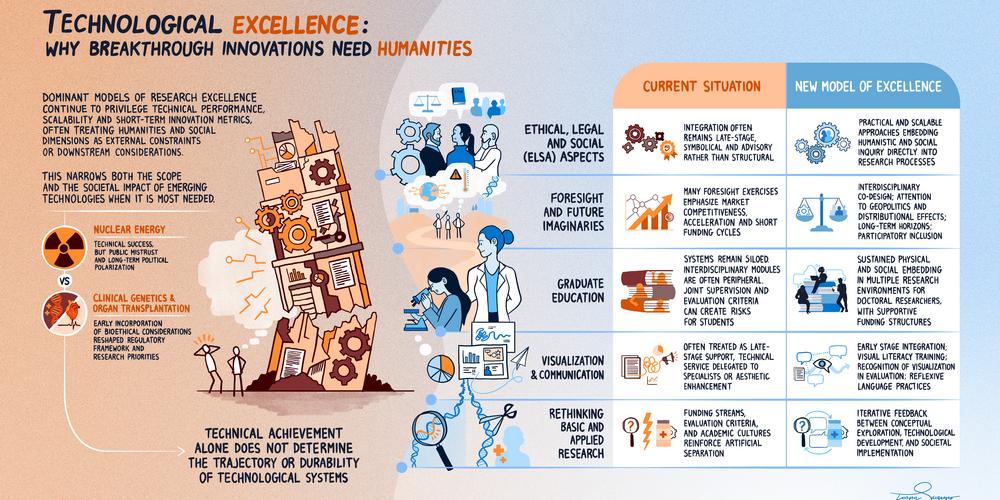
Drawing on historical examples and contemporary research practices, the article examines five interconnected domains where the humanities and social sciences, treated as integrated dimensions of research practice, can strengthen technological development:
- ethical, legal, and social integration in agenda-setting and research design.
- plural and reflexive foresight practices that shape technological futures.
- education as a leverage point for cross-disciplinary literacy.
- visualization and communication as epistemic and civic practices
- institutional frameworks that move beyond rigid distinctions between basic and applied research.
Across these dimensions, the authors propose practical strategies for embedding interdisciplinary collaboration structurally rather than symbolically.
The workshop was part of a series of events we organised within the Quantitative Techniques to Measure and Predict Protein Folding and Misfolding with Single-Molecule Resolution. This was funded via the VR Network grant for Planning Future Excellence Clusters.
