Image
underwater photo of eelgrass meadow
Eelgrass meadows play a unique ecological role in Swedish waters. They are vital habitats for a large number of marine animals and plants, but are also under threat and are covered by conservation programmes.
Photo: Marlene Janhke
Breadcrumb

Seascape genomics of eelgrass

Sustainability and environment
Science and Information Technology

How is marine biodiversity shaped across space? In this seminar, the Seascape Genomics method is presented with eelgrass as a case study.

Seminar
Date
7 May 2026
Time
15:15 - 16:15
Location
Lasselab, Tjärnö Marine Laboratory
Additional info
Link to Zoom

Participants
Marlene Jahnke, Researcher, Department of Marine Sciences
Good to know
The seminar is held in English and will also be broadcasted digitally, see link above. No registration is required, the seminar is free and open to everyone.
Organizer
Department of Marine Sciences

Seascape genomics combines ecological, environmental, and genetic data to understand how marine biodiversity is shaped across space. 

In this seminar, Marlene Jahnke will use eelgrass as a case study to show how these approaches can reveal patterns of connectivity, adaptation, acclimation, and resilience in coastal ecosystems.

Drawing on recent work, Marlene Jahnke will present results from genetic and environmental analyses, biophysical modelling, and mesocosm experiments. 

Marlene Jahnke will then discuss how these insights can support more effective conservation and restoration in coastal ecosystems, and how genomic tools can contribute to practical decision-making and policy.
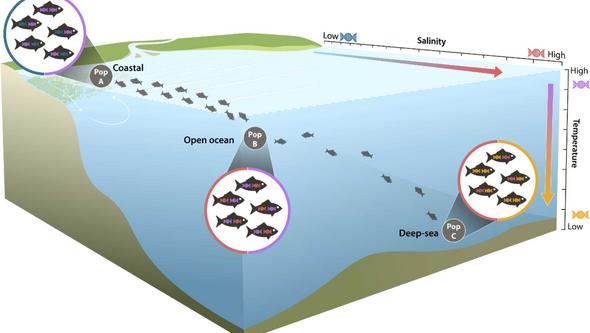
Illustration with fish in the sea
Seascape genomics incorporates geo-referenced environmental, oceanographic and biophysical data across vertical and horizontal environmental gradients, shown here by temperature and salinity.
Photo: Jerker Lokrantz, Azote