Júlia Teixidor Deulofeu – Central Neural Mechanisms Underlying Weight Loss Driven by GLP-1 Receptor Agonism and Immune Challenge
Avhandling för medicine doktorsexamen vid Sahlgrenska akademin, Institutionen för neurovetenskap och fysiologi, Sektionen för fysiologi
Opponent och betygsnämnd
Opponent: professor Stefan Trapp, Department of Neuroscience, Physiology & Pharmacology, University College London, London, Storbritannien
Betygsnämnd: docent Louise Adermark (ordf.), professor Christian Broberger (SU) och docent Fredrik Sterky
Bra att veta
Disputationen hålls på engelska
Det är möjligt att delta på distans. Disputationen sänds via Zoom Webinar: klicka på den rosa knappen ovan för att ansluta till mötet
Ordförande för disputationsakten: docent Anna Benrick
Brainstem Regulation of Feeding
The regulation of eating and metabolism is essential for survival, requiring the brain to continuously integrate information from the body about nutrient status, hormonal signals, and immune state. While much attention has focused on hypothalamic circuits controlling hunger and satiety, the brainstem has attracted increasing attention as a crucial area through which peripheral signals can modulate feeding behaviour and energy balance. But how does the brainstem translate signals from the body into changes in appetite, metabolism, and body weight?
This thesis investigates the role of the brainstem, particularly the area postrema and nucleus of the solitary tract, as a key area linking peripheral signals to central feeding circuits. This work shows that semaglutide, a glucagon-like peptide-1 (GLP-1) receptor agonist, engages a specific population of brainstem neurons that relay signals to e.g. hypothalamic feeding circuits to silence hunger-promoting neurons.
During GLP-1 receptor agonist treatment, these brainstem neurons drive weight loss, and preferentially the loss of fat mass, mainly in a non-aversive manner. Thus, the work presented here provides a framework for understanding how the beneficial metabolic effects of GLP-1-based therapies may be dissociated from their unwanted side effects at a circuit level, such as nausea.
Beyond pharmacological regulation, this thesis further shows that viral immune activation can recruit a separate set of brainstem neurons to drive sustained appetite suppression and weight loss.
Together, these findings highlight the brainstem as an active integrator of metabolic and immune signals, with implications for both obesity treatment and involuntary loss of appetite during illness.
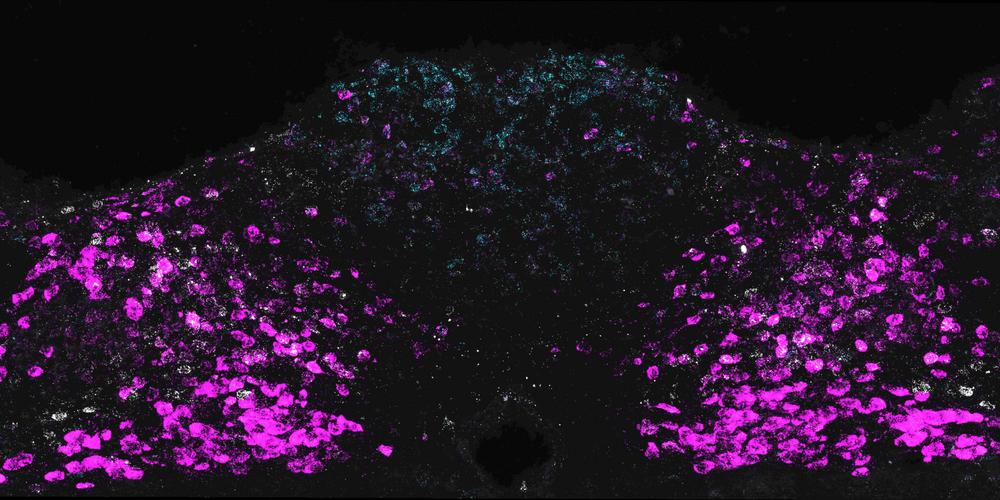
Originalbild tagen av Júlia Teixidor Deulofeu.
Publicerad: Teixidor-Deulofeu J, Blid Sköldheden S, Font-Gironès F, Fejes A, Ruud J, Engström Ruud L. Semaglutide effects on energy balance are mediated by Adcyap1+ neurons in the dorsal vagal complex. Cell Metabolism (2025) 37(7):1530-1546. DOI: 10.1016/j.cmet.2025.04.018.