Welcome Mattias Folkestad – new researcher in political economy
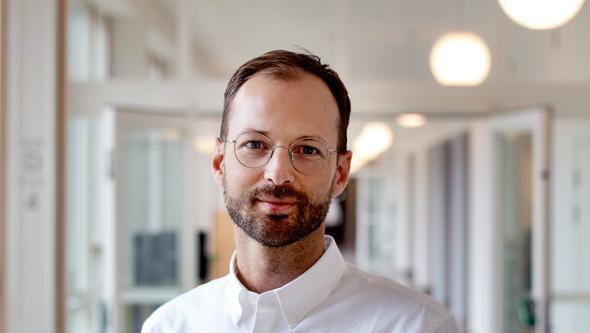
In September, Mattias Folkestad joined the Department of Economics as a researcher. Mattias recently completed his PhD at the Institute for International Economic Studies (IIES) at Stockholm University.
Could you tell us a little about your background and your path into research – how did you become interested in political economy?
“My professional background is in civil society and politics, which sparked my interest in economics. I was impressed by economists’ ability not only to theorise about societal issues, but also to quantify the effects of different proposals that were often debated in the public sphere. It made me want to master those same skills.”
“At the Institute for International Economic Studies at Stockholm University, where I completed my PhD, I had many colleagues who were interested in the interplay between economics and politics – not least in how political institutions affect the economy. Given my background, it felt natural for me to explore these questions in greater depth. In recent years, advances in methods for both analysing and generating data from previously inaccessible sources, such as spatial data and archives, have also led to a growing empirical focus within political economy. This is a development that I have tried to contribute to.”
What is your research about, and what makes these questions particularly interesting to you?
“Broadly speaking, my research focuses on the importance of political institutions for economic outcomes, as well as how and why our institutions have developed the way they have. What makes these questions particularly interesting to me is that we can use insights from economics and economic decision-making to analyse historical and political processes. Above all, this provides a rigorous framework for testing hypotheses and theories against real-world evidence, which more qualitative methods for analysing the same questions lack.”
Which questions or themes have been most important in your research so far?
“In join work with Monir Bounadi (IIES) I have spent a great deal of time trying to understand what drove the substantial increase in women’s political participation in the late nineteenth and early twentieth centuries. This was particularly connected to the issue of women’s suffrage, which led to widespread mobilisation among women in many Western countries. In Sweden, we study how one driving force was the emergence of female primary-school teachers after 1859, who helped encourage their pupils and other women around them to become politically engaged.”
How can research in political economy help us understand today’s political and economic developments?
“Today, the world is undergoing a major technological transformation while also facing substantial investment needs, not least in order to limit and mitigate damages due to climate change. A key question is which political institutions will be best equipped to manage these and other external forces. Left unregulated, these processes create winners and losers within society – and how the resulting conflicts are managed becomes a test of a system’s inherent resilience.”
“I believe we need to use theoretical models to think through the relative strengths and weaknesses of different systems. But we can also look to history and previous paradigm shifts to better understand which mechanisms are most relevant.”
Is there anything within your field of research that we still know surprisingly little about?
“A great deal! One particularly interesting area is gaining a better understanding of how political parties operate. We know that parties perform many different roles in a developed democracy, such as selecting suitable candidates for elections, shaping public opinion and running information campaigns, sometimes serving in opposition and sometimes holding power. Questions about parties’ “objective functions” – what their goals are and how they weigh different objectives against one another – have received relatively little research attention, partly because the data needed to answer these questions are difficult to obtain.”
What will you be working on here, and what are you most looking forward to?
“I will continue some of my research in political economy on women’s political participation and the tension between local and national objectives in the green transition. I am also hoping to start new research collaborations together with colleagues here in Gothenburg.”