Vasiliki Mylonopoulou awarded the Faculty of Science and Technology Pedagogical Award 2026
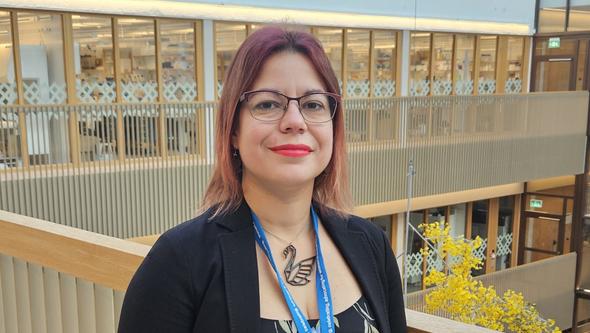
Senior Lecturer Vasiliki Mylonopoulou has developed a course in cognitive science in which students work on project-based assignments in collaboration with businesses and the public sector. The course is continuously developed based on student evaluations. She has now been awarded the Faculty of Science and Technology Pedagogical Award.
How does it feel to be named a recipient of the pedagogical award?
"I feel honoured that my colleagues nominated me. This award means for me that I can contribute with something to this faculty regardless discipline, or at least I hope so."
When is teaching at its most enjoyable?
"First and foremost, the engagement of students makes the teaching enjoyable. The way I design the courses I teach require students’ participation, so if they decide not to prepare or not to appear then the course will become boring for everyone. Often times the methods I teach need props, roleplay, and actual experience of the artifact (digital or not) so the learner can empathise with the user of the technology, see technology in the context of the user, and finally reflect on the constrains of the methods and why they could never replace user involvement in the design of technology with mere simulations, guidelines, and automated tools.
Thus, I hope I can use the award partially for getting my hands on some inclusive technology for the students to experience. According to the citation, your teaching incorporates project-based learning."
What are the benefits of this type of teaching? Are there any drawbacks or challenges?
"The main course I teach is on a bachelor’s level, and I assume that many of the students will go towards a non-academic career. I want my courses to make them hireable and comfortable applying for a job. For this reason, project-based learning is the most suitable. Therefore, every year, I try to find time and invite non-academic organisations to discuss design challenges they wish the students to help them with. It is not that the organisations drop their design challenges and disappear.
Each organisation needs to engage 1-2 hours with the group that work on their challenge. That is, if they want to receive the student report and materials at the end. The time limitation is important, first, the organisations get to know the students, second the students realise that they do not have unlimited access to resources.
Furthermore, the final projects/solutions are given to the organisations for further use, and the students get to place an item to their portfolio of a real case, not a student project, but a real-life mini case. In addition, the students connect with people working in industry, if not with a future employer. Finally, the students learn to work together even with people they disagree with. I am there to facilitate and guide. Sometimes the students think it is about the final design/the solution and they get too attached to a specific product; however, the point of the course is to experience the process, and then I have to jump in and change the subject the group is engaged with.
The biggest challenge though is when the students focus on passing the course instead of learning, when they try to do the minimum work. I tried to change this, by explaining the benefits of the project-based learning and replacing a big summative assessment with formative assessment."
It also states that you continuously develop the cognitive science course based on student feedback. Please tell us more!
"There is feedback and feedback. Unfortunately, I do not think that there is any seminar in the faculty that teaches the students how to give feedback to the courses. Students’ feedback, when it is not constructive, does not help the teacher. However, when I started teaching in the Cognitive Science programme with the second-year students many of them gave me feedback that I can use. For example, how the Canvas outline felt and how it can be improved, which sessions (instances when I meet the class) should be in person, online, or highbred.
In addition, the students help me realised that there is another feedback. I call it “engagement feedback”. Often the students give feedback on the additional literature! This means that they read it even if it was not obligatory! Or they give their opinion on a concept.
I always think that this feedback would have been better to come up and discussed in the classroom, but it gives me an idea of what was not clear or what would be interesting to discuss the year after."
Award motivation
Vasiliki Mylonopoulou has developed and successfully implemented an innovative pedagogical approach that integrates societal challenges, sustainability, and real-world collaboration into technology education. As course leader, she has designed and continuously refined a cognitive science course that has received the University’s sustainability-related certification and is open to international students, including participants in Erasmus and other EU initiatives.
Her teaching is structured around project-based learning in collaboration with public authorities, healthcare organisations, industry, and civil society. These long-term partnerships result in student projects that contribute to ongoing development in partner organisations, demonstrating clear external impact.
The course is systematically developed based on student feedback, with a strong emphasis on formative assessment and student-centered learning. Student evaluations highlight both the intellectual value of the course and the teacher's commitment.
Through sustained excellence, pedagogical innovation, and documented societal impact, Vasiliki Mylonopoulou serve as a role model through her contribution to teaching and learning in higher education.
The Pedagogical Award recognises excellence in teaching. It can be awarded to one person or be shared among multiple recipients. The award ceremony will take place on 11 November.