
The 2026 Swedish Election: Implications for Sweden’s Role in the EU
Sweden’s general election on 13 September 2026 will have important implications beyond domestic politics, particularly for the country’s role in the European Union. Key issues include security and defence, support for Ukraine, migration and asylum policy, climate and energy, and EU competitiveness. Sweden’s position on these questions matters at a time when the EU is debating how to strengthen European security, manage migration, accelerate the green transition and improve its financial strength. Two CERGU-affiliated researchers have offered their opinions on how the upcoming election will affect Sweden's role in European politics moving forward.
Sweden’s parliamentary election takes place against a European backdrop defined by Russia’s war against Ukraine, geopolitical uncertainty, the green transition and debates over the future direction of European integration. Yet the European Union itself is not a central issue in the Swedish campaign. Rather, the EU enters electoral politics indirectly, through policy areas such as climate, migration and security.
To examine what the election may mean for Sweden’s role in Europe, we spoke to Sofie Blombäck, Senior Lecturer in Political Science at Mid Sweden University, whose research focuses on political parties and party systems in Western Europe, and Jacob Gunderson, Associate Senior Lecturer in Political Science at the University of Gothenburg, whose research examines party competition, party systems and political behaviour.
The EU: relevant, but not electorally salient
The most important issues for Swedish voters remain predominantly domestic. A recent SVT survey identifies healthcare, education, law and order, elderly care and the environment as the leading concerns, while only around 30 per cent of voters regard defence as particularly important.
For Gunderson, this illustrates the limited electoral salience of the EU itself. “The EU relationship itself is not a key policy issue,” he argues. Instead, European questions are embedded in areas such as migration, defence and climate policy, while healthcare and education remain largely domestic policy domains.
This distinction is important. The absence of the EU as a major electoral issue does not mean that European politics is unimportant. Rather, European policy is increasingly embedded in domestic policy debates.
Blombäck makes a similar observation from the perspective of party competition. She notes that “climate/environmental policy is where the EU most often features in Swedish political debate”, while parties and voters nevertheless attach substantial importance to the European level. The pattern is therefore less one of disengagement from Europe than of European issues being filtered through domestic political conflicts.
This continuity is also evident when comparing the 2026 election with 2022. In her analysis of the previous election, Blombäck noted that EU issues received relatively little attention despite major changes in Sweden’s international position. Energy prices and law and order instead dominated the campaign.
Climate, energy and the European policy agenda
Climate and environmental policy remain the clearest area in which the European level matters for Swedish electoral politics. Sweden has traditionally pursued comparatively ambitious climate policies, and all opposition parties have proposed some form of strengthened climate action.
Blombäck highlights the tension between climate policy and energy prices. The 2022 election was strongly affected by rising energy prices, while the current government’s efforts to keep fuel and electricity prices low have at times conflicted with EU regulations. As she puts it, “the current government’s efforts to keep fuel/electricity prices low have sometimes run into EU regulations.”
A change of government could therefore have consequences for Sweden’s position in European climate policy. The key question is not whether Sweden will participate in the EU’s green transition, but how ambitious Sweden will be within it and how it balances climate objectives against energy prices and industrial competitiveness.
Forest policy may become another point of contention. Forests cover more than half of Sweden’s territory and are economically important, particularly in rural areas. Blombäck identifies dissatisfaction with EU forest policy as a possible challenge for the next government. European regulation in this field could therefore have potential political consequences domestically.
Migration and security: European issues framed nationally
Migration remains politically important, but it is primarily framed as a domestic issue during this election. The governing parties have presented Sweden’s more restrictive migration policies as a political achievement, while opposition parties have criticised specific measures. Blombäck notes that migration “has been important in recent years but [is] not debated primarily as an EU issue in the 2026 campaign.”
At the same time, the European dimension remains visible. Some parties argue that Sweden should have one of the toughest migration policies in the EU, while party manifestos also contain proposals for stricter European-level policies and enforcement.
There is nevertheless an ideological difference between the blocs. Left-of-centre parties generally favour a more open immigration policy than right-of-centre parties, although the Social Democrats occupy a comparatively restrictive position for a centre-left party. A change of government could therefore alter Sweden’s position on specific aspects of EU asylum and migration policy, without necessarily reversing the broader restrictive trajectory of recent years.
Security presents a different picture. Swedish parties are broadly united in viewing Russia’s invasion of Ukraine as a serious threat and in emphasising close European cooperation. As Blombäck puts it, “all parties see Russia’s invasion of Ukraine as serious threat and stress close European cooperation.” Defence, however, is not among the issues that voters identify as most important. The election is therefore unlikely to produce a major change in the strategic direction of Swedish security policy.
Continuity in Sweden’s relationship with the EU
A fundamental change in Sweden’s European orientation appears unlikely. All parties currently represented in the Riksdag support EU membership, and a “Swexit” debate is not expected to form part of the campaign.
Blombäck emphasises the extent of this consensus: “All parties in the Riksdag now favor Swedish EU membership, so Swexit [is] not in the cards.” At the same time, most parties combine support for membership with scepticism towards further integration. Most oppose increasing the EU budget, while emphasising democratic standards as a condition for EU funding. The Liberals are the only parliamentary party that actively supports adopting the euro.
Gunderson places this Swedish consensus in a broader comparative perspective. His analysis draws attention to an inverted U-shaped relationship between left-right ideology and attitudes towards the EU: parties in the political centre tend to be more supportive of European integration, while parties towards the ideological extremes are generally more sceptical.
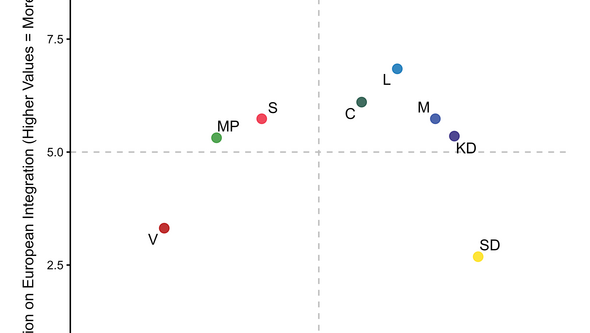
Figure 2. Left-right ideology and EU position among Swedish party families, 2024.
Source: Jacob R. Gunderson, based on the Chapel Hill Expert Survey (2024).
This relationship is also present in Sweden. The figure above shows that V and SD, the most ideologically extreme parties in the Swedish party system, are the most eurosceptic. The other parties share a broad pro-EU consensus with L and C being the most pro-EU parties in the system, though only by a small margin.
For Gunderson, this has implications for coalition politics. “The EU can remain a source of intra-coalition disagreement regardless of left/right coalition,” he argues. The important point is therefore not simply whether a future government is left- or right-led, but how the parties within that government position themselves regarding European integration.
Gunderson nevertheless sees “little chance of large change in Sweden’s overall EU approach.” A left-bloc government could be somewhat more supportive of European environmental legislation, but this would represent a shift in particular policy areas rather than a fundamental reorientation of Sweden’s relationship with the EU.
The likely consequence is therefore continuity in Sweden’s overall EU orientation, combined with potential shifts in particular policy areas, especially climate policy.
The party system and government formation
For researchers of European politics, the most consequential aspect of the election may ultimately be the development of Sweden’s party system.
Swedish politics reflect a wider European trend towards party-system fragmentation and more complex coalition formation. Blombäck describes the election as one that should be understood in the context of “increased fragmentation and difficulty forming stable governments.”
The fate of the Liberal Party is particularly significant. If it crosses the four per cent electoral threshold, Sweden will retain eight parliamentary parties broadly organised into two blocs. Strategic voting, which has historically benefited smaller parties close to the threshold, could prove decisive.
The strength of the larger parties will also matter. Both the Moderates and Social Democrats are expected to be weaker than in 2022, potentially reducing their bargaining positions during government formation. As Blombäck notes, both prime-ministerial candidates are likely to receive fewer votes than in 2022, which could further complicate coalition negotiations.
The experience following the 2022 election provides an important reference point. The Sweden Democrats became the second-largest party but remained outside the government, while the Moderate Party, Christian Democrats and Liberals formed a minority government dependent on Sweden Democrat support. The Sweden Democrats obtained substantial policy influence in return.
In 2026, however, the party has indicated that it wants a different arrangement and seeks participation in any coalition government dependent on its support. If it again outperforms the Moderate Party, this could create significant tensions within the right-wing bloc. Blombäck points out that the Sweden Democrats may demand “significant cabinet/policy influence”, while the other right-wing parties may resist such demands.
The left faces its own coalition problem. The Left Party has demanded participation in a government that depends on its support, while the Centre Party has ruled out supporting a government that includes either the Left Party or the Sweden Democrats.
The election may therefore provide another case of a broader European phenomenon: electoral fragmentation increasing the difficulty of translating electoral outcomes into stable governing coalitions.
What comes next?
The next Swedish government will face a European agenda in which climate, energy, security and competitiveness are increasingly intertwined. It will also immediately confront negotiations over the EU’s next Multiannual Financial Framework. Sweden is among the member states calling for reductions to the Commission’s proposed budget, placing traditional Swedish budgetary restraint in tension with growing demands for European investment.
The election is unlikely to redefine Sweden’s relationship with the EU. Instead, its significance lies in how a fragmented party system responds to an increasingly demanding European environment.
For researchers and European observers, the key questions are consequently less about whether Sweden is pro-European than about which policy areas it prioritises, how domestic coalition dynamics shape its European positions, and whether the next government can translate Sweden’s relatively stable European orientation into effective influence within the EU.
Text by Angelica Sohlberg