
Student clinic delivers a win-win-win
More confident students, shorter patient wait times, and newly hired biomedical scientists who get up to speed faster. The student-run echocardiography clinic has proven beneficial for students, patients, and the healthcare system. The initiative is now being recognized with the Sahlgrenska Academy’s 2026 Award for Excellence in Teaching.
The student clinic was developed by Caroline Schmidt and Anita Persson, both active in the Biomedical Laboratory Science program.
“Echocardiography is a craft. You have to handle the probe, obtain the right images, and understand and interpret what you see on the screen. It takes a lot of practice to get good at it,” says Caroline Schmidt, Associate Professor of Cardiovascular Prevention and Senior Lecturer.
But opportunities for hands-on practice during clinical placements varied depending on where students were placed.
“We wanted to give all students the same opportunities to practice and become confident performing the examination,” says Anita Persson, Senior Biomedical Scientist and Adjunct Senior Lecturer.
Strong support
The solution was a student-run clinic at Mölndal Hospital. Students work in pairs and see selected patients, with an experienced biomedical scientist nearby for support and a physician available if needed. Students are also given more time for each examination than at a regular clinic.
The initiative has received strong support from managers, biomedical scientists, and physicians at Sahlgrenska University Hospital.
“When we presented the idea to the managers, they loved it. There has been enthusiasm at every level,” says Anita Persson.
“We made a lot of progress in a short time”
Sümeyya Kadri was one of the students who trained at the student clinic. She graduated in 2025 and now works as a biomedical scientist at Sahlgrenska University Hospital.
“It was really exciting to see patients ourselves and start building experience from the outset. You knew you were still a student and could work at your own pace. I learned a great deal and felt much more confident by the time I started working,” says Sümeyya.
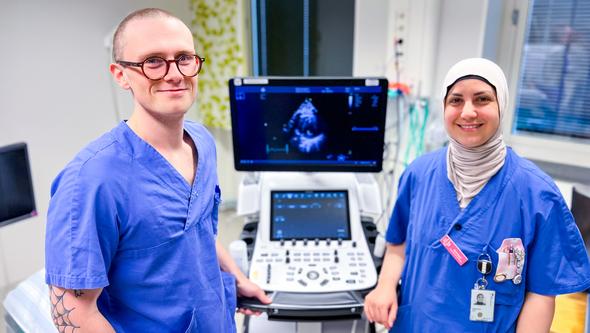
Martin Larsson, who also works as a biomedical scientist at Sahlgrenska University Hospital, was among the first students at the clinic and has since returned as a supervisor.
“It was fantastic to be able to perform the examinations in a calm setting and always have something to work toward. The learning curve is very steep at first, but we made a lot of progress in the short time we were there,” says Martin.
Exceeded expectations
The results have exceeded expectations. Students perform better in practical examinations, while patients report feeling just as safe and confident as at a regular clinic.
“In the past, a newly hired biomedical scientist might need to work alongside two experienced colleagues. Now we see that they can start examining patients much sooner. They are considerably more independent from the outset,” says Anita Persson.
The student clinic can also examine around 140 patients during each course period. These are lower-priority patients with less complex clinical questions who might otherwise face a long wait for their examination.
“It’s become a win-win-win: for the students, the patients, and the clinical operation,” says Caroline Schmidt.
The next step is to apply the same model to vascular ultrasound. At the same time, the approach is attracting interest beyond the Biomedical Laboratory Science program. Faculty members from other programs, including the Law program, have expressed interest in the idea of giving students opportunities to practice in real-world situations in a supportive environment while also making a tangible contribution.
Sahlgrenska Academy’s Award for Excellence in Teaching recognises educational work that contributes to the development of teaching, student learning or learning environments. The award covers education at first-cycle, second-cycle and doctoral levels and may be presented to an individual teacher or a group of teachers.
The award carries a prize of SEK 100,000, provided as a grant for continued professional and educational development. The aim of the award is to strengthen the quality and national attractiveness of the Academy’s education.
Both students and staff may nominate teachers or groups of teachers for the award. Self-nominations are not accepted. Nominations are assessed by a panel appointed by the Council for Education.
