
Research that is improving care for newborns
Henrik Hagberg’s research is advancing our understanding of how to prevent and treat brain injury in newborns following severe oxygen deprivation. He and his colleagues are now investigating new treatments that could reduce brain injury and ultimately reach more children.
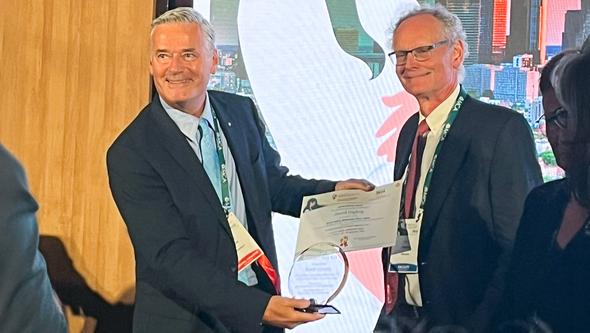
Henrik Hagberg, Senior Professor of Obstetrics at the University of Gothenburg, received the 2026 Erich Saling Maternity Prize for his contributions to perinatal medicine. Perinatal medicine encompasses care and research involving mothers and babies before, during, and after birth.
New treatments following oxygen deprivation
A central focus of Henrik Hagberg’s research is brain injury that can occur when a baby experiences severe oxygen deprivation around the time of birth.
Together with research colleagues Eridan Rocha-Ferreira and Gaurav Verma, Henrik Hagberg is now investigating new treatments for these injuries. One area of focus is GLP-1 receptor agonists, a class of drugs primarily used to treat diabetes and obesity that have also been shown in animal studies to protect the brain following oxygen deprivation.
Among their findings, the researchers have shown that the drug exenatide can reduce brain injury. The results are particularly promising because the treatment has been effective even when administered as late as six hours after oxygen deprivation.
The researchers are now working to better understand the mechanisms behind this effect. Their studies suggest that GLP-1 receptor agonists improve mitochondrial function in neurons. This part of the research is being conducted in close collaboration with Gaurav Verma, whose work focuses on mitochondrial function.

“Our hope is that these findings can pave the way for clinical trials. The treatment is relatively inexpensive and easy to administer,” says Henrik Hagberg, adding:
“It could be particularly important in low- and middle-income countries, where therapeutic hypothermia, currently used to protect the brains of newborns with acute brain injury following oxygen deprivation, is not always available.”
A window for treatment
The research underway today builds on an important insight from earlier studies: brain injury does not occur solely at the time of oxygen deprivation but can continue to develop in the hours, and sometimes days, that follow. This revealed a window during which treatment can be initiated in an effort to limit the injury.
Henrik Hagberg showed that several types of experimental treatments, acting through different mechanisms in the brain, could reduce brain injury and improve neurological recovery when administered during the first hours following a period of oxygen deprivation.
Hagberg subsequently contributed to the experimental research that laid the groundwork for therapeutic hypothermia, in which newborns are cooled following severe oxygen deprivation to protect the brain. The treatment is now used in neonatal care.
His research has also advanced our understanding of the biological processes underlying brain injury following oxygen deprivation, including how inflammation can exacerbate the injury. His work has included research on biomarkers that can help detect brain injury, as well as studies of new treatments that could provide additional protection for the brain.
Earlier induction of labor
Henrik Hagberg has also contributed to research on pregnancies that continue beyond 41 completed weeks of gestation.
He was one of the researchers behind the Swedish SWEPIS study, which examined whether inducing labor after 41 completed weeks of pregnancy is preferable to waiting until 42 weeks.
The study and subsequent research provided evidence that earlier induction may reduce the risk of infant death or serious health complications. The findings have contributed to the evidence base for changes in induction practices in Swedish obstetric care.
Hagberg’s research thus spans basic studies of what happens in brain cells following oxygen deprivation to large clinical studies with direct implications for the care of pregnant women and newborns.
Henrik Hagberg was appointed Professor and Consultant in Obstetrics and Perinatology at the University of Gothenburg and Sahlgrenska University Hospital in 2000. He has also held professorships at Imperial College London and King’s College London. He has published more than 350 original research articles and supervised 42 doctoral students. His research is widely cited internationally.
The Erich Saling Maternity Prize is awarded every two years by the European Association of Perinatal Medicine (EAPM) to an obstetrician and a neonatologist who have distinguished themselves through their professional careers and contributions to perinatal medicine. Previous recipients include several internationally leading researchers in the field.