
Molecule's form mirror it's function
A certain type of molecule can exist in two forms—identical in composition and structure, but mirror images of each other. This year’s Nobel laureates in chemistry have solved many of the difficulties chemists face when they want to build new compounds, but their advances also raise questions about the origin of life.
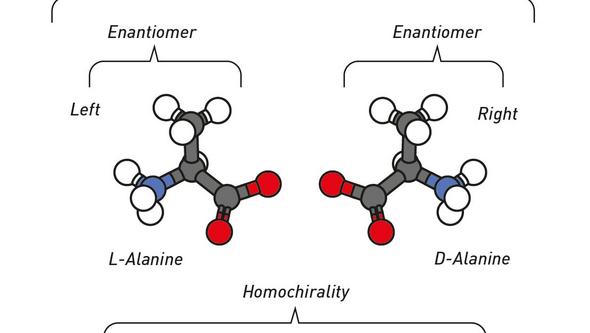
Molecules that can form two mirror-image variants are called chiral molecules. Their components and bonds are the same, but they differ in the same way as the left and right hand.
The mirror-image forms of a molecule interact differently with biological systems. It is a bit like accidentally trying to pull a left-hand glove onto your right hand.
Undesired variant
“We chemists have known since the 19th century, thanks to Louis Pasteur, that some molecules exist in two variants. But for a long time, we had no method for producing only one mirror-image form of a molecule intended for use in a medicine. This is important because the other mirror-image form can be highly undesirable,” says Henrik Sundén, professor of organic chemistry.
The thalidomide scandal is a tragic example: one molecular variant acted as a sedative, while the other inhibited the growth of new cells. This was extremely harmful for pregnant women who took the drug.
Catalyst influences the outcome
When chiral molecules are produced synthetically, equal amounts of the left- and right-handed forms are normally formed, but a chiral catalyst can influence the outcome of the reaction. In the 1980s, this year’s Nobel laureate Henri B. Kagan carried out experiments in which he was able to shift the distribution further by manipulating the chemical reactions with a catalyst. In these reactions, one variant became more dominant.
His colleague Kenso Soai took this one step further. He started the reaction without any catalyst and without any chiral molecules at all. Instead, he allowed a chemical reaction to create the catalyst itself, and only in the next step were chiral molecules formed—but only one of the two mirror-image forms. Soai had shown how reactions that produce only one mirror-image form, known as homochirality, can arise spontaneously.
The origin of life
Kagan and Soai’s advances have been crucial for today’s chemists, but the science of chiral molecules is also connected to all plants, animals, and fungi. All living organisms are built from 20 amino acids. Yet these occur only in their left-handed forms. Why is that?
“When Soai was able to create homochiral molecules from nothing, I think he touched on the question of the origin of life. For some reason, the right-handed mirror forms of the molecules did not fit when the building blocks of life were created long ago in the primordial soup. Why were the left-handed amino acids the ones that prevailed in the first reactions when life began?” Henrik Sundén asks.
This year’s Nobel Prize has opened up opportunities for chemists to efficiently design reactions in which only one molecular mirror image is formed. This has been essential in drug development, and in the future the discovery paves the way for advances in life science as well as energy-saving materials that could be used in the computer displays of the future.