
Marine student to embark icebreaker Oden for the Arctic
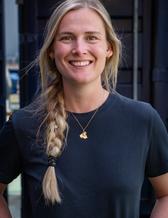
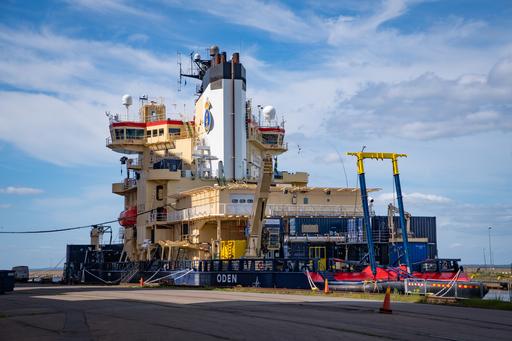
On 10 August, Susanna Hentschel from Gothenburg will board the icebreaker Oden to take part in this year’s Polar Expedition to the Arctic as one of 25 students selected for the expedition’s research school.
“It’s going to be absolutely brilliant to gain a better understanding of what it is I’m working towards,” says Susanna Hentschel, Master’s graduate in oceanography from the Department of Marine Sciences.
Hello Susanna, what will you be looking at in your project?
“I’m going to investigate something in the ocean called thermohaline staircases. It’s a specific type of stratification where relatively well-mixed layers of water lie on top of one another and are separated by thin layers where temperature and salinity change rapidly.”
“I want to understand what determines the characteristics of these staircases and how their structure relates to small-scale turbulence in the ocean. By measuring the turbulence, we can investigate the relationship between turbulence and the structure of the staircase, thereby gaining a better understanding of how heat and salt are transported between the water layers. This is important because, ultimately, this transport determines how much heat reaches the sea ice.”
How are the measurements carried out?
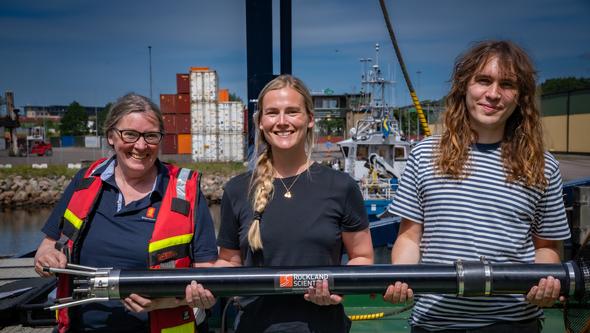
“We’ll fly out by helicopter from Oden to the sea ice. There, we will stand at the edge and deploy our measuring instruments into the sea to measure turbulence, temperature, and salinity. The instrument will be lowered to a depth of around five hundred metres at the ice edge, and we’ll also have another instrument that will measure currents just beneath the ice. Together, these measurements will provide a more complete picture of how the water moves beneath and around the sea ice.”
“We’ll need to watch out for polar bears, so there’ll be guards from the Swedish Polar Research Secretariat keeping watch over the ice.”
Why are you participating?
“I was accepted onto the Polar Secretariat’s research school. I’d already been working with data from last year’s Arctic expedition in my degree project, so that was a really good way in. My degree project is very closely related to this project.”
“In the research school, everyone works on their own project, but on top of that we’ll have seminars every day with lecturers and researchers. For example, we’ll be discussing the interconnected climate system in the Arctic. So it’ll also be really exciting to gain a broader perspective on what’s happening in the Arctic.”
Have you been on a large cruise like this before?
“I took part in Professor Fabien Roquet’s expedition on the R/V Skagerak to the Faroe Islands in the summer of 2025. We were out at sea for two weeks. It was a bit of a trial run to see if it was the right thing for me, and it certainly was. For one thing, there’s the proximity to the sea – I love that. You look out and there’s just ocean everywhere. That does something to you. And then it’s also exciting to be involved in collecting data for the first time.”
What are you most looking forward to in the Arctic?
“I’m really looking forward to the helicopter trips out onto the ice! And then, of course, meeting everyone – all the students, all the teachers – and experiencing life on board. I’ve never been to the Arctic before, so it’ll be a completely new experience to have nothing but sea ice all around me.”
“Going to the Arctic feels like a once-in-a-lifetime experience, so it’s really exciting to be part of it, to see the ice, maybe spot a polar bear, and gain an understanding of what it is we actually want to preserve and what I’m working for. It’s going to be absolutely brilliant.”
Contact
Annika Wall
Communications coordinator, Department of Marine Sciences
Email: annika.wall@gu.se
Canada–Sweden Arctic Ocean 2026
Between 10 August and 20 September 2026, the Oden will undertake a joint cruise with the Canadian icebreaker CCGS Louis S. St-Laurent.
The cruise is led by the Swedish Polar Research Secretariat in collaboration with the Geological Survey of Canada and aims to map the seabed in the central Arctic Ocean within the framework of the United Nations Convention on the Law of the Sea (UNCLOS).
At the same time, research will be carried out in areas including marine geology, geophysical mapping, meteorology, sea ice, oceanography, and marine ecosystems. The cruise brings together researchers from Sweden, Canada, Denmark and Greenland. Inuit observers with expertise in marine mammals will also be on board the Canadian vessel.
Read more about the cruise at the Swedish Polar Research Secretariat website.