How can a research vessel remain almost perfectly still at sea? And what technology is used to explore the ocean? A group of upper secondary school students found out when they visited the University of Gothenburg's research vessel Skagerak as part of Fönster mot naturvetenskap och IT, an annual event introducing students to science and technology research.
From advanced underwater technology to the captain's chair, there was plenty to discover aboard R/V Skagerak when upper secondary school students from several schools stepped on board at Nya Varvet in Gothenburg.
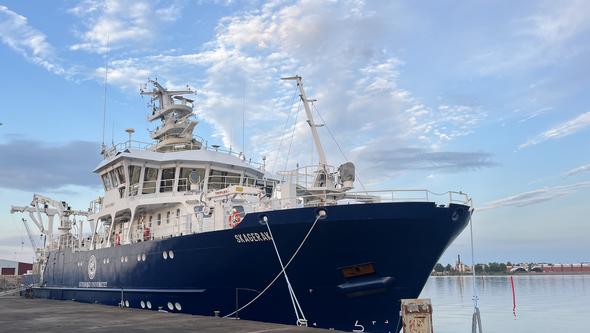
R/V Skagerak – a research vessel owned by the University of Gothenburg.
Photo: Laura Bristow
The visit was part of Window on Science and IT, an annual event organised by the University of Gothenburg to give students a glimpse into the world of research.
"We've attended a few lectures and we're here to learn more about biology and chemistry. There were several activities to choose from, and marine sciences sounded interesting," says Jonas Holm, a student at Nils Ericsongymnasiet in Trollhättan.
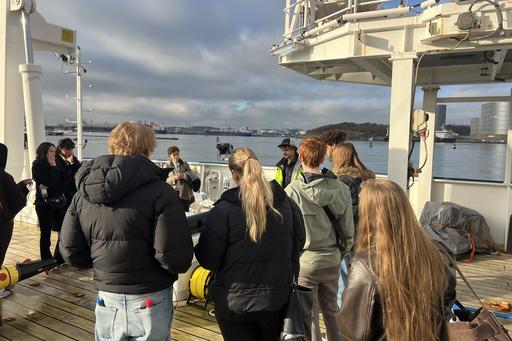
Image
Research engineer Filip Stedt demonstrates the underwater vehicle aboard R/V Skagerak.
Photo: Agnes Faxén
From Antarctica to the captain's chair
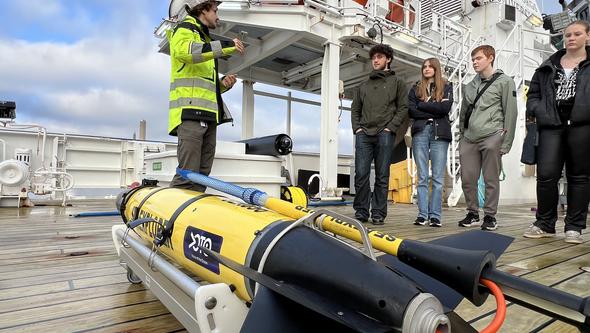
During the guided tour, research engineer Filip Stedt demonstrated a range of underwater technologies, including an underwater glider from VOTO and a newly built remotely operated vehicle (ROV). The latter will be used for research beneath the ice in Antarctica, which is several hundred metres thick.
On the bridge, Captain Richard Olsson and Second Officer Niels Terneus explained navigation and dynamic positioning – a technology that enables the vessel to maintain a highly precise position at sea. The students also had the chance to try out the captain's chair, an opportunity they were keen to capture on their phones.
It's exciting. You don't often get to see this much technology...
How it works – Filip Stedt demonstrates the technology.
Photo: Agnes Faxén
The visit also offered an insight into what it is like to live and work aboard a research vessel during extended expeditions.
"It's exciting. You don't often get to see this much technology, and it's interesting to learn about what life is like when you're spending weeks at sea," says Jonas Holm.
He has also considered pursuing further studies in the field.
"Possibly, yes. But at this age, you tend to change your mind quite a lot."
Photo and text: Agnes Faxén
An opportunity to meet researchers
Fönster mot naturvetenskap och IT is organised annually by the Faculty of Science and Technology at the University of Gothenburg. Through lectures, laboratory sessions and study visits, upper secondary school students have the opportunity to meet researchers and explore the University's study programmes and research.