
Increased methane uptake in a warming Arctic
The climate changes rapidly in the Arctic region and changes will follow in the vegetation. A new study from the University of Gothenburg in Global Change Biology shows that it can also lead to an increased consumption of methane.
The Arctic region warms four times faster than the global average, and here the effects of climate change are visible in the form of melting glaciers, vanishing sea ice and thawing permafrost. But also, the plant community reacts to the change in climate with taller plants, a change in vegetation composition and increased shrub encroachments.
This will in turn change the exchange of greenhouse gases between the soil and the atmosphere.
Bacteria eats methane
“These changes in vegetation also alter soil conditions, with slightly drier surface soils and favoured conditions for methane consumption” says Mats Björkman, a senior lecturer at the Department of Biological and Environmental Sciences. “Most people know that methane is a powerful greenhouse gas; however, it is less known that there are actually bacteria who eats methane, basically living on air.”
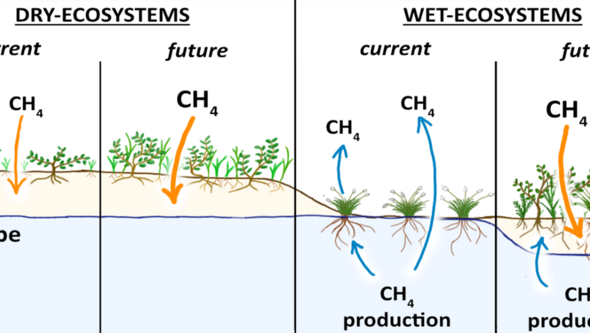
In the soil, you have two contrasting processes; methane production and consumption. Methane is produced during anaerobic conditions, as in waterlogged soils, while consumed in drier soil with more oxygen available. The methane-eating-bacteria in these drier soils both consume the methane produced within the soil, as well as the methane we have in the atmosphere.
At the Field station Latjnajaure, 15 km outside of Abisko in northern Sweden, researchers have mimicked the effects of climate change using small hexagonal greenhouses without a roof, called open-top chambers, since the early 1990s.
“In our long-term experiment we see an increased uptake of atmospheric methane in two of our drier plant communities, and our tussock tundra that usually emits methane to the atmosphere has reduced emissions and even show sign of turning into a methane sink instead of source”, Mats Björkman continuous.
Hidden methane processes
Usually when measuring methane fluxes from the ground, you only see the net effect of the production and consumption processes, leaving a large part of the dynamics undetectable. In this study, the researchers also investigated the magnitude of these processes by temporarily inhibiting or stunning the methane-eating-bacteria.
“We found methane production occurring even in our driest sites with no standing water close by, indicating that the methane consumption occurring in the soil is far greater than we earlier assumed, revealing a hidden ecosystem service usually overlooked in the greenhouse balance”, says Mats Björkman.
Comprehensive picture of the Arctic
Most studies on methane fluxes in the Arctic have taken place in wetland areas and regions with high emission rates. However, large parts of the Arctic landscape are composed of drier mineral and upland soils, prone to taking up methane from the atmosphere rather than emitting it. These experiments are a counterweight to all the stories on melting permafrost emitting methane in the tundra.
“Our research shows the importance of having these long-term warming experiments running since it can take decades before plant composition starts to change, and for species to migrate. And where our now 30 years of climate treatment is only the childhood for some Arctic plants that can be up to and well above 100 years old”, says Mats Björkman.
In the future the team of scientists want to investigate if the data from the Latnjajaure Field Station is representative of the full Arctic, with a new pan-Arctic methane synthesis on the way. He also points out that his findings do not alter humanity’s impact on climate change.
“The best way to curb the greenhouse effect is still for humanity to reduce its greenhouse gas emissions.”
Scientific study in Global Change Biology: Increased CH4 oxidation in Arctic tundra ecosystems caused by vegetation-mediated soil drying
Contact info: Mats Björkman, Department of Biological and Environmental Sciences, University of Gothenburg,
Phone: +46 766 -18 18 20, email: mats.bjorkman@bioenv.gu.se

