
Chinese delegation explores sustainable marine research
How can research, ocean observation and open data contribute to more sustainable ocean management? A delegation from China’s Ministry of Natural Resources visited the University of Gothenburg’s research vessel R/V Skagerak to learn more.
“We want to learn more about how Sweden approaches the sustainable development of marine areas,” says Ye Yuan, a researcher at China’s National Marine Environmental Forecasting Center.
China’s coastal waters face a number of environmental challenges, including those linked to climate change, eutrophication and changes in marine ecosystems. This creates a considerable need for research, ocean observation and long-term knowledge development.
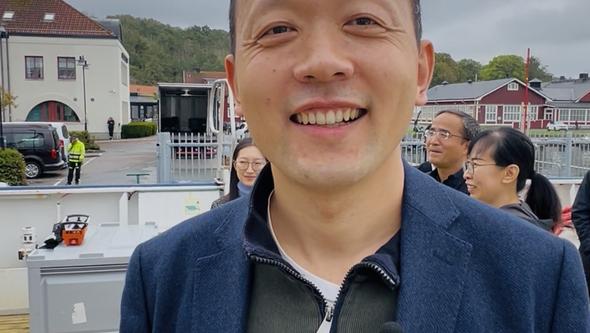
Around 20 participants took part in the delegation, with expertise in areas including marine spatial planning and governance, marine geology, physical oceanography and marine meteorology.
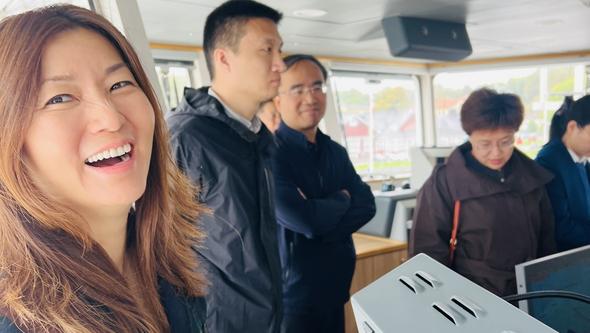
On board R/V Skagerak, they visited the vessel’s laboratories and viewed its scientific equipment, while learning more about how the research vessel is used for marine research, ocean observation and environmental monitoring.
Impressed by the research capacity
Ye Yuan was impressed by the amount of research capacity brought together on board.
“The vessel is not very large, but it is compact and the equipment is very advanced. We have similar research vessels in China that are larger, but I think the laboratories and the way the equipment is organised here are very good,” he says.
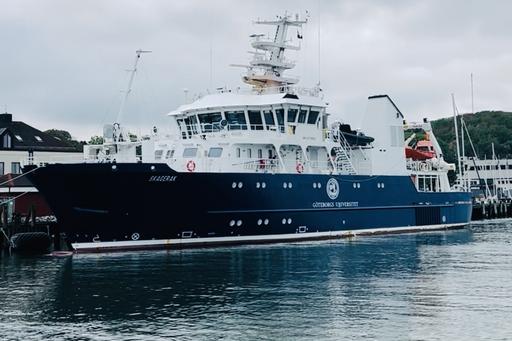
The vessel’s FerryBox attracted particular interest. The system can continuously measure properties of seawater while the vessel is under way. Ye Yuan also highlighted the work to make research data openly available.
“That is very interesting, particularly from a research perspective,” says Ye Yuan.
Focus on sustainable ocean management
The visit to R/V Skagerak formed part of a wider programme in Sweden focusing on marine research, ocean management and sustainability.
“We want to learn more and establish contacts with government agencies, research centres and companies conducting research or working within the green and blue economy,” says Ye Yuan.
At the University of Gothenburg, the delegation also visited the Centre for Sea and Society, where participants learnt about interdisciplinary research and collaboration on marine issues. They were also introduced to the work on marine allotments and how small-scale ocean farming can contribute to knowledge about sustainable food production and the marine environment.
The visit was organised by Cathay AB. Qiu Chen, who works with study visits and knowledge exchange, describes the interest in Swedish marine research and sustainability as considerable.
“Sweden may not be the largest country, but it is seen as being at the forefront of the green transition. There is great interest in coming here and learning from Swedish experience,” she says.
“We had heard a great deal about Skagerak
R/V Skagerak was an anticipated part of the programme.
“We had heard a great deal about Skagerak and the vessel’s importance to Swedish marine research. Having now been on board, I am very impressed, both by the vessel and by its crew,” says Qiu Chen.
For Ye Yuan, one of the main takeaways is how research can be linked to more sustainable use of the ocean.
“We have received a great deal of information that is relevant to our work. Above all, we are taking home knowledge about how Sweden works to protect marine environments and how sustainability is integrated into its approach to the ocean,” Ye Yuan says.
Text and photo: Agnes Faxén