
Anne Carson writes in the playful tradition of antiquity
This year’s Nobel laureate in literature, Anne Carson, is not only a poet and writer, but also a classicist with an extensive knowledge of ancient languages and literature. Greek mythology and classical themes feature prominently throughout her work.
“Carson shows us how the literary heritage of antiquity can take on entirely new perspectives and meanings when viewed through a contemporary lens,” says Anna Blennow, Professor of Latin.
In its citation, the Swedish Academy states that Anne Carson is awarded the prize "for her bold and inventive oeuvre that in playful dialogue with the classical tradition, has created new forms for contemporary literature."
“Absolutely. This is simply a wonderful continuation of the ‘Hot Homer Summer’ we’ve already had, with all the attention surrounding Christopher Nolan’s film The Odyssey. Incidentally, Homer is the author Carson always recommends if you were to choose just one ancient writer to read.”
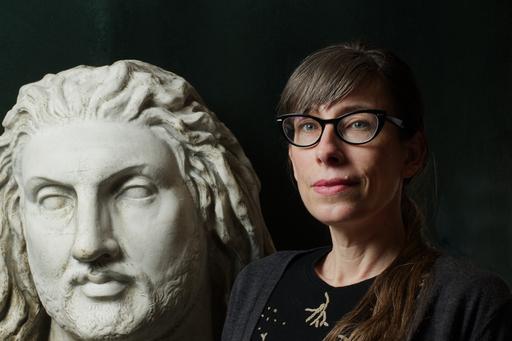
How does she draw on her knowledge of antiquity in her writing?
“Despite her scholarly training in the classics, she takes a remarkably free and creative approach to the ancient textual tradition. As the Academy writes in its citation: ‘Almost everything she has written has inhabited the intersection between the philologist’s obsession with words and the poet’s desire for new meaning.’ There is also a performative dimension to her work, including dramatised performances of her writing, as well as a highly visual approach to text and poetry – perhaps partly a reflection of her background in graphic design.”
What is your view of this free approach to the classical tradition?
“Not everyone in academia is as enthusiastic about her approach as I am. A few years ago, for example, the classicist and Homer translator Emily Wilson launched a rather unexpected attack on Carson. Wilson argued that Carson was a careless philologist* who did not handle her source texts accurately and that she took excessive liberties in her translations. But I think Wilson rather missed the point. Carson’s hallmark is precisely this playful creativity, which in many ways resembles the literary practices of antiquity itself, where writers readily built on and reshaped earlier literary models as they saw fit.”
She is perhaps most closely associated with Greek literature. Are there any important connections to Latin literature or the Roman tradition in her work?
“Yes. Alongside Sappho, one of Carson’s favourite poets is the Roman poet Catullus – who was himself a great admirer of Sappho and translated one of her best-known poems into Latin. Sappho and Catullus are both poets of emotion and desire par excellence, and their work encompasses everything from overwhelming passion to profound grief.
“Carson draws on the poetry of Catullus in, among other works, her substantial artist’s book Nox – Latin for ‘night’ – in which she uses fragments of text, clippings and sketches to construct a book-form funerary monument to her late brother. ‘I have raised a monument more lasting than bronze,’ the Roman poet Horace once wrote, and Carson reminds us of literature and poetry as perhaps the only enduring things in our transient existence.”
How has she influenced the way ancient texts are read and used today, including within academia?
“She has opened up a path between academia and the literary world that I believe is immensely important in both directions. She shows how the literary heritage of antiquity can take on entirely new perspectives and meanings when we bring it into the present day. At the same time, through the pedagogical engagement that often surfaces in her work, she draws the literary and cultural world into the classrooms and the promised land of classical learning.”
If you were to recommend one work by Carson to someone who wants to understand her relationship with antiquity, which would you choose, and why?
“I would choose her translation of Sappho, If Not, Winter, which brings together Sappho’s surviving poetry, the vast majority of which exists only in fragments – sometimes just a single word or line. By allowing the gaps and silences to become part of the translation itself, Carson creates a richly layered and extraordinarily beautiful reading experience.”
Elisabeth Hjorth, Professor of Literary Composition at HDK-Valand, is also delighted that Anne Carson has been awarded the prize.
“She is, so to speak, a two-tailed creature – both an academic and a poet! Her hybrid works show us just how porous and generous literary genres can be. Reading Autobiography of Red, Nox and the recently translated Wrong Norma, you understand why we need literature in our lives in the first place.”
Carson also allows antiquity to come alive again in the heart-rending light of love, death and everyday life.
“Who knows, perhaps the lyric essay will finally gain a foothold in Sweden now?” says Elisabeth Hjorth.
Janna Roosch and Cecilia Köljing
* Philology is the study and analysis of texts and languages with the aim of understanding literature and its cultural and historical contexts. It differs from linguistics, which focuses on the analysis of language and its structure.