
American exchange students gain new perspectives on healthcare in Gothenburg
Patient encounters, research, and new friendships. Meet four international exchange students taking the medical degree program’s new elective courses. They are expanding their knowledge and experiencing Swedish healthcare alongside Swedish medical students.
For the first time, advanced-level electives are being offered in the 11th semester of the medical degree program. Taught in English, the courses are also open to medical students from Sahlgrenska Academy’s international partner universities.
Nicholas Barber and David Pogosyan from the University of Arizona and Annie Simplot from the University of Iowa are taking the course Chronic inflammatory diseases. Nicholas and David hope to specialize in psychiatry, while Annie plans to pursue internal medicine. All three were drawn to the opportunity to broaden their understanding of inflammation, a field relevant to a wide range of medical specialties.
Swedish healthcare is highly regarded in the United States, Nicholas explains.
“We hear a lot of positive things about Swedish healthcare back home. It’s valuable to see how healthcare is delivered here and think about what we can bring into our own future medical practice.”
David has been particularly interested in how the two countries differ when it comes to the affordability of healthcare and access to treatment.
“Patients in Sweden seem to face far fewer financial barriers to care than in the US. Even expensive medications, like the biologics we’ve been learning about for inflammatory diseases, are more straightforward to access. It’s been interesting to compare how the two systems approach affordability.”
Annie particularly values the opportunity to interact with researchers and faculty.
“We’re learning from highly knowledgeable researchers and specialists, and it’s easy to ask questions and discuss things with them. It makes me want to seek out more research opportunities as I move further into clinical practice.”
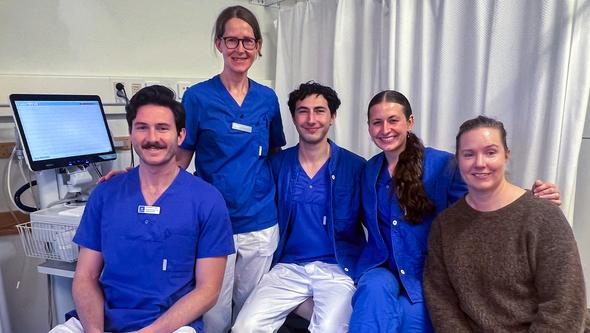
Enriching the learning experience
Many people have contributed to the course, with Anna-Karin Ekwall and Martina Sundqvist overseeing its final development. Over four weeks, students attend lectures, study research methods, learn about drug development, work through clinical cases, and meet specialists from several medical fields.
“We want to show students how research translates into clinical treatment. They get to follow a patient case over time and see how the disease progresses and treatment changes,” says Anna-Karin Ekwall.
The course has 14 students, and the mix of Swedish and international participants enriches the discussions.
“Students compare experiences from different healthcare systems and ask why we do things the way we do. It brings new perspectives into the discussion, and everyone benefits from learning from one another,” says Martina Sundqvist.
A memorable patient encounter
One patient encounter during a clinic visit left a particularly strong impression on Nicholas.
“It was a bright room with two identical chairs at a small table overlooking the forest. The doctor and patient spoke naturally, as equals. It was a lovely setting for building a good relationship, and that’s something I want to carry into my future medical practice.”
The students have also been struck by the warm welcome from their Swedish classmates. Annie recalls how they invited the exchange students to lunch on their very first day and have continued to include them in activities outside class.
“Everyone has been incredibly welcoming. It’s been easy to get to know the other students, and we’ve had a lot of fun together.”
David has also appreciated the cultural diversity among his Swedish classmates.
“Although many were born and raised in Sweden, they come from a variety of cultural and family backgrounds. I’m of Armenian heritage myself, so it’s particularly nice to connect with classmates who share that multicultural perspective.”
For Nicholas, the friendships he has made are among the most important things he will take home. He hopes some of his classmates will visit Arizona so he can return the hospitality.
A closer look at ophthalmology
Thomas Martinez from the University of Iowa is taking another of the new electives, Advanced Clinical Ophthalmology, and spends much of his time at the ophthalmology clinic in Mölndal. He hopes to become an ophthalmologist and was drawn to the opportunity to gain more experience in his future specialty.
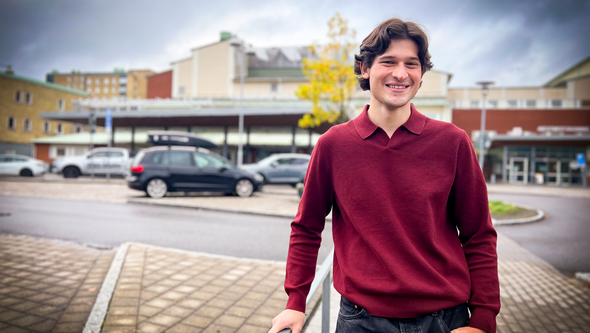
One difference he has noticed is how follow-up appointments are scheduled in ophthalmology.
“In the US, we generally have more frequent follow-up appointments. In Sweden, doctors are more likely to decide that patients don’t need further checkups unless problems arise. It shows how difficult it can be to balance keeping healthcare costs down with achieving the best possible outcomes for patients.”
Thomas is the only exchange student in his course. Classes are taught in English, and when patient encounters take place in Swedish, his classmates and clinical supervisors help by summarizing what was said.
“Everyone has been incredibly welcoming. They really go out of their way to make sure I can participate.”
A two-way exchange
All four American students are nearing the end of medical school and are currently applying for residency positions in the United States. For Thomas, this means juggling his studies in Gothenburg with remote interviews at US hospitals, often across several time zones.
“It’s an exciting time. I feel incredibly fortunate to be here and have the opportunity to deepen my knowledge in the field I want to work in.”
During the fall 2026 semester, the medical degree program is welcoming 12 students from international partner universities, eight of whom are taking the new 11th-semester electives.
The English-language courses are also opening up more opportunities for reciprocal exchanges. As early as next month, three medical students from Gothenburg are expected to travel to the University of Arizona to take courses there.
