AI is changing how we need to think about financial risk
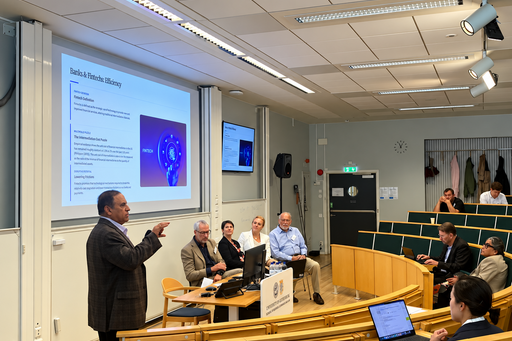
AI is becoming increasingly important to the economy and can contribute to both higher productivity and more efficient financial services. At the same time, these developments are creating new dependencies and risks. At the conference Technology, Financial Services and Evolving Societal Needs, researchers in banking and finance gathered at the School of Business, Economics and Law to discuss the links between technological development, financing and financial risk.
AI, financial technology (fintech) and new forms of digital financial services are rapidly transforming both the financial sector and the wider economy. However, a recurring point during the conference was that technological development is not only about which new technologies are being developed. Equally important is how technology spreads, who finances it, and how it is adopted by banks, businesses and households.
“Financial institutions play a dual role. Banks and other financial actors are affected by technological developments, but at the same time they help determine which innovations receive funding and have the opportunity to grow,” says Stefan Sjögren, Professor of Industrial and Financial Management at the School of Business, Economics and Law, University of Gothenburg, and one of the conference organisers.
AI creates new dependencies
The conference brought together international researchers in banking and finance to present and discuss new research on topics including AI, fintech, private credit, digital financial services and financial stability.
Several contributions highlighted how AI can increase productivity and make financial services more efficient, while also creating new forms of concentration and shared dependencies. Research presented at the conference showed, among other things, how AI is increasingly spreading beyond the IT sector and playing a greater role in other parts of the economy. This reinforces the view of AI as a technology with broad applications across the economy, with the potential to affect everything from manufacturing and finance to healthcare.
At the same time, participants discussed what happens when companies across many different industries become dependent on the same AI models, data platforms and digital infrastructure.
“A bank may lend to companies across many different industries and therefore appear to have a well-diversified credit portfolio. But if those companies depend on the same technological infrastructure, they may still be exposed to the same risks in ways that standard risk measures may not pick up,” says Stefan Sjögren.
Financing shapes development
The conference also highlighted how the financing of technological transformation affects both innovation and risk. Discussions focused on established companies investing in young technology firms, the rapid growth of private credit, and the substantial investments required for AI infrastructure and data centres.
A common question is where risks end up as new investments and credit flows increasingly take place outside traditional banking. Even if risk is moved off banks’ balance sheets, it does not necessarily disappear from the financial system, since banks, credit funds, insurance companies and pension funds are interconnected.
The conference highlighted the need for further research into the interplay between technological development, financing, competition and financial stability.
“One important lesson is that technology itself is only part of the picture. How it spreads and how it is financed affect both the economic opportunities it creates and the risks that may arise. That is why we increasingly need to see innovation, competition, financial stability and regulation as parts of the same bigger picture,” says Stefan Sjögren.
The conference Technology, Financial Services and Evolving Societal Needs was held on 3–4 September 2026 at the School of Business, Economics and Law, University of Gothenburg, Sweden.