Ferran Font – Brainstem-Immune Mechanisms Driving Metabolic Alterations in Cancer and Infection
Dissertation for Medicine Doctoral degree at Sahlgrenska Academy, Institute of Neuroscience and Physiology, Department of Physiology
Opponent and examining committee
Opponent: PhD Jan Pieter Konsman, ImmunoConcEpT, Centre National de la Recherche Scientifique, University of Bordeaux, Bordeaux, France
Examining committee: Professor Elisabet Jerlhag Holm (chair), Associate Professor Marie Hagbom (LiU) and Associate Professor Louise Olofsson
Good to know
The disputation is held in English
Welcome to attend online via streaming, via Zoom Webinar: link to be announced
Chairperson of the disputation: Associate Professor Patrik Aronsson
Maintaining energy balance is essential for survival.
During infection and cancer, this balance is often disturbed, leading to weight loss and shifts in how the body uses fat and carbohydrates. While these changes may initially GFRAL+ with stress, sustained weight loss can become harmful and worsen disease outcomes. While it is clear that these metabolic alterations are orchestrated by the brain, how the brain coordinates these responses in disease remains unclear.
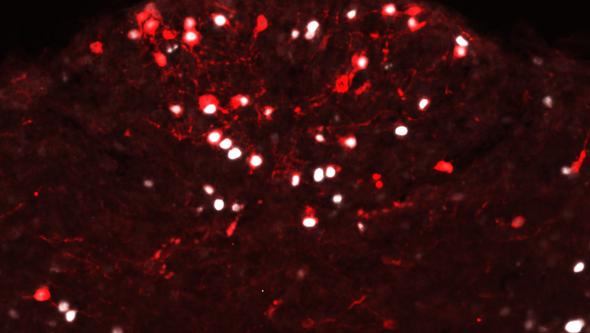
This thesis explores the role of a specific group of potent anorexigenic nerve cells, known as GFRAL+ neurons, in controlling energy balance during illness. The findings show that activation of these neurons induces a state toward energy conservation, where the body lowers its body temperature and shifts its energy preferences toward using fat rather than carbohydrates. These changes are accompanied by altered glucose handling, highlighting a broader role beyond their known role in appetite suppression.
This thesis further demonstrates that during viral infection, GFRAL+ neurons are engaged via a distinct signaling pathway. Specifically, detection of viral double-stranded RNA (dsRNA) through toll-like receptor 3 (TLR3) leads to increased levels of the hormone GDF15, the only known endogenous ligand to the receptor GFRAL exclusively expressed in the lower brainstem. This signaling promotes weight loss and increased fat use, even independently of reduced food intake, via the action of GFRAL+ neurons.
In addition, in pancreatic cancer, elevated GDF15 levels were found linked to activation GFRAL+ neurons and the development of weight loss and anorexia. Both experimental models and patient data show an association with weight loss and a shift in the body’s macronutrient handling.
Together, the findings of this thesis identify GFRAL-expressing neurons as key regulators of metabolic alterations during specific types of infection and cancer, linking immune and disease signals to changes in energy balance and fuel use. Importantly, these neurons do not just act as general sensors of physiological stress, but instead respond in a context-dependent manner to distinct disease signals.