Programme structure, Software and AI Engineering, MSc
An overview of the curriculum for the Master's programme in Software and AI Engineering.
Compulsory courses
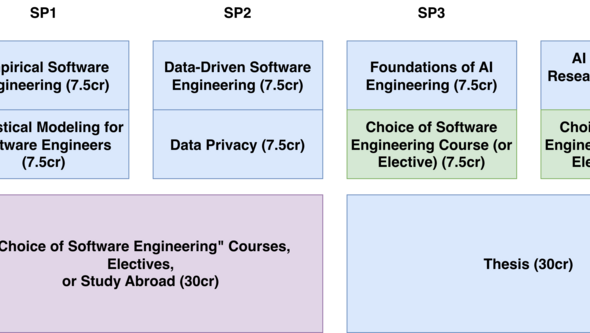
The programme includes 75 credits of compulsory courses that provide a common basis shared by all students. The compulsory courses are:
Term 1
- Empirical Software Engineering (study period 1, 7.5 credits)
- Statistical Modeling for Software Engineers (study period 1, 7.5 credits)
- Data-Driven Software Engineering (study period 2, 7.5 credits)
- Data Privacy (study period 2, 7.5 credits)
Term 2
- Foundations of AI Engineering (study period 3, 7.5 credits)
- AI Engineering: Research and Practice (study period 4, 7.5 credits)
Term 3
- No mandatory courses
Term 4
- Thesis (30 credits)
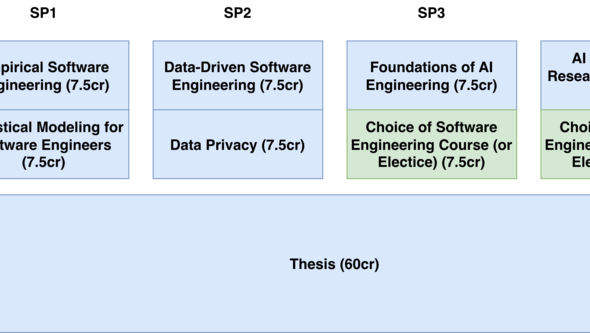
- Alternatively, students may choose to take a 60 credit thesis (terms 3-4).
“Choice of Software Engineering” courses
All students must complete 15 credits of advanced courses in software and AI engineering. This allows students to specialize in self-selected aspects of the field. Students choose these credits from a list of approved courses. The current list of courses can be found on the programme page on the Canvas online platform.
Examples of such courses include:
- Advanced Requirements Engineering
- Quality Assurance and Testing
- Architectures for Scale-Out Systems
- Secure Software Engineering
- Agile Development Processes
- Behavioral Software Engineering
- Principles of Human-Computer Interaction
- Human-Robot Interaction
- Software Innovation Project
- Special Topics in Software Engineering
- AI and Software Engineering Seminar
- Industrial Project in Software Engineering
- Research Project in Software Engineering
Elective Courses
In addition, all students must complete 30 credits in elective courses. These courses can be in any subject area. Students may take additional software and AI engineering courses as part of these electives, but are not required to do so.
If students elect to take a 60 credit thesis, they are not required to complete elective credits.