Jesús Pineda awarded the faculty’s Doctoral Thesis Award
Jesús Pineda’s doctoral thesis shows how deep learning can become more data-efficient and accessible through so-called inductive biases. For his research at the intersection of AI and microscopy, he is now awarded the Faculty of Science and Technology's Doctoral Thesis Award 2026.
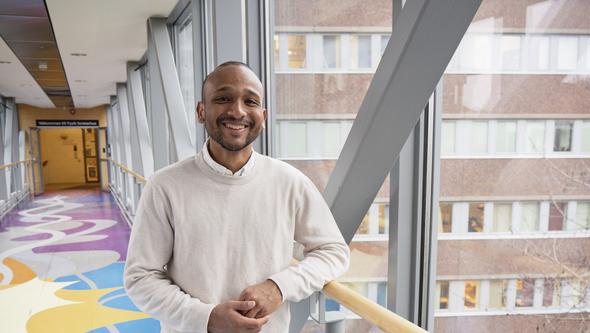
How does it feel to receive this year’s Doctoral Thesis Award?
“I’m very grateful for this recognition. The PhD was an incredibly important period for me, both professionally and personally. I’m especially happy that the work, and hopefully some of the ideas behind it, have resonated with others. Receiving this feels both humbling and encouraging, and I’m genuinely thankful for it.”
What is your research about?
“The recent progress in AI has been remarkable, but much of it has been driven by more data, bigger models, and more computing resources. My thesis examines how this approach works in microscopy, where data vary between experiments and large annotated datasets are often difficult to obtain.
I explore how models can be designed with built-in assumptions, what AI researchers call inductive biases. This can help models learn more efficiently and transfer better to new scientific settings. The broader question is whether progress in AI for microscopy should rely only on making models larger, or whether we can also design them more intelligently for the scientific problems we want to solve.”
How might your research benefit society?
“I think the main benefit is making advanced AI more useful and more accessible in scientific research. If AI depends on enormous datasets and huge computing resources, only a few places can realistically use it. Designing models that learn more efficiently and generalize better helps lower that barrier.
But there is also an important sustainability side. Training and running increasingly large AI systems takes significant amounts of energy, and that has an environmental impact. I think efficiency shouldn’t just be a technical detail, but part of how we define progress.
For me, the value of this work is helping to move toward AI that achieves more with less. Less data, less computation, less energy, but still powerful enough to tackle big scientific questions.”
What are you doing now?
“Today, I’m continuing with many of the ideas that shaped my PhD, but bringing them closer to real-world problems.
I’m a co-founder and CSO of IFLAI, where we develop AI across different sectors, including life sciences, medtech, manufacturing, and security.
What is especially exciting for me is seeing how some of the principles behind my research translate into very different industrial settings. In industry, data and energy efficiency are not only theoretical ambitions but practical constraints. Data can be expensive, computing resources are not unlimited, and solutions need to be efficient enough to operate reliably in the environments where they are needed.”
Motivation
Jesús Pineda’s doctoral thesis, Inductive Biases for Efficient Deep Learning in Microscopy, addresses a central challenge in artificial intelligence: how to develop powerful deep-learning methods without relying on ever-larger datasets and computational resources. Focusing on microscopy, where annotated data are often scarce and heterogeneous, Pineda demonstrates how carefully designed inductive biases can make AI more data-efficient, computationally accessible, interpretable, and scientifically meaningful.
The thesis presents three original methodological contributions. MAGIK applies geometric deep learning to microscopic motion, exploiting the relational structure of particle trajectories to extract dynamic properties from limited data. MIRO develops recurrent graph neural networks for single-molecule localization microscopy, integrating clustering, classification, and multiscale analysis in a lightweight framework that learns from few examples. GAUDI extends these principles to unsupervised representation learning, producing interpretable representations of complex systems.
A particular strength is the thesis’s conceptual coherence: these contributions form a clear scientific progression rather than disconnected studies. Written with exceptional clarity and supported by effective visual explanations, the dissertation makes advanced concepts accessible across disciplines.
Through its originality, methodological innovation, coherence, and clarity, Pineda’s dissertation constitutes an outstanding contribution at the intersection of AI, microscopy, and complex systems and merits the Faculty of Science and Technology’s Thesis Award 2026.
The award is given for successful and innovative research presented in a well-written doctoral thesis. The author receives a diploma and an award. The award ceremony will be held on November 11.