Dag Hanstorp receives the Faculty's Synergy Award 2026
From schoolchildren and teachers to industry and international collaborations. For several decades, laser physicist Dag Hanstorp has been building bridges between the University and the surroundings community. His wide-ranging commitment to collaboration has now been recognised with the Faculty’s Synergy Award.
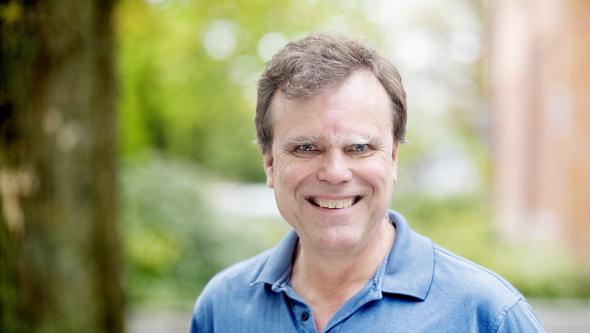
Congratulations! How does it feel to receive the Faculty’s Synergy Award?
“It’s great fun and a real honour! It’s a bit like Melodifestivalen, lots of people are doing good things, and sometimes you happen to get recognised for what you do. It’s fantastic!”
Which of your collaborative initiatives are you most proud of?
"One thing I’m particularly fond of is Upptäckarklubben. It’s great fun working with 11-year-olds, and it’s also an important initiative. I came up with the concept 15 years ago, and since then others have taken over and continued to run it. It’s very rewarding to have created something that lives on.
But perhaps the most spectacular thing we’ve done was when we brought together 400 children at Ullevi for a sound experiment during the opening of the International Science Festival Gothenburg. The children spread out across the field, held a screen above their heads and closed their eyes. When they heard the sound, they lowered the screen. We filmed the whole thing with drones, so you could actually see the sound wave travelling across the grass.”
You have collaborated with many different kinds of people and organisations over the years. How have you managed to do that?
“Curiosity! If you’re curious and talk to people, things come up. You might talk to someone and plant a seed, then pick it up again further down the line. A lot of what you do doesn’t pay off straight away, but it can still prove worthwhile in the long run.”
What has made you want to collaborate so widely, both with different parts of society and internationally?
“I really enjoy explaining things and sharing my knowledge. International exchange is particularly important in times like these. There are around twelve to fifteen people in our research group. Perhaps a third are from Sweden, while the rest come from different parts of the world. It’s fantastic to bring together people from different cultures, with different languages, religions and backgrounds. I think that’s one of the most important things you can do to make the world a better place.”
What are you working on at the moment?
“My latest project is a seminar series. I feel that I don’t see enough of my colleagues, as many have continued to work from home since the pandemic. I think that’s a shame, so we want to attract people here by bringing some well-known names to a seminar series. The idea is that students, administrative staff, professors and others at the Department will enjoy coming along to the seminars, having a coffee and meeting each other. Zoom is great for collaborating, but I don’t come up with new ideas there. I need to meet people! I think the coffee queue is the best place for that.
Another thing I’m working on is an applied medical project that we’ve just received funding for. I’m an atomic physicist and work with large lasers, and a cancer researcher got in touch because he needed to access the bone marrow in mouse bones. It’s difficult to cut into bone without damaging the bone marrow at the same time, but with a laser beam we can cut the bone without killing the cells. So this is a practical application of what we do that medical researchers can use. We’re now going to set up a lab with equipment specifically for this purpose, so that medical researchers can come here and use it.”
Award Motivation
Dag Hanstorp has conducted research in laser physics and worked at the Department of Physics for more than 40 years. In addition to being an accomplished and respected researcher, he is also a qualified secondary school teacher and holds a teaching licence – a combination that has proved invaluable in a wide range of collaborative activities.
Over several decades, he has built up an unusually broad range of collaborations bringing together academia, schools, wider society, industry and international partners. His engagement ranges from preschool teachers and children in Upptäckarklubben to upper secondary school students, teachers and educational networks. Through courses, lectures, school visits and creative initiatives such as staff exchanges between the University and upper secondary schools, he has built lasting bridges between different levels of education.
At the same time, his science communication reaches a broad public through the International Science Festival Gothenburg, Universeum, radio and the press. Internationally, Dag has developed long-standing collaborations with universities in Latvia, Mexico and India, involving extensive exchanges of students, teachers and staff. His expertise in laser physics has also led to collaboration with industry and to his role as Director of Laserlab Göteborg.
What particularly distinguishes Dag is his ability to bring together research, education, engagement with wider society, international exchange and industry in ways that allow them to enrich one another. This breadth makes him an exceptionally worthy recipient of the Synergy Award
The Synergy Award recognises positive efforts within the Faculty of Science’s community outreach. The award is in the form of a SEK 250,000 grant to the recipient’s department for appreciated and successful community outreach efforts. The Faculty’s 2026 award will be presented on 11 November.