
Organisation
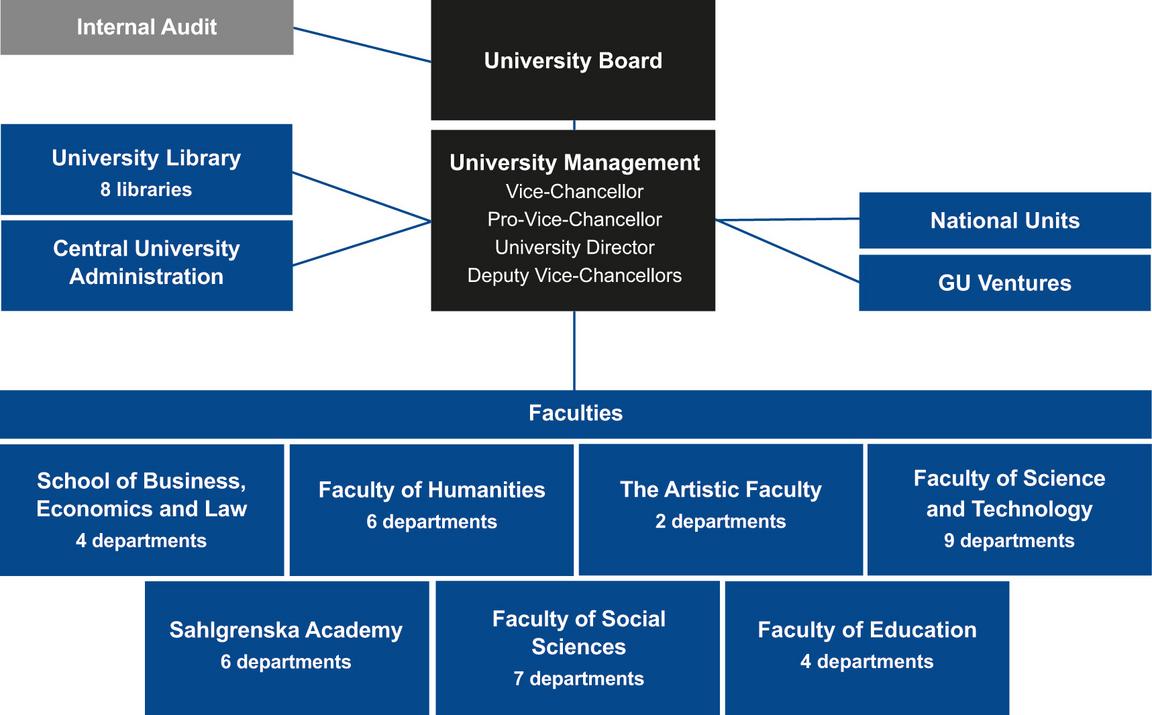
The University of Gothenburg is organised into faculties, departments and central administrative support that together are responsible for education, research and operations. This page provides an overview of the University’s management, organisational structure and decision-making.
The University Board is the University’s highest decision-making body, and the Vice-Chancellor of the University is the head of the University. The University is made up of a number of University-wide staff positions, units, and bodies that support the University Management and the organisation in different matters.
The University’s core activities, i.e. research and education, are organised and run by the University’s seven faculties, which comprise 38 departments, and by the University’s approximately 20 centres of expertise and research.
The University Board
The University Board is accountable to the government for its operations and is to ensure that these are run efficiently. It is also to ensure that University operations are reported in a reliable and equitable manner, as well as ensuring that the University is economical in its use of public funds. According to the Higher Education Act, the University Board is also to supervise all University affairs and be responsible for the tasks associated with these.
Internal Audit
The task of the University’s Internal Audit is to help the University achieve a fit-for-purpose and efficient organisation that is run in accordance with governing statutes, and reports its results in a reliable and trustworthy manner. The University’s Internal Audit reports directly to the University Board.
Contact: Jan Sandvall, Audit Manager
University Management
The University Management consists of the Vice-Chancellor, the Pro-Vice-Chancellor, the University Director and the three Vice-Chancellors. The management team works on behalf of the University Board and is responsible for the University's overall strategies and goals, based on its overall vision.
Vice-Chancellor – Malin Broberg
The Vice-Chancellor is line manager, head of the public authority and the University's main representative in external contexts. The Vice-Chancellor is a member of the University Board, is Chair of the University Management Council and the University Health and Safety Committee and has the overall responsibility for the working environment.
Malin Broberg has been Vice-Chancellor at the University of Gothenburg since 1 July 2023. She is a Professor of psychology and previously worked as Dean at the Faculty of Social Sciences

Pro-Vice-Chancellor – Carina Mallard
The Pro-Vice-Chancellor is the Vice-Chancellor’s deputy and has the overall responsibility for research issues including research infrastructure. The Pro-Vice-Chancellor is the Chair of the Research Board and is head of the directors of the university's national units.
Carina Mallard is Professor of experimental perinatal brain injury research, focusing on the newborn baby's brain. She is working on issues regarding research infrastructure and has been Director for the university’s HoD Core Facilities.

University Director – Johan Johansson
The University Director is head of the Central University Administration and part of the University Management and the University Management Council. The University Director also chairs the University Director's Management Council, which consists of the Heads of Secretariat from the faculty or equivalent.
Johan Johansson has previously been Deputy University Director and Head of Unit for the staff of the Vice-Chancellor's Office.

Deputy Vice-Chancellor responsible for issues regarding education – Pauli Kortteinen
The Deputy Vice-Chancellor has the overall responsibility for Education. The Deputy Vice-Chancellor is the Chair of the University Board of Education. The assignment also includes overall responsibility for knowledge, lifelong learning, and cultural issues.
Pauli Kortteinen is senior lecturer in linguistics and has previously been Head of the Department of Philosophy, Linguistics and Theory of Science. He has also been Vice Dean for education at undergraduate and advanced level at the Faculty of Humanities.

Deputy Vice-Chancellor responsible for issues regarding campus development and internationalisation – Mette Sandoff
The Deputy Vice-Chancellor is responsible for issues regarding campus development and internationalisation. The Deputy Vice-Chancellor responsible for issues regarding campus development and internationalisation is the Chair in the planned board for campus development and sustainable development.
Mette Sandoff is a Professor in Public Administration. She has previously been Acting Pro-Vice-Chancellor at the University of Gothenburg. Right before, she had the position as the Deputy Vice-Chancellor, strategically responsible for education at all levels and Head of the University's Board of Education. Former managerial positions are among others Vice-Dean at the School of Business, Economics and Law. She has also been Head of the Department of Business Administration and Board member of Universeum AB.

Deputy Vice-Chancellor for collaboration, knowledge transfer, and open science – Max Petzold
Max Petzold is the Deputy Vice-Chancellor for Collaboration, Knowledge Transfer, and Open Science. He also holds overall responsibility for doctoral education and research ethics. The role includes chairing the Library Board, the Doctoral Education Council, the Collaboration Council, and the Committee for Research Ethics, as well as serving as Vice Chair of the Research Committee.
Max Petzold is Professor of biostatistics. He has previously been, among other things, Director of the Swedish National Data Service, SND and Head of the School of Public Health and Community Medicine within the Department of Medicine.

University-wide bodies
The task of university-wide bodies is to support the University Management and the organisation in different matters.
Central University Administration
The central operational support at the University of Gothenburg is located within the Central University Administration. In addition to providing support and service in the administrative and technical tasks at the University, the Central University Administration is responsible for ensuring the University's authority function and contributing to the University's goal and strategy work.
The Central University Administration is headed by University Director Johan Johansson.
The University Library
The University Library supports research and education at the University of Gothenburg by providing information services and collections, by providing access to electronic resources, and by giving courses in how to search, evaluate, and handle information.
National Units
University of Gothenburg hosts a number of national units that are designated specific responsibilities.
GU Ventures
Since 1995, GU Ventures has supported projects and companies spun off from the University of Gothenburg. The company is wholly owned by the Swedish state and, since 1998, managed by the University of Gothenburg.
The aim is to create successful businesses to expand our knowledge base and generate a return on investments for the University of Gothenburg. Furthermore, we work to increase growth in the region and contribute to the utilization of research for better quality of life and a better society with new products and services.
Faculties
University of Gothenburg is a traditional European university with seven faculties.
Deans supervise the work carried out at the Faculty Office. They also serve as Chairs of the Faculty Boards.
The faculties at the University of Gothenburg are listed here. Contact information can be found on the page: Contact
Departments
University of Gothenburg consists of in total 38 departments. Here, all departments are listed in alphabetical order, based on subject area.
Centres of expertise and research
A centre of expertise and research serves as a meeting point for students, researchers, and representatives from the private and public sectors. Centres of expertise and research are cross-disciplinary and may include several academic subjects, faculty areas, and higher education institutions.
The purpose of these centres is to manage areas and topics of interest that, by nature, span across several academic disciplines. There are approximately 20 University-wide centres at the University of Gothenburg. There are also other collaboration and networking groups.