Awards
Each year, The Faculty of Science and Technology at University of Gothenburg recognizes four achievements. These are awarded with one of four prizes – the Research Prize, the Thesis Prize, the Educational Prize and the Synergy Prize.
Research Award
The Research Award is given for developing a research line that significantly contributes to novelty of the research at the Faculty of Science and Technology. The award holder will receive a diploma and a prize of 250.000 SEK for research.
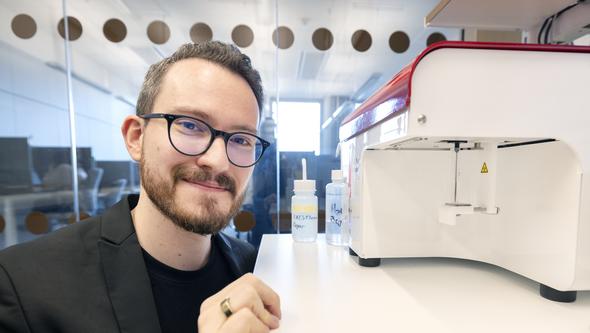
Research Award 2026: Daniel Bojar
Department of Chemistry and Molecular Biology
Motivation for the award:
Daniel Bojar is an exceptionally creative and innovative researcher, whose work is characterized by both outstanding scientific excellence and a strong ability to advance established fields of research. His research on the glycosylation of biological molecules lies at the intersection of molecular biology, bioinformatics, artificial intelligence, and quantitative methods, where he develops new approaches to understanding and predicting complex biological processes.
What particularly distinguishes Bojar’s research is his ability to combine technical and methodological innovation with deep biological insight. He uses modern computational methods not merely to analyze existing data, but to formulate new biological hypotheses and open up entirely new avenues for experimental research. In this way, his work contributes not only new findings within his own fields of research, but also new ways of conducting cell biology research.
Despite his relative youth, he has in a short period of time established a dynamic and rapidly expanding research group, and forged collaborations with a wide range of research environments.
Daniel Bojar represents a generation of researchers that is actively reshaping the boundaries between experimental and computational research. Through his combination of scientific excellence, originality, and innovative thinking, he is a worthy recipient of the faculty’s research award.
Doctoral Thesis Award
This award is given for successful and novel research that has been presented in a well written thesis. The award holder will receive a diploma and a prize.
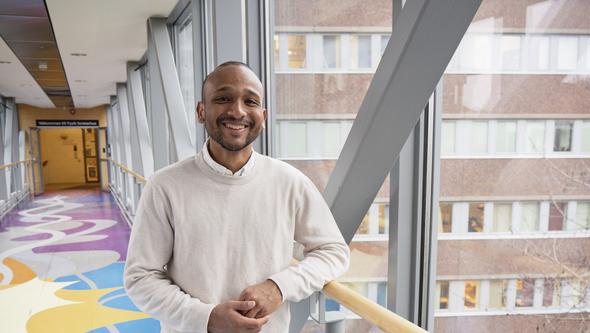
Doctoral Thesis Award 2026: Jesús Pineda
Department of Physics
Motivation for the award:
Jesús Pineda’s doctoral thesis, Inductive Biases for Efficient Deep Learning in Microscopy, addresses a central challenge in artificial intelligence: how to develop powerful deep-learning methods without relying on ever-larger datasets and computational resources. Focusing on microscopy, where annotated data are often scarce and heterogeneous, Pineda demonstrates how carefully designed inductive biases can make AI more data-efficient, computationally accessible, interpretable, and scientifically meaningful.
The thesis presents three original methodological contributions. MAGIK applies geometric deep learning to microscopic motion, exploiting the relational structure of particle trajectories to extract dynamic properties from limited data. MIRO develops recurrent graph neural networks for single-molecule localization microscopy, integrating clustering, classification, and multiscale analysis in a lightweight framework that learns from few examples. GAUDI extends these principles to unsupervised representation learning, producing interpretable representations of complex systems.
A particular strength is the thesis’s conceptual coherence: these contributions form a clear scientific progression rather than disconnected studies. Written with exceptional clarity and supported by effective visual explanations, the dissertation makes advanced concepts accessible across disciplines.
Through its originality, methodological innovation, coherence, and clarity, Pineda’s dissertation constitutes an outstanding contribution at the intersection of AI, microscopy, and complex systems and merits the Faculty of Science and Technology’s Thesis Award 2026.
The Pedagogical Award
The Faculty of Science’s Pedagogical Award is awarded annually to focus attention on good efforts within education. The award consists of a SEK 100.000 operational contribution.
After 2012 The Pedagogical Award transformed from being an Award for the entire university to be an Award at each Faculty.
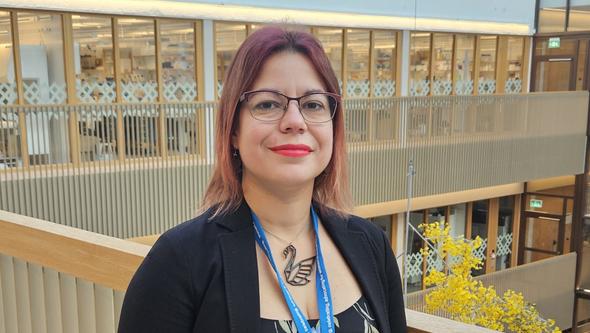
Pedagogical Award 2026 in Science: Vasiliki Mylonopoulou
Department of Applied IT
Motivation for the award:
Vasiliki Mylonopoulou has developed and successfully implemented an innovative pedagogical approach that integrates societal challenges, sustainability, and real-world collaboration into technology education. As course leader, she has designed and continuously refined a cognitive science course that has received the University’s sustainability-related certification and is open to international students, including participants in Erasmus and other EU initiatives.
Her teaching is structured around project-based learning in collaboration with public authorities, healthcare organisations, industry, and civil society. These long-term partnerships result in student projects that contribute to ongoing development in partner organisations, demonstrating clear external impact.
The course is systematically developed based on student feedback, with a strong emphasis on formative assessment and student-centered learning. Student evaluations highlight both the intellectual value of the course and the teacher's commitment.
Through sustained excellence, pedagogical innovation, and documented societal impact, Vasiliki Mylonopoulou serve as a role model through her contribution to teaching and learning in higher education.
The Synergy Award
The Synergy Award recognises positive efforts within the Faculty of Science’s community outreach. The award is in the form of a SEK 250,000 grant to the recipient’s department for appreciated and successful community outreach efforts. The Faculty’s 2021 award will be presented on 2 December.
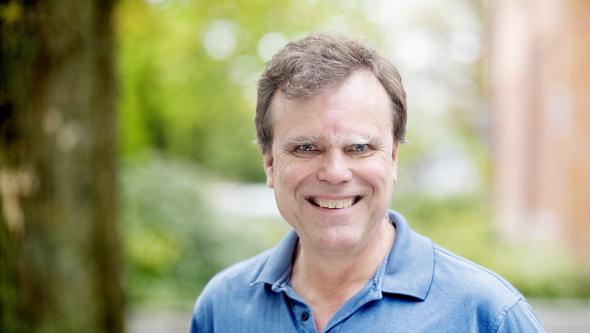
Synergy Award 2025: Dag Hanstorp
Department of Physics,
Motivation for the award:
Dag Hanstorp has conducted research in laser physics and worked at the Department of Physics for more than 40 years. In addition to being an accomplished and respected researcher, he is also a qualified secondary school teacher and holds a teaching licence – a combination that has proved invaluable in a wide range of collaborative activities.
Over several decades, he has built up an unusually broad range of collaborations bringing together academia, schools, wider society, industry and international partners. His engagement ranges from preschool teachers and children in Upptäckarklubben to upper secondary school students, teachers and educational networks. Through courses, lectures, school visits and creative initiatives such as staff exchanges between the University and upper secondary schools, he has built lasting bridges between different levels of education.
At the same time, his science communication reaches a broad public through the International Science Festival Gothenburg, Universeum, radio and the press. Internationally, Dag has developed long-standing collaborations with universities in Latvia, Mexico and India, involving extensive exchanges of students, teachers and staff. His expertise in laser physics has also led to collaboration with industry and to his role as Director of Laserlab Göteborg.
What particularly distinguishes Dag is his ability to bring together research, education, engagement with wider society, international exchange and industry in ways that allow them to enrich one another. This breadth makes him an exceptionally worthy recipient of the Synergy Award