
ZORRO - Interdisciplinary research about management and restoration of eelgrass in Sweden
Short description
Zorro is an interdisciplinary research program where marine ecologists, oceanographers, ecotoxicologists, environmental lawyers and environmental economists collaborate on issues related to the management and restoration of eelgrass ecosystems. The work is also carried out in close association with various authorities.
Among other things, Zorro has produced national guidelines for restoration and ecological compensation of eelgrass, a national action plan for eelgrass and over 40 scientific publications and popular science articles.
The Research Program Zorro
(Zostera restoration)
Interdisciplinary research about management and restoration of eelgrass in Sweden
Zorro is an interdisciplinary research program that started in 2011 at the University of Gothenburg. It has the goal to improve the management of coastal ecosystems with focus on eelgrass meadows along the Swedish west coast. The program constitutes a base for research collaboration between marine ecologists, oceanographers, ecotoxicologists, environmental legal scholars, and environmental economists about management and restoration of eelgrass ecosystems, and is carried out in close collaboration with the Country Administrative Board of Västra Götaland, and the Swedish Agency for Marine and Water management. The name ‘Zorro’ is constructed from the words ‘Zostera’ (the eelgrass genus) and ‘restoration’.
Today, more than 20 Swedish and international researchers and national and regional managers are collaborating in 6 different research projects coordinated by the program, with funds from national research councils, national authorities and the EU.
The research program have produced national guidelines for restoration and ecological compensation of eelgrass, as well as a national action plan to protect eelgrass beds. The research has also resulted in over 40 scientific publications and popular science articles. Furthermore, Zorro conducts public outreach to spread information about eelgrass, why it is threatened and how it can be protected and restored. This work is carried out by researchers from the program giving lectures, through interviews in media, and through a number of films about eelgrass produced within the program.

The Research Group
Coordinators
Researchers
Eduardo Infantes, Louise Eriander, Marlene Jahnke, Kristjan Laas, Elina Lampi, Mats Envall.
PhD students
Stefanie Ries, Johan Severinson, Maru Bernal
Project assistants 2025
Felix Steinbrecher, Karl Karlsson
Project assistants 2022-2024
Karl Karlsson, Johan Persson, Maru Bernal, Matilda Rasmussen, Henrik Möller
Graduate students 2025
Erica Wik, Karl Karlsson, Nina Eriksson, Hanna Thomsen
Graduate students 2017 – 2024
Erica Wik, Karl Karlsson, Maru Bernal, Elin Treutiger, Alex Koivukangas Larsen, Eva Pagan, Alexander Larsson, Henrik Möller, Nicolina Andersson, Lea Stolpmann, Astrid Fridell, Joakim Nilsson, Ida Johansson, Maja Billman, Aze Peeters, Niklas Niemi, Katarina Bergström, Beatriz Marin, Laura Djikhuizen, Selwyn Hoek, Tristan Alison
National and international partners
- Project Seagrass – seagrassrestorer.org
- Johan Höjersjö, Magnus Loven Wallerius, Fred Halldén. Laxekologi-gruppen (SEG), Institutionen för biologi och miljövetenskap, Göteborgs universitet
- Ingemar Andersson, Elisabeth Anderberg, Karin Thompson-Svanfeldt och Mikael Haldin, Havs- och vattenmyndigheten
- Beatrice Alenius, Anders Olsson och Anita Tullrot, Länsstyrelsen i Västra Götalands Län
- Johnny Berglund och Carlos Paz von Friesen Länsstyrelsen Västerbotten
- Oscar Törnqvist, Sveriges Geologiska Undersökning (SGU)
- Erik Ytreberg, Chalmers Tekniska Högskola
- Michael Palmgren, Naturum Öresund
- Johan Eklöf, Sofia Wikström och Joakim Hansen, Stockholms universitet
- Marianne Holmer, Syddansk Universitet, Danmark
- Christoffer Boström, Åbo Akademi University, Finland
News
(15/09/25) New Handbook on Seagrass Restoration Published
An updated handbook on seagrass restoration in Sweden has now been published by the research group ZORRO in collaboration with the County Administrative Board of Västra Götaland.
It summarizes experiences from restoration projects between 2016–2024 and presents new insights on methods, site selection, genetic aspects, and practical application.
Link to news item

04/07/25) Volunteers Test New Restoration Method in Kosterhavet
In collaboration with Kosterhavets Naturum, Zorro recently tested a new method for seagrass restoration.
Shoots are tied to pieces of rebar and released from a boat at selected sites.
The aim is to develop restoration techniques that enable volunteer participation without the need for diving or snorkeling – making marine conservation more accessible and inclusive.

(13/06/25) Kristjan Laas Defended His Doctoral Thesis: "Ekologisk kompensation - Om juridik under ytan och relationen mellan rättsvetenskap och ekologi"
The doctoral thesis explores the relationship between legal studies and ecology in the implementation of environmental goals.
It is based on the need to preserve and prevent further loss of habitats and biodiversity, often referred to as "no net loss."
Link to thesis in Swedish

08/06/25) Zorro Joins SeagrassRestorer as New Partner
Zorro is now a partner of the SeagrassRestorer platform, which collects and shares global knowledge on seagrass restoration.
The initiative is led by Project Seagrass in collaboration with international research networks.
(12/12 -24) Volvo For Life Fund supports eelgrass restoration in Hakefjorden.
Volvo Cars' fund, Volvo For Life Fund, contributes funds to Zorro to expand the planned restoration of eelgrass in Hakefjorden, north of Gothenburg. The goal is to contribute to increased biodiversity and better water quality, as well as to increase knowledge about coastal ecosystems. Read more about the news here.
(4/6 -24) 400 million SEK to EU Improve Aquatic Life
Zorro and the Salmon Ecology group at the University of Gothenburg, together with 17 different partners, have received 400 million SEK to work on 500 different action projects in Swedish rivers and coastal waters over a seven-year period within the EU project Improve Aquatic Life.
The project, led by the County Administrative Board, constitutes one of the largest water conservation projects in Europe. The Zorro group will, among other things, work on major restoration projects of eelgrass in Hakefjorden in collaboration with the County Administrative Board and study how eelgrass affects the recruitment of sea trout.
(17/5 -23) Fauna return rapidly in planted eelgrass meadows
Eelgrass meadows have declined heavily in southern Bohus county in recent decades and in many places have disappeared altogether. Researchers at the University of Gothenburg have been working on the restoration of eelgrass meadows for twelve years. These meadows are important for biodiversity, as the eelgrass serves as habitat or nursery for young cod, crabs and shrimps for example.
In a new study, the researchers have evaluated how rapidly replanted eelgrass gets populated by various invertebrates. The study shows that fauna return rapidly once the eelgrass has started to grow. Already after the second summer, the biodiversity in the planted meadow was almost the same as in old established eelgrass meadows.
(30/9 2022) Successful sand capping and eelgrass restoration at Lilla Askerön
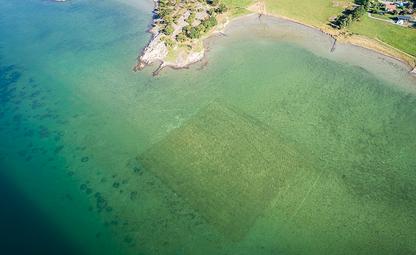
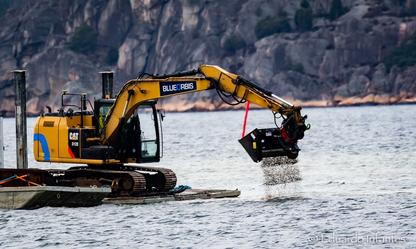
In the spring of 2021, one hectare of clay bottom was covered with 1,800 tons of sand in a bay at Lilla Askerön in Bohuslän, in collaboration with the County Administrative Board of Västra Götaland, to stabilize the bottom, reduce sediment resuspension and improve light conditions for eelgrass. In the summer, 80,000 shoots of eelgrass were subsequently planted on the sand-covered area in an attempt to restore eelgrass to the bay.
Sampling in the fall of 2022 shows that the eelgrass survived and growth exceeded expectations, where the number of shoots increased tenfold to over 860,000 shoots. This is the largest successful eelgrass restoration in Scandinavian waters and the first time sand cover is used to enable a restoration.

(7/9-22) Eelgrass's genetics determine its survival
The genetic history of eelgrass can play a greater role than the local environment regarding the morphology of the plants and the biomass of the associated plant and animal community. This is shown in a new large-scale study published in the journal Proceedings of the National Academy of Sciences (PNAS) that included 50 sites around the northern hemisphere in which researchers from Zorro led the Swedish part of the study.
Read the University of Gothenburg's press release
Read the article in PNAS

(12/7-22) New monitoring of eelgrass in Bohuslän with drones and genetic methods
In collaboration with the County Board of Västerbotten and Västra Götaland, Zorro is developing a new type of monitoring where flying drones and drop video are used to estimate the areal distribution of eelgrass meadows, in combination with genetic methods to estimate genetic diversity, connectivity and possibilities for the eelgrass to adapt to e.g. ongoing climate change. Over 100 bays with eelgrass will be mapped by the Zorro team during the summer.

(13/12 -21) Promising results for eelgrass restoration using sand-capping
During the summer, divers planted 80,000 eelgrass shoots in the sand. The follow-up study now shows that the eelgrass shoots have survived and reproduced to a total of 176,400 shoots. Also test sites outside the sand-capped area show a good survival rate.
Read more: Promising results for eelgrass restoration using sand-capping
(3/8 -21) Losses of eelgrass beds give rise to large emissions of carbon and nutrients
A new study published in the journal Ecosphere shows that losses of eelgrass meadows lead to sediment erosion and release of large amounts of carbon and nutrients.
Link to article: https://esajournals.onlinelibrary.wiley.com/doi/10.1002/ecs2.3658
Link to press release: https://www.gu.se/en/news/losses-of-eelgrass-beds-give-rise-to-large-emissions-of-carbon-and-nutrients

(17/5-21) 80,000 eelgrass shoots planting started
The planting of over 80,000 eelgrass shoots has started at the sand-covered area at Lilla Askerön, in the municipality of Tjörn. The shoots will be planted by scuba divers and the work is expected to be completed within 2 months.

(12/3 -21) Eelgrass will be restored using 1800 tonnes of sand
The County Administrative Board of Västra Götaland and Gothenburg University are studying if coarse sand placed on top of the seafloor can help re-establish threatened eelgrass. The method will be tested at a small island in the municipality of Tjörn, 70 kilometers north of Gothenburg. This is the first time restoration of eelgrass using this sand coverage technique is tested at large scale in Sweden.
Read more Eelgrass will be restored using 1800 tonnes of sand

Zorro on BlueSky
Follow Zorro on BlueSky for latest updates.
Ongoing Research Projects
Ecological Interactions Between Sea Trout and Eelgrass Meadows (2024-2030)
The goal of the project is to investigate the role that eelgrass meadows play in the growth and survival of sea trout in the ocean, as well as the role sea trout play as predators in the eelgrass ecosystem.
The project uses various methods to mark and track young sea trout in the ocean to study if they use eelgrass meadows as nursery areas, what they eat, and if eelgrass increases growth and protection from predators such as cormorants compared to shallow areas without eelgrass. Through methods like stomach content analysis, the effect of sea trout as predators on their prey in the eelgrass ecosystem will also be analyzed. The results can provide information on the need to co-manage sea trout and eelgrass meadows in the ocean.kan ge information om behovet av att samförvalta havsöring och ålgräsängar i havet.
Project group: Johan Höjesjö och Per Moksnes (PIs), Magnus Loven Wallerius, Fred Halldén (Göteborgs universitet)
Funding: Interreg Europe, EU LIFE Program

Sand Capping and Restoration of Eelgrass in Hakefjorden (2023-2030)
The goal of the project is to sand cap and restore up to 5 hectares of eelgrass at Källnäs in Hakefjorden, Bohuslän, and to study how the measures affect biodiversity and various ecosystem services in the area. In collaboration with the County Administrative Board of Västra Götaland, the same restoration methods successfully used at Lilla Askerön will be applied to a larger area in Hakefjorden, where the bottom is first covered with a thin layer of sand to reduce the resuspension of clay sediments, followed by planting eelgrass on the sand. To study how the measures affect biodiversity, water quality, and the storage of carbon and nitrogen, these variables will be examined both before and after the restoration, including the use of e-DNA methods
Project group: Beatrice Alenius (PI), Anders Olsson (Länsstyrelsen i Västra Götalands län), Per Moksnes (PI GU), Eduardo Infantes, Louise Eriander, (Göteborgs universitet)
Funding: LOVA, EU LIFE Program, Volvo Cars
Framework for Large-Scale, Climate-Adapted Eelgrass Restoration for Biodiversity in Coastal Ecosystems (2023 - 2027)
The goal of the transdisciplinary project is to develop and enable the implementation of new management and funding tools to scale up the restoration and protection of coastal habitats, using eelgrass meadows as a model system. With an interdisciplinary research group and in close collaboration with authorities and companies, we aim to (1) produce a national mapping of eelgrass distribution, genetics, and ecosystem services to identify the meadows that are most valuable and vulnerable, in need of protection and restoration, (2) identify eelgrass that is resilient to climate change and investigate whether the planting of climate-adapted genotypes can save threatened meadows in the Baltic Sea, (3) evaluate new large-scale restoration methods for eelgrass and assess the cost and economic value of produced ecosystem services, and (4) study how sustainable Funding can be developed to fund the long-term restoration and protection of coastal ecosystems
Project group: Per Moksnes (PI), Lena Gipperth, Marlene Jahnke, Eduardo Infantes, Elina Lampi, Louise Eriander (Göteborgs universitet)
Funding: Vetenskapsrådet, FORMAS

Eelgrass's Ability to Survive in a Climate-Affected Marine Environment through Local Adaptation (2023 - 2026)
This project aims to identify environmental factors that drive local adaptation in eelgrass, Zostera marina, and predict eelgrass's survival in a future and changing marine environment. We will conduct a genomic study over large spatial scales (hundreds of km) and relate genomic patterns of local adaptation to various environmental factors. We will then predict the ability of different genotypes to adapt and survive in a future climate-affected marine environment.
Our predictions will be verified in experimental studies, where we expose identical genotypes (eelgrass is clonally reproductive) to various environmental changes. The project enables the incorporation of an evolutionary dimension into ecological questions and highlights the importance of genetic diversity in the management and conservation of the marine environment.
Project group: Marlene Jahnke (PI), Carl André, Kathleen Lotterhos
Funding: Vetenskapsrådet VR
Effects of Perennial Algal Mats on Shallow Coastal Ecosystems (2022-2026)
The goal of the project is to study the ecological function of free-floating, perennial algal mats of Fucellaria and Fucus serratus in shallow coastal ecosystems, and which measures can be used to reduce their negative impact on eelgrass meadows. In collaboration with the coastal municipalities' joint project 8+fjords, the study includes how biodiversity and the production of invertebrates in algal mats differ from nearby bottoms with seagrass or without vegetation. Using remote sensing and population genetic methods, the dynamics and connectivity of the algal mats are also studied. Experiments with harvesting and fencing off mats from eelgrass meadows are also examined.
Project group: Per Moksnes, Johan Severinson, Marlene Jahnke, Eduardo Infantes, (Göteborgs universitet), Niclas Åberg och Patrik Magnestam (8+fjordar, Stenungssunds kommun)
Funding: LOVA, Göteborgs universitet

Negative Effects of Shore Crabs on Eelgrass at Sydkoster (2022-2025)
The goal of the project is to study how damage from shore crabs on eelgrass affects natural eelgrass meadows and attempts to restore eelgrass within Kosterhavets National Park, and to develop methods to reduce damage during eelgrass restoration. In collaboration with the County Administrative Board of Västra Götaland, studies have been conducted that identified that shore crabs can cause extensive damage to eelgrass and lead to large-scale restoration attempts failing, and possibly explain the decline of eelgrass around Sydkoster. Ongoing studies are examining whether different planting methods and crab fishing can reduce damage and enable restoration in the
Project group: Per Moksnes, Eduardo Infantes, Louise Eriander (Göteborgs universitet) och Anlita Tullrot (Länsstyrelsen i Västra Götalands län, Kosterhavets nationalpark)
Funding: LOVA, Länsstyrelsen i Västra Götalands län.

Small-Scale Physical Impact and Large-Scale Sediment Resuspension - New Solutions for Sustainable Management of Shallow Coastal Ecosystems (2021-2025)
The goal of the interdisciplinary project is to combine remote sensing, oceanographic modeling, ecological, and legal studies to (1) try to identify threshold values when small-scale exploitation causes large-scale sediment resuspension with significant ecological effects on, among other things, eelgrass, (2) investigate if the dumping of dredged material from small boat harbors constitutes a dominant source of ongoing TBT and other pollutant spread in the coastal environment, (3) develop a more sustainable management of the coastal environment that considers cumulative effects of small-scale exploitation.
Project group: Per Moksnes (PI), Lena Gipperth, Louise Eriander (Göteborgs universitet), Erik Ytreberg (Chalmers), Oscar Törnqvist (SGU).
Funding: Vetenskapsrådet FORMAS

Eelgrass Genetics - Important Knowledge for Managing One of the Baltic Sea's Key Species in a Changing Climate (2020-2025)
The goal of the project is to integrate new knowledge about eelgrass genetics combined with modeling of connectivity and how the distribution and demography of eelgrass may change in a future with climate change. The project will use various modeling techniques to support prioritization of eelgrass meadows for protection or restoration and assess the capacity of different meadows to recover and adapt to future environmental changes.
Project group: Marlene Jahnke (PI), Per Jonsson, Kerstin Johannesson och Per Moksnes
Funding: Vetenskapsrådet FORMAS

Development and Evaluation of Satellite and Drone-Based Methods for Monitoring and Mapping Marine Natural Values (2018-2025)
The goal of the project is to (1) further develop methods for using drone images for mapping and monitoring the areal distribution of eelgrass and other shallow underwater environments, (2) further develop analysis methods for using satellite images for monitoring vegetation distribution, and (3) develop a web platform for satellite image analyses of vegetation distribution along the Swedish coasts.
Project group: Per Moksnes (PI), Eduardo Infantes, Mats Envall, Henrik Möller, Matilda Rasmusen (Göteborgs universitet), Johnny Berglund, Carlos Paz von Friesen (Länsstyrelsen Västerbotten) Magnus Danbolt (Länsstyrelsen Kalmar), Lars Johansson (DHI).
Funding: Havs- och vattenmyndigheten

Completed research projects
Seagrass as a Natural Protection Against Coastal Erosion (2019-2022)
The goal of the project is to combine small-scale laboratory experiments, large-scale field studies, and biophysical modeling studies to investigate how eelgrass meadows affect large-scale sand transport and coastal erosion, and whether eelgrass restoration can be used as a measure to counteract coastal erosion, which is expected to increase due to climate change. In collaboration with authorities, the results will be used to develop guidelines for the conservation and restoration of eelgrass along wave-exposed coasts, where the meadows' protection against coastal erosion can be included in coastal zone planning.
Project group: Eduardo Infantes (PI), Per Moksnes (Göteborgs universitet), Charlotte Carlsson (Länsstyrelsen Skåne).
Funding: Vetenskapsrådet FORMAS
Management and restoration of eelgrass (2018-2021)
Goal: (1) develop new measures that can improve the environment locally and enable restoration of eelgrass, e.g. sand-capping of the bottom and supplementary restoration of blue mussels, (2) carry out large-scale restoration of eelgrass, and (3) improve the protection of eelgrass in the county of Västra Götaland.
Project group: Beatrice Alenius (PI), Anders Olsson (Country Administrative Board of Västra Götalands län), Per Moksnes (PI, University of Gothenburg), Eduardo Infantes, Louise Eriander, Per Jonsson (University of Gothenburg), Mogens Flindt (University of Southern Denmark).
Funding: The European Fisheries Fund (EHFF), Swedish Agency for Marine and Water Management
Ecological compensation in the coastal environment ECOCOA (2018-2021)
Goal: to support the use of ecological compensation in coastal management. The aim is to produce a scientifically based guide for ways to offset losses of biodiversity and ecosystem services in connection with human activities.
Project group: Lena Bergström (PI), Göran Sundblad, Ulf Bergström, Patrik Kraufvelin (SLU Aqua), Per Moksnes (University of Gothenburg ), Scott Cole (EnviroEconomics Sweden), Linus Hasselström och Tore Söderqvist (Anthesis Enveco)
Funding: The Swedish environmental protection agency

Cost-effective monitoring of coastal environments with the help of drones (2018-2019)
Goal: Develop technology and methods for using drones in mapping and monitoring of eelgrass and other shallow coastal environments.
Project group: Eduardo Infantes (PI), Per Moksnes (Univeristy of Gothenburg), Anita Tullrot (Country Administrative Board of Västra Götaland)
Funding: Vinnova
Evaluation of suitable sites for eelgrass restoration (2017-2018)
Goal: Identify sites suitable for large-scale restoration of eelgrass in southern Bohuslän where large losses of eelgrass have occurred.
Project group: Per Moksnes (PI), Louise Eriander (University of Gothenburg ), Sandra Andersson (Marine monitorinng), Ewa Lawett, Anders Olsson (Country Administrative Board of Västra Götaland).
Funding: Country Administrative Board of Västra Götaland
Integrating seascape ecology and ecosystem services of eelgrass meadows for marine spatial management (2016-2018)
Goals: (1) assess connectivity between past and present eelgrass meadows using oceanographic particle models and population genetic methods to assess genetic diversity and identify vulnerable and valuable eelgrass areas, (2) assess historical changes of key ecosystem functions and services provided by eelgrass ecosystems, and estimate area-specific economic values using model results of cost of nutrient reduction measures, (3) develop a new model-approach that integrates the connectivity of eelgrass communities with area-specific values of the ecosystem services to identify the eelgrass beds that promote the largest and most resilient metacommunities, and the highest benefits to society.
Project group: Per Jonsson and Per Moksnes (PIs), Lars-Ove Loo and Marlene Jahnke (University of Gothenburg ), Jeanine Olsen (Department of marine benthic ecology & evolution, University of Groningen, The Netherlands), Berit Hasler och Janne Helin (Department of environmental science, Aarhus University, Denmark)
Funding: Swedish Research Council FORMAS
Towards science-based coastal management: Tipping points for seagrass conservation and restoration. (2015-2019)
Goals: (1) assess how much vegetation can be lost before an eelgrass system collapse, and how much should be re-vegetated to improve the water quality for seagrass recovery, using empirical flume and field studies in combination with biophysical models, (2) develop a management tools to predict critical thresholds required for seagrass conservation and restoration.
Project group: Eduardo Infantes (PI) and Per Moksnes (University of Gothenburg ), Marieke van Katwijk och Tjisse van der Heide (Radboud University Nijmegen), Tjeerd Bouma (NIOZ Royal Netherlands Institute for Sea Research), The Netherlands.
Funding: Swedish Research Council FORMAS
Long-term carbon and nitrogen storage in Swedish eelgrass sediments (2015-2017)
Goals: assess the capacity of long-term carbon and nitrogen storage in the sediment of eelgrass meadows along the Swedish west coast, and the fate of the organic rich sediment when an eelgrass meadow is lost.
Project group: Per Moksnes (PI), Eduardo Infantes, Louise Eriander (University of Gothenburg), Christoffer Boström and Emilia Röhr (Åbo Akademi University, Finland), Marianne Holmer, University of Southern Denmark, Johan Eklöf (Stockholm University)
Developing management and restoration of eelgrass ecosystems (2014-2017)
Goals: (1) assess processes that prevent recovery and restoration of eelgrass, (2) develop oceanographic and economic model tools for eelgrass management, and (3) produce detailed handbooks and instructions videos about eelgrass restoration in Sweden.
Project group: Per Moksnes (PI), Lena Gipperth, Eduardo infantes, Scott Cole, Kristjan Lass, Louise Eriander and Per Jonsson (University of Gothenburg ) and Jonas Stenström (UntamedScience).
Funding: Swedish Agency for Marine and Water Management
No-net-loss and restoration of marine habitats: Legal and ecological constraints and solutions (2012-2018)
Goals: (1) identify the legal and biological causes to the present loss of eelgrass and lack of recovery of eelgrass in Sweden, (2) assess the legal and ecological constraints and possibilities of compensatory mitigation, (3) develop cost-effective methods for restoration of eelgrass ecosystems in Sweden, and (4) develop an alternative preventive and reparative legislation that is based on non-degradation and restoration.
Project group: Lena Gipperth and Per Moksnes (PIs), Scott Cole, Eduardo Infantes, Kristjan Laas, Louise Eriander (University of Gothenburg )
Funding: Swedish Research Council FORMAS, Gothenburg University
Publications in English
1. Reports on management and restoration of eelgrass
2. Scientific publications
3. Graduate theses
Films in English
From the online conference MAST, Annual Science Meeting October 5-7 2021
2. Abstract and video recording: Sand capping to promote eelgrass restoration (Infates et al.)
Other films
Eduardo Infantes talks about the restoration of eelgrass in Koster 2020
University of Gothenburg production
Drone observations of mating dugongs in Thailand
Research by Eduardo Infantes (read more here)
Video handbook for eelgrass restoration
The video handbook is a complement to the report "Handbook for restoration of eelgrass in Sweden" (Moksnes et al. 2016) which in three films summarizes the important parts of restoration: Site Selection, Large-scale Harvesting and Planting, and Monitoring and Evaluation.
More videos about restoration of eelgrass can be found on Zorro's YouTube Channel.