Environmental impact - effects on health and ability to prepare for crises
Overview
Project time
2023
Status
Active
Typ av forskning
Research project
Forskningsämnen
Health and medicine
Occupational Health and Environmental Health
Public Health, Global Health and Social Medicine
Disaster medicine
Biochemicals
Ansvarig organisation
Center for Disaster Medicine
Within the group "Environmental impact - effects on health and ability to crisis preparedness", the effects of conscious and unconscious environmental impact on society's crisis preparedness and on human health are investigated. The group's areas also include questions about how crisis preparedness is affected by access to education, health, social justice and human rights, and how inequalities in access to and trust in health care affect the ability to respond to crises caused by environmental impacts.
The research group consists of medical, natural sciences (chemical, physical) and social science expertise. Environmental impacts here refer to chemical, biological and physical agents that are either spread naturally, for example via climate disasters, or by humans, more or less unconsciously (accidents, emissions) or deliberately (antagonistic threats). One purpose of the group's activities is to understand the challenges that a population in environmentally affected areas faces when it comes to crisis preparedness.
Background
In a crisis preparedness context, environmental exposures can be interpreted as a broad concept, including natural or human exposures from both the environment and industry as well as antagonistic CBRNE (Chemical, Biological, Radiological, Nuclear and explosive) events.
Natural exposures might be: (RN) background radiation from radon-containing bedrock or from UV light (B) endemic diseases, such as infectious diseases; (C) air pollution caused by, for example, volcanic eruptions and natural gas leaks;
Anthropogenic (man-made) exposures might be: (RN) nuclear power plants and areas contaminated by radiation; (B) Antibiotic-resistant bacteria, biochemical industry (C) heavy metals from leachate in the mining industry, hydrocarbons from the petrochemical industry, gases and particles from the combustion, traffic and energy sectors.
Antagonistic exposures can be: Attacks with chemical, biological, and nuclear weapons, such as (C) nerve agents, (B) anthrax, and (RN) nuclear weapons.
In order to investigate how one or more of these exposures in the long term affect the ability of individuals and societies to act mentally and physically in the event of a crisis or immediately after a crisis, an interdisciplinary approach is needed, which includes scientific, medical and social science expertise. A starting point for this broad approach is that health is understood as a result of physical, psychological and social factors together, i.e. what is usually called the biopsychosocial model in health psychology. With this as a starting point, it is possible to create a clearer understanding of the ability of individuals and societies to act mentally and physically in the event of a crisis or immediately after a crisis.
Regarding for example research on how exposure to chemical and biological weapons affects the biopsychosocial well-being of the civilian population, there is a lack of and access to data. Other research areas concern health inequalities and trust in care in CBRN/EIHH incidents and how these parameters affect the capacity for national crisis preparedness.
Purpose and Goal
The aim of this interdisciplinary research is to create knowledge about how the effects of different exposures in the environment affect individuals' and communities' ability to act physically and mentally in the event of a crisis or immediately after a crisis.
Research project
The following projects are ongoing or are intended to be started within the research group;
This project investigates the long-term effects of chemical warfare agents with the goal that society can be prepared in the event of weapons of mass destruction, terrorism, chemical attacks or industrial accidents. The aim of the project is also to minimize the risk of long-term biopsychosocial complications through targeted care, targeted acute intervention and treatment.
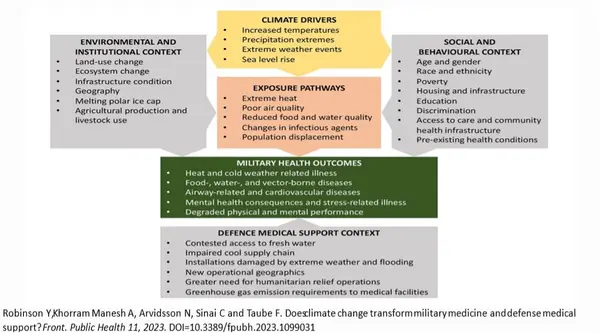
This project investigates the effects of climate on health and on military medical preparedness. The figure below, which is taken from a literature review published within the project, illustrates how the most important climate factors, i.e. increased average temperature, periods of extreme precipitation with subsequent floods, droughts, hurricanes, rising sea level (Climate Drivers) lead to exposure of both civilian and military personnel (exposure pathways) and the consequences this has on military health outcomes (Military Health outcomes). However, the outcome also depends on Social and behavioural Context as well as Environmental and institutional Context.
The box below this text illustrates the effect climate impact is expected to have on the Defence medical logistics and its ability to provide medical support (Defence medical support context); such as limited access to drinking water, deteriorated or broken cold chain, damage to infrastructure due to extreme weather, new geographical areas of operation, increased need for humanitarian aid efforts, increased demands for more climate-adapted medical facilities.
In a study within the project, climate data and medical data from the Swedish task force in Mali have been analyzed. The results from this study show that the majority of the reported injuries were musculoskeletal and were caused by incorrect training and poor ergonomics. The results also show a significantly higher incidence of "heat stress" at high temperatures with high humidity. The combination of high temperature, high humidity, high sun radiation and high visibility resulted in more heat-related illnesses and injuries than during any other periods.
The image illustrates the effect climate impacts are expected to have on defense medical healthcare logistics and its ability to provide medical support (Defence medical suport context) (..). Read more in the box above.
Trust in health care is expected to decline over time, nationally and internationally, due to the costs of health care, an increased dependence on expensive medical technology, and the for-profit health care system. COVID-19 has further eroded trust, and the measures taken to combat the pandemic have highlighted a mistrust in relation to health advice and healthcare providers.
This project will study trust in health care in Italy, which has been hit hard by the pandemic, while its population is experiencing the consequences of a neglected and crumbling national health system. The research will document the dynamics of distrust in situated healthcare interactions that develop between patients and general practitioners in Italy in the aftermath of COVID-19. The study will highlight distrust not only as the absence or lack of trust, but as an interactional and structural resource and a force in its own right. In this way, the project will contribute to debates on the "crisis of confidence" in healthcare. The study will provide information and analysis that will help us understand the complexity of mistrust in times of health crises.
The project leader, Dr Mirko Pasquini, has also been a part of the editorial board of The Lancet Cases in Global Social Medicine that started on November 15th 2025. This case series aims to channel burgeoning collaboration between the critical social sciences and medicine into a conceptual and practical translational social medicine toolkit for responding to the social and structural aspects of health care, confronting health inequities and their causes, and promoting equity in and around health and healthcare.
This project concerns human rights aspects in the events of crisis, such as right to health of the affected populations, right to life, housing, food, water, and to a healthy/safe environment, and how these rights relate to crisis preparedness, such as information and participation of communities in crisis management.
In the event of a release of radioactive substances into the atmosphere from a nuclear accident, nuclear detonation or antagonistic event, there is a risk of internal contamination of humans via inhalation or via contaminated food (including drinking water). To clarify the need for medical interventions, a strategy for measurements, validated measurement methods and a system for follow-up are needed. The project includes investigating the responsibilities of the implementation of the measurements, as well as the development of measurement methods and the choice of measurement instruments.
To maintain strong preparedness for nuclear energy incidents involving small modular reactors (SMRs) that could release radioactive materials into the environment, it is essential to understand which radionuclides are produced, in what quantities, and how they behave if released. The projects involve calculating the radioactive inventories of different reactor types that may be used in future SMR operations, as well as modeling how these substances would disperse in the atmosphere in the event of a release. The purpose is to provide a basis for estimating radiation doses to the public and determining which protective measures may be needed.