Sona researches belonging and works to create it
Doctoral studies can offer a great deal of freedom, but also uncertainty about the future. For Sona Sukiasyan, meeting other doctoral students has become an important part of the journey towards completing her PhD. At the same time, her own research explores how food and food traditions can contribute to identity and a sense of belonging.
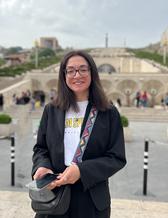
Sona Sukiasyan is a doctoral student in sociology at the University of Gothenburg. When she talks about life as a doctoral student, she repeatedly returns to the fact that it is, in many ways, a unique period in working life.
Research is not the kind of work where the day’s tasks are necessarily finished when the working day ends. During some periods, it can be difficult to maintain a clear boundary between working time and personal time.
“Sometimes work becomes such a big part of your life that it can be difficult to tell where work ends and your personal life begins.”
At the same time, doctoral studies have a fixed time frame. After four or five years, something else awaits, and the question of what comes next is present throughout the journey.
“There is always this uncertainty: What will happen after four or five years? Will I be able to secure funding to continue as a postdoc, or find another job in academia?”
Not being alone in your experiences
For Sona, connecting with other doctoral students has therefore become important. Since 2024, she has chaired the Social Sciences Doctoral Student Council and worked to create more opportunities for doctoral students from across the faculty’s departments to meet.
One example is the doctoral student lunches organised by the council. Participants have been able to discuss topics ranging from the work environment to international opportunities and life after completing a PhD.
But for Sona, the opportunity for doctoral students simply to meet is at least as important as the themes of the lunches.
“It’s a good way to get to know each other, but also to realise that we are not alone in our experiences.”
Connections across departmental boundaries can also benefit research. Doctoral students who study related questions from different perspectives have the opportunity to find one another – and perhaps collaborate in the future.
Food, migration and a sense of home
Most of Sona’s time as a doctoral student, however, naturally revolves around her own research.
In her thesis, she studies migration and diaspora, focusing on Armenians in Sweden. She is particularly interested in how food, food culture and food traditions are connected to identity, a sense of home and belonging. This can involve something as everyday as where food can be bought.
Sona describes how both the range of food available and shopping habits differ between Sweden and Armenia. In Sweden, large supermarket chains dominate, while in Armenia, shops are smaller and people have closer contact with those who produce the food. Some Armenian products are also difficult to find in Sweden, Sona explains.
As a result, food can travel with people across national borders. Someone travelling from Armenia to Sweden might bring products for friends and relatives. People help one another obtain things that would otherwise be difficult to find.
“There is a kind of solidarity in that. People help each other.”
In this way, food becomes more than what is on the plate. It can also help maintain relationships and a sense of connection to another place.
Belonging as a common thread
When Sona talks about her research and her engagement with other doctoral students, the same theme keeps returning: the importance of feeling that you belong.
“It’s important to me that people don’t feel alone or excluded. That there is an environment where you feel safe and can talk to others about your experiences, both good and bad. An environment where you feel at home, in a way.”
It is also her commitment to building a sense of community among doctoral students that has now been recognised. Sona Sukiasyan has been awarded the 2026 Gunnar Svedberg Award, which is presented each year to a student who has worked to improve conditions for students at the University of Gothenburg.
In its citation, the jury highlights, among other things, her work to create meeting places and build bridges between doctoral students from different departments and subject areas. They describe her as a unifying force who has helped create a more inclusive and vibrant study environment.
“It feels really good to have this work recognised. We have put a lot of time into creating more opportunities for doctoral students to connect and collaborate.”
More time for the thesis
After around two years as chair, Sona is now beginning to consider handing over the role to someone else.
Partly, she believes it is important for others to have the opportunity to get involved and contribute new ideas. She also wants to free up more time for the part of doctoral life that has been there in the background all along – her thesis. She expects to remain involved in the doctoral student community, just not to the same extent as before.
And her goal for the remaining years? To write a good thesis, complete her PhD and look back on her time as a doctoral student feeling that all the time and energy she invested was worth it.
Text: Sara Bjurenvall