
New directions in cancer research – from patient involvement to AI
AI can design entirely new proteins for future cancer drugs. Sine Reker Hadrup presented the technology at Sahlgrenska Comprehensive Cancer Centre’s Research Day, which also highlighted patient involvement, new cancer research networks, and better access to health data.
Research Day on 28 September brought together researchers and other staff from the University of Gothenburg and Sahlgrenska University Hospital. The event was organized by Sahlgrenska Comprehensive Cancer Centre (CCC), which works to strengthen the links between research and cancer care.
“This is an important day for research across traditional boundaries, from preclinical to clinical research, both at the hospital and in academia. We presented what we have achieved over the past five years, what we are doing right now, and the new activities we are planning for the future,” says Lars Ny, professor at the Institute of Clinical Sciences and chair of Sahlgrenska CCC’s Research Council.
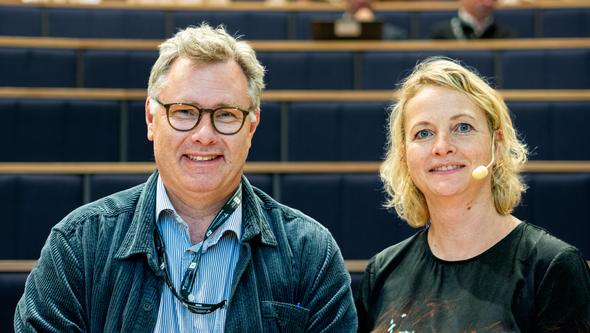
AI designs entirely new proteins
After lunch, Sine Reker Hadrup, professor at the Technical University of Denmark, gave a lecture on how AI can be used to develop future immunotherapies – treatments that help the body’s own immune system fight cancer.
AI models can now predict how proteins fold and what three-dimensional structures they will form. In Sine Reker Hadrup’s research, this knowledge is used to create entirely new proteins with AI that can recognize and bind to specific molecules on the surface of cancer cells.
“AI is essential for designing the structures of these artificial proteins because they do not exist in nature,” says Sine Reker Hadrup.
Helping immune cells find cancer
The proteins do not kill cancer cells themselves. Instead, they can be attached to the patient’s immune cells and act as a kind of search tool. This can help the immune cells find and attack cancer cells carrying the specific target on their surface.
“This opens up opportunities to target structures on the cell surface that we have previously been unable to reach. We can now make things visible that the body normally cannot see.”
The artificial proteins are currently undergoing safety testing, which is required before they can be used to treat patients.

Patients as research partners
Another theme was how patients can become more actively involved in research. This is not limited to clinical trials or research on quality of life. Patients’ experiences can also influence the questions asked in laboratory-based research.
“The patient perspective is relevant even to basic science questions. It can influence what researchers consider important and how these issues are discussed within a research group. But we should not expect patient involvement to become mandatory in all preclinical cancer research,” says Lars Ny.
New cancer research networks
Clinical Academic Groups (CAGs) bring together researchers and clinicians from different fields to address shared questions. The three new pilot groups are a concrete example of what the CCC collaboration can contribute. The groups are intended to create new connections across organizations and make it easier to link research projects with clinical practice.
“We also want to open this up to younger colleagues and the next generation of researchers. That is extremely important. Through the CCC initiative, we are bringing together areas that previously had little insight into each other’s work, allowing us to collaborate in new ways,” says Lars Ny.
Sahlgrenska CCC is also preparing for reaccreditation. In February, an international panel of experts is expected to visit Gothenburg to review its activities and development since the center was accredited five years ago.
Data crucial for AI research
The afternoon session of Research Day also focused on digital infrastructure and opportunities to use large volumes of health data in research. The program included presentations on AI infrastructure at Sahlgrenska University Hospital and within the Västra Götaland Region (VGR), as well as experiences from using AI in research projects at both the hospital and the University.
According to Lars Ny, access to data and the ability to combine information from different technical systems are crucial if AI is to be used on a large scale. He also calls for faster progress and a broader national perspective.
“The rapid development of AI means that timelines for implementation in healthcare and research need to be continuously reassessed. We cannot settle for seven-year timelines in certain strategic areas. If we do, we will fall behind. Patients and their opportunity to receive the very best care must be our guiding principle, with new diagnostic methods and treatments becoming available within a reasonable timeframe.”
Text: Jakob Lundberg
Sahlgrenska Comprehensive Cancer Centre (Sahlgrenska CCC) was established to meet the need for coordination of cancer care and research. The aim is to bring together the highest level of clinical expertise and cutting-edge research to provide patients with the best possible care.
In September 2026, Sahlgrenska CCC was elevated to the highest level in the Organisation of European Cancer Institutes’ classification of research at European cancer centres. The designation is awarded to cancer centres that combine the highest quality of care with strong research and clinical trials.