
Collaborations in Chile and Japan broaden Marica’s aquaculture research
Doctoral student Marica Andersson is researching how aquaculture can become more sustainable. Through the international networks ACCESS and MIRAI, she has collaborated with researchers in Chile and Japan, learned new methods and built an international network of contacts.
Marica Andersson is a doctoral student at the Department of Biological and Environmental Sciences, where she researches sustainable methods for fish farming.
“Aquaculture is the fastest-growing food production sector in the world, and farmed seafood now accounts for a larger share than wild-caught seafood. But there are still a number of challenges,” she says.
One such challenge is managing the nutrients left over from feed and fish waste. Marica has experimented with co-farming rainbow trout together with seaweed and the aquatic plant duckweed to investigate how they absorb nutrients and how this type of integrated farming affects fish welfare.
During her time as a doctoral student, Marica has been involved in two international networks in which the University of Gothenburg participates: the Swedish-Chilean Academic Collaboration Chile Sweden (ACCESS) and the Swedish-Japanese network MIRAI.
“Both Chile and Japan are considerably further ahead than Sweden when it comes to aquaculture. Their production is much larger, and yet many of the challenges they face are surprisingly similar to ours,” she says.
New methods through exchange with Chile
Through the networks, Marica has connected with researchers and doctoral students from both countries and had the opportunity to develop her project together with them. Among other things, she has participated in doctoral student exchanges and research forums in Chile.
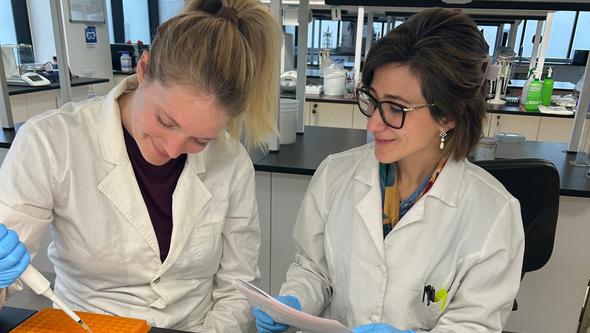
“Last spring, three Chilean doctoral students came here. They joined us in the laboratories and learned about our methods. We work a lot with tissues and farming systems, while they work more with cell cultures and molecular biology.”
This summer, it was Marica’s turn to travel to Pontificia Universidad Católica de Chile. She brought samples from one of her experiments in Gothenburg with her.
“I brought a box of samples that we analysed using their methods to assess fish welfare. Our different methods complement each other.”
Testing new technology from Japan
Marica has also participated in a project with engineers and researchers at Hiroshima University. The project involves developing buoys that measure factors such as temperature and pH levels in the water. The information can be used to adapt aquaculture to local conditions, and Marica has brought a buoy back with her to test in Sweden.
This autumn, she is also taking part in the MIRAI Global Solutions Olympiad, where students and doctoral students from Japan and Sweden work together on solutions to global challenges.
International contacts bring new perspectives
Marica is now nearing the end of her doctoral studies and is writing her thesis. Her experiments show that farming fish together with algae or duckweed allows more of the nutrients from fish farming to be utilised and reduces nitrogenous waste production.
Her international collaborations have given her a new perspective on what it is like to be a doctoral student in Sweden and at the University of Gothenburg.
“We have clear guidelines and conditions regarding things such as employment and salary, and many opportunities to take part in exchanges and conferences. Here at the Faculty of Science, we also have access to well-functioning research facilities and modern, well-equipped laboratories.”
At the same time, the collaborations have given Marica an international network of contacts and insight into how research is conducted and how international collaborations are developed.
“I’m still early in my career, and it has been valuable for my development to see how we can work together to address challenges. It has been interesting to see that we face similar research challenges in different parts of the world and to realise that you are part of a global research community.”
Text: Hanna Wedel
The University of Gothenburg participates in several international networks and projects where researchers, doctoral students and students can exchange knowledge, methods and perspectives across national borders. By bringing together experiences from different parts of the world, these networks can also contribute to new solutions to shared global challenges.