Research Group in Chronic Obstructive Pulmonary Disease
Our group in Chronic Obstructive Pulmonary Disease (COPD) led by Dr Lowie Vanfleteren carries out research related to diagnoses and treatment of COPD patients in order to improve the patients’ quality of life.
Regional VGR ALF funding, Region Västra Götaland, Astra Zeneca, CICERO, Vinnova, the Kamprad Family Foundation, GSK, Sanofi
Our group in Chronic Obstructive Pulmonary Disease (COPD) led by Dr Lowie Vanfleteren carries out research related to diagnoses and treatment of COPD patients in order to improve the patients’ quality of life. Our aim is also to digitalize and personalize the healthcare system and new methods to enhance patient-centred approach. There are many research and development projects going on in collaboration with academies and other local and international institutions.
About us
Plans for the COPD centre began in 2015 and today we are a recognized centre for person-centred care, with team-based care and a developed digital support for the care of our patients, which is unique. The research activity at the COPD centre is undergoing strong growth with support of new research grants.
Our goal is to become world leading within sharing knowledge, patient participation and collaboration with primary care and across specialities to benefit the patients' health and quality of life. To provide the best care for all the diagnoses that often are associated with COPD will play a crucial role in our endeavor. The National Board of Health and Welfare's guidelines for care are fully applied to our centre. You as patient are at the centre of care, will also contribute to the care design and implementation, including quality work and research.
We develop care of COPD with the idea of providing the best possible coordinated care to increase the well-being and health of our patients. We aim to reach this goal through a multidisciplinary team-based care in collaboration between care and research where all patients are prepared to contribute with their knowledge of how care could be improved.
Patient-centred care: The patient is involved in all stages and has full access directly through his/her mobile phone to all information, including planning ahead.
Integration: The patient's care plan should follow the patient's entire path through the healthcare system over all boundaries: care units, care levels and specialties.
Standards: All information management is based on standards in order to allow data integration between different systems.
Interoperability:The entire store of information is based on structured data to facilitate security, information sharing and analysis in research and quality work.
Research: All parts of the insertion are under continuous concept evaluation, such as real-time data, real world data and personalized medicine. The architecture of the digital platform is open and fully integrated with other systems used locally. Constant development and improvement are a core of our work.
Patient’s perspective
Good healthcare provides the patient with help beyond the support needed within the current diagnosis. Our information platform meets the needs without limitations for those with multiple diagnoses, multiple health contacts and in the case of chronic diseases. Therefore, integration of health support and care planning for the patient is needed while the care is supported for quality work and research.
Patient participation means that the patient continuously knows what is planned and has an opportunity to provide and receive information from the care givers. Our digitalized care support offers the patient a very strong position in the planning and implementation of care. The patient has easy access to the provided care plans in his/her mobile telephone and can directly adjust it.
A patient with better knowledge of his or her illness, strengthened by the support by the care we give, understands what is needed, will feel better and have a better quality of life. Therefore, we educate our patients, support lifestyle changes and provide psychological and social support in addition to the medical treatment.
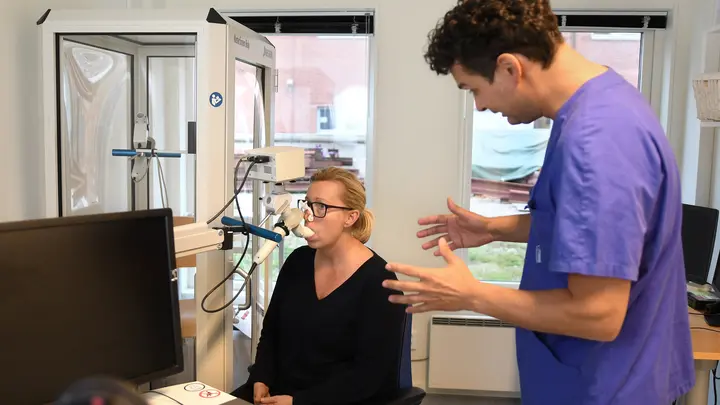
A woman performs a lung function test, also called spirometry, by inhaling and exhaling trough a nozzle, supervised by care staff.
Multidisciplinary teams
The COPD centre offers a structured interprofessional care focusing at accurate and interprofessional management of the COPD. The management program is based on Swedish best practice recommendations for patients with COPD which entails correct diagnosis, correct treatment and exacerbation management. The comprehensive care empowers the individualized approach in for of care plans, use of patient-tailored devices and emphasizes patients’ education. All support is given by specialist as a multidisciplinary team, including pulmonologist, dietician, social counsellor, specialized nurse, physiotherapist and occupational therapist.
The specialists in our multidisciplinary teams
Pulmonologists are the doctors that ensure if you have COPD and assess its severity. They also make an assessment of whether you may have suffered from other diseases that can often be associated with COPD and tobacco smoking, such as heart disease and osteoporosis. At the visit, together we go through your treatment options (including your respiratory medications) and make sure that you receive the medicines that are suitable for you.
There are four asthma/COPD specialized nurses at the COPD centre. They work actively with consultations and support with smoking cessation, both through patient visits and telephone contact. Nurses will go through inhalation techniques with you, do follow-ups after a deterioration period, take samples and perform certain treatments.
At the COPD centre, the nurses are responsible for counselling patients like you through phone contact and answering medical matters via the e-service 1177 (link to the 1177 website, in Swedish). Nurses can also visit you if necessary, for advice and support matter. There are several ongoing research studies that are being conducted at the COPD centre where the nurses play an active role.
There are three nursing assistants working at the COPD centre that are responsible for booking of all your appointments. You will meet them on your first visit. They are responsible for taking samples, checking your saturation and blood pressure, performing an ECG and measuring your height and weight.
When you come to us, we will ask you to fill in some questionnaires that help us with diagnosis and measuring further outcomes. We will provide you also with a Watch-PAT, which is an ambulatory equipment for diagnostic and measurement of sleep apnea.
At the COPD centre every patient performs a lung function test, also called spirometry. This is managed by our biomedical scientist, who specializes in various medical examination- and analysis methods and works on conducting the test in a standardized way and interpreting the results. All to deliver a good experience for the patient and keep a high quality of the examination.
The physiotherapist at the COPD centre will test your physical capacity through a 6-minute walk test. At the appointment we will discuss your physical activities and possible training levels. You can also receive help with a personalized training schedule, to be able to work out at home or join a training group with other COPD patients. Together we will also go through breathing techniques and methods to help you eliminate mucus.
Together with the patient, the dietitian reviews the nutritional status and asks questions about appetite and eating habits. We help the patient to find solutions that work in everyday life. There are many different problems around eating habits and weight, ranging from underweight to obesity. Weight loss is common in patients with COPD and can result in low BMI and decreased muscle mass.
At the COPD centre all patients have access to a dietitian who helps with personalized nutrition advice. We also perform a measurement of body composition where we get an idea of the patient's fat and muscle mass.
When you as a patient at the COPD centre visit your occupational therapist, our focus is on facilitating everyday activities. We will go through the daily activities that are important to improve and facilitate in order to enhance the quality of life.
The measures we focus on, are primarily energy-saving strategies and breathing techniques that can be used in your daily activities. We also offer the opportunity to participate in a breathing group where we practice breathing techniques with various activities together with other COPD patients.
On the visit to the social counsellor, the focus is on patient’s psychosocial health. "How do you feel in your present situation?" is a relevant question. Chronic illness not only affects physical health but can affect the life situation in several ways.
With support talks and other actions we try to make life easier for patients with COPD, primarily for persons who have the diagnosis, but also for their relatives. Support and actions are of course adapted from what the person with COPD her-/himself considers to be most important.
Research
Ongoing research and development projects
The COPD centre is research oriented and research is a strong part of our routine. We constantly aim to improve the healthcare system, diagnostics, outcomes, and develop new methods to improve patients' quality of life. There are many research and development projects.
If you wish to participate as research person in our project, please contact Maria Segeda. Phone: +46 761 14 30 72.
Care4COPD is a longitudinal pragmatic clinical study aiming to document the effects of multidisciplinary management of COPD and comorbidities through the application of digital care plans tailored to individual patient needs. Acute COPD exacerbations indicate a risk for repeated exacerbations, hospitalizations, and mortality, highlighting the need for careful management of these episodes and associated multimorbidity.
The study aims to investigate whether accurate diagnosis, severity assessment, and long-term interdisciplinary management will lead to fewer hospital admissions, reduced healthcare utilization, and improved quality of life for patients. The study is supported by VGR-ALF government funding and the Kamprad Family Foundation.
MONITOR is a pilot study involving 70 patients using a tablet for home-based communication and remote monitoring in collaboration with the COPD Center. By evaluating user-friendliness and patient preferences regarding modern technology, the study aims to establish a more personalized care approach for COPD patients. Patients perform regular measurements such as blood pressure, pulse, and weight, and complete questionnaires. When values fall outside the patient’s individual alert limits, a signal is sent to the COPD Center, which responds based on the data..
For COPD patients, increasing physical capacity and activity levels is essential to improving quality of life. Traditional pulmonary rehabilitation typically takes place in hospitals under physiotherapist supervision, but barriers such as transportation and accessibility exist. Therefore, the COPD Center has introduced “Exergaming,” a home-based rehabilitation method combining gaming with physical exercise. This offers an effective and engaging way to exercise at home, supported by telemonitored physiotherapist guidance, providing a mix of independence and professional support. This is an open label, randomized controlled clinical study investigating whether home-based rehabilitation program is associated with improved health-related quality of life, exercise capacity, physical activity levels and body composition, less COPD-exacerbations and lower healthcare utilization. Patient inclusion has now been completed, and data analysis is currently ongoing.
Epidemiological studies report that about 75% of COPD patients experience nocturnal symptoms of the disease including increased dyspnea and cough. It is important for patients with COPD to optimize the efficacy of respiratory function, also while sleeping.
Elevated body position (>30° from supine) has been shown to improve oxygenation, functional residual capacity, and reduce the work of breathing in patients with respiratory issues. Upright or flexed trunk positions may also benefit COPD patients at night.
In this clinical, cross-over study we evaluate if adjusted sleeping position with elevated trunk improves the quality of sleep in patients with COPD.
The primary aim of the Sleep Positioning study is to evaluate whether adjusted sleep positioning with an elevated upper body improves sleep quality in COPD patients. Secondary aims include investigating whether elevated positioning is associated with improved sleep efficiency and oxygenation, lower heart rate, and improved breathing patterns. Additional goals are to assess whether elevated sleep positioning reduces COPD-related fatigue and symptoms during both sleep and wakefulness, and whether it leads to more daytime activity and fewer rest periods in patients' everyday lives. Patient inclusion has now been completed, and data analysis is currently ongoing.
COPD is a major source of morbidity, mortality and healthcare costs in Western societies. Importantly, cardiovascular comorbidity, here specifically ischemic heart disease and heart failure, strongly associates with survival in COPD. Increased vascular stiffness due to systemic inflammation in COPD has been highlighted as a specific risk marker for cardiovascular disease in COPD. However, until now, no systematic research has investigated vascular stiffness during sleep as a potential cardiovascular risk factor in COPD and if sleep provides a time window for therapeutic intervention with the goal to improve CV function during daytime.
In this study new methods for non-invasive and continuous assessments of cardiovascular (finger photoplethysmography) and respiratory (flow sensor) function during sleep are used. The methods (oximeter probe, light flow sensor applied over nose and mouth) can be easily applied in clinical routine by means of ambulatory recording systems for simple detection of dysfunction during sleep in COPD patients (e.g. sleep screening devices). If the proposed research generates functional insights, these are technologies that may be rapidly updated for use in various clinical settings such as in the hospital, in outpatient clinics or for telemedicine approaches in patients’ home (e.g. WatchPAT, mobile phone and blue tooth-based technology).
Portable recording instruments to monitor treatment effects of positive pressure ventilation (CPAP/BiLevel PAP) therapy or nasal high flow treatment applied in the home are of very high clinical relevance. If PAP therapy improves vascular function and reduces inflammatory load in a subgroup of COPD patients, new therapeutic algorithms and outcome studies may need to be considered.
A collaborative initiative involving healthcare, academia, and industry, aiming to develop a digital care-support platform for individual-centered medicine. The goal is to create a unified information structure that enables clinical process support, clinical documentation, and clinical research within a single integrated solution, where all collected data can be used both for individual patient care and for generating new clinical knowledge. The project is based on several key innovations, including workflows co-designed by patients and healthcare providers, a transaction engine for care plans, a new common data model, harmonized terminology across diagnoses including outcome measures, FAIR-compliant technology enabling remote algorithm-based analysis, and alignment with established international standards. The project is supported by Vinnova / Swelife.
National Collaborations
The study is conducted in collaboration with Karolinska Institutet, Stockholm.
Bronchoalveolar investigations of never-smokers with chronic obstruction from the Swedish CArdio-Pulmonary bioImage is a national multicenter study. It is based on the population study SCAPIS from which researchers are recruited. Tobacco smoking is the most common cause of COPD, but several national and international studies have shown that 20-25% of those affected by COPD have never smoked. This patient group is still largely unexplored.
The goal of Broncho-SCAPIS is to find factors associated with the development of COPD in never-smokers, understand how common it is and what mechanisms are behind it. Approximately 600-700 affected people are estimated to be included in the screening study.
There are four control groups: never-smoker with normal lung function, smoker with normal lung function, former smoker with COPD and smoker with COPD. Some of these will also undergo a bronchoscopy to collect samples.
The primary objective of the study is to identify molecular sub-phenotypes of never-smokers with COPD, specifically by correlating clinical phenotypes multi-molecular omics profiling from multiple lung compartments of early stage COPD patients compared to healthy and at-risk control populations.
Secondary goals involve identification of subsets of prognostic/diagnostic biomarkers for classification of the defined subgroups, as well as relevant pharmaceutical targets. The hope is to find the best treatment for COPD sufferers who have never smoked. The drugs available today are mainly tested on smokers with COPD. Patient inclusion in this study has now been completed, and data analysis is currently ongoing.
BRONCHIOLE is a national study on beta-blockade in COPD, initiated by the Department of Cardiology and Respiratory Medicine at Örebro University Hospital. With 1,700 participants, the study examines the effectiveness of beta-blockers compared to standard treatment. Despite COPD's high prevalence in Sweden and its association with cardiovascular disease, the potential benefits of beta-blockers for patients with or without cardiovascular complications are being explored. After optimized treatment, patients are randomized to receive either standard therapy or additional metoprolol. Follow-up and data collection occur at multiple timepoints and Swedish sites, including the COPD Center. Patient inclusion has now been completed, and data analysis is currently ongoing.
Within SNAR, the COPD Centre collaborates nationally to improve understanding of early lung function patterns in COPD. Our current research focuses on identifying and characterizing pre-COPD and PRISm (Preserved Ratio Impaired Spirometry) among patients in the register. These groups may represent early forms of the disease but are still poorly understood.
Using data from SNAR, we investigate how common these early spirometric patterns are, their symptom burden, and whether they are linked to worse outcomes such as exacerbations, hospitalizations, cardiovascular events and mortality. The large number of patients in SNAR (approximately 50 000–100 000 individuals) provides strong statistical power and allows for detailed analyses of disease progression and risk factors. This project is conducted in close collaboration with the national leadership of SNAR and partners at Umeå University and the University of Gothenburg.
International Collaborations
CICERO (Collaboration In COPD ExaceRbatiOns) is a clinical research network supported by the European Respiratory Society, connecting academia, industry, patient representatives, and independent international scientific advisors.
CATALINA, embedded within CICERO, involves 20 clinical centers across 8 European countries. These centers, along with their associated expert clinical researchers and young investigators, drive the collection of prospective data and samples. The study focuses on patients hospitalized due to acute exacerbations of COPD. The primary aim is to generate high-quality clinical data (including biological samples) representing a European COPD population across all age groups and disease stages. A secondary aim is to deepen understanding of disease progression, mechanisms, and prognosis. The study includes adults with confirmed COPD hospitalized due to suspected acute exacerbations.
CADSET (Chronic Airway DiSeases Early sTratification) is a pan-European network advancing clinical research in chronic airway diseases. The hypothesis is that asthma and COPD exist on a continuum with shared mechanisms, known as endotypes, which can be identified using biomarkers. These biomarkers may represent new treatment targets and enable more individualized therapy for patients with chronic airway diseases.
Clinical Trials
RESOLUTE is an international phase III study conducted in partnership with AstraZeneca. It focuses on the efficacy and safety of benralizumab for treating moderate to severe COPD. Although benralizumab is already approved for asthma, this study investigates its benefits in COPD patients. Participants with frequent COPD exacerbations and high eosinophil levels are included. The goal is to determine whether benralizumab improves COPD control alongside current inhalation therapies. The study lasts approximately four years and involves around 868 patients globally.
OBERON is an international phase III study in partnership with AstraZeneca, focused on the efficacy and safety of MEDI3506 in COPD patients with symptoms and previous exacerbations. Approximately 1,272 participants, who have optimized inhalation therapy and experienced at least one exacerbation, are stratified based on region, inhalation therapy (dual vs. triple), and smoking status (current vs. former smokers).
PROSPERO is a Phase III, multicentre, randomized, double-blind, placebo-controlled extension study conducted in collaboration with AstraZeneca. The study evaluates the long-term efficacy and safety of tozorakimab as an add-on to standard of care in participants with COPD and a history of exacerbations. Tozorakimab is a monoclonal antibody targeting IL-33, a key cytokine involved in airway inflammation. By inhibiting upstream inflammatory pathways, it may provide sustained benefit in reducing COPD exacerbations, particularly in patients with chronic inflammation and a history of frequent exacerbations. The main objective is to assess whether tozorakimab reduces the risk and rate of severe COPD exacerbations over a prolonged treatment period. Additional assessments include moderate-to-severe exacerbations, time to all-cause death, pharmacokinetics, immunogenicity, and long-term safety. The study plans to include up to 2544 participants. Treatment is administered every four weeks, with the option for self-administration. Results will be combined with data from previous studies to support the potential of tozorakimab as a long-term maintenance therapy for COPD.
JOURNEY is an international Phase III clinical trial conducted in collaboration with AstraZeneca, designed to evaluate the efficacy and safety of tezepelumab as an add-on therapy for adults with moderate to very severe COPD. Tezepelumab is a monoclonal antibody that inhibits thymic stromal lymphopoietin (TSLP), a key upstream cytokine that drives multiple inflammatory pathways involved in respiratory diseases. The main objective is to determine whether tezepelumab can reduce the annual rate of moderate or severe COPD exacerbations and improve lung function and quality of life in a COPD population where treatment options remain limited.
Digitalized healthcare
The patient's path through care is characterized by many meetings and efforts from different professions. Coordination and knowledge sharing are key-words for getting the highest quality of care and support to the patient, whether at home, primary care or in specialist care. The care plans we develop should accompany the patient’s journey within the healthcare system. Highly specialized care should reach all patients on the right indication. The work we do is well-received nationally and we have increasing funding for our research. The results are better when care and research go together. A digitalized working instrument supports our model.
Information serving different purposes
Our developed digitalized care support provides data directly to the patient's journal. The information can be used not only by healthcare providers and patients, but also for research purposes and outcomes measures for quality and development. We develop methods to make it easier to conduct clinical trials directly in the working routines. This modern approach enables all professions to participate in the research and share the multidisciplinary knowledge. The real-time data sharing system provides immediately usable and professional access to the data for every end user.
Information environment integrating new methods
The principle is based on the patient's path through the healthcare system where whatever can be planned based on e.g. care programs, bookings, the patient needs and desires can be described in a dynamic care plan that is shared between the patient and the care provider. At the same time, not everything can be foreseen, and the system must also be able to cope with the unexpected. To reduce the workload, most of the documentation is automatically based on clinical notes during the process work. All information is structured and based on standardized terms at a national and local level. This means that data that is automatically created fits into documentation, quality work and research and that the information environment can integrate new methods gradually. The platform's data is handled so that it is very easy to follow the laws surrounding individual’s data (e.g. GDPR).
Structured information flow
The patient's path through the healthcare system should be characterized by continuity, security, knowledge sharing, good planning and all measures must have scientific evidence. The best care based on individual needs should reach all patients. Most of all, improved continuity of healthcare in chronic diseases is needed. A well-thought-out information environment where everything is shared with the patient and where the information follows the patient's journey through the care is the basis. It provides better sharing of the knowledge between everyone who works in the healthcare sector. Since all information is structured, it can be used directly for both quality work, development and research.
Vanfleteren LE, Beghe B, Andersson A, Hansson D, Fabbri LM, Grote L. Multimorbidity in COPD, does sleep matter? Eur J Intern Med. 2020 Mar;73:7-15. doi: 10.1016/j.ejim.2019.12.032. Epub 2020 Jan 21. Review
Innovationsplattformen ingår i nya regionala processteamet KOL (news article on the Region Västra Götaland's web site for their Innovation Platform, published in 2018)