"Flexible Surge Capacity" is a new concept based on international guidelines. It refers to the extra and adjustable human and material resources that can be mobilized in the event of disasters and serious events. This by activating non-professional but trained personnel, as well as various accepted facilities in a fast, flexible, and productive way.
Public health and public education play an essential role in obtaining such flexibility.
Background:
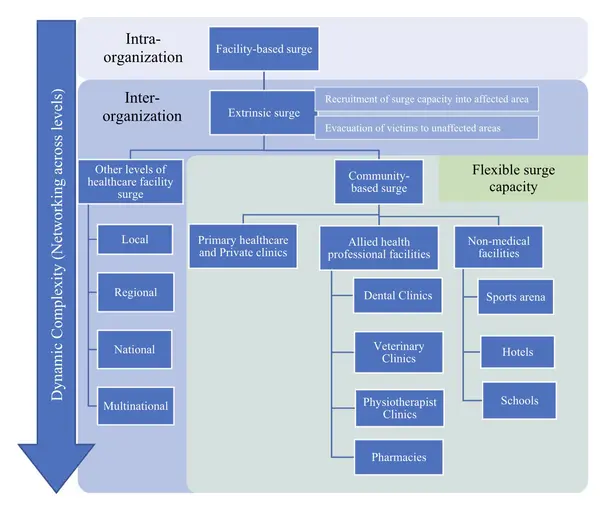
Failed attempts to improve healthcare delivery to communities show distinct flaws that have a higher impact during a major incident or disaster (MID). In disasters and emergencies, the first attempt is to surge the existing capacity. From a healthcare perspective, this can be done in a vertical procedure within the organization. However, resources must be obtained from elsewhere if they are not enough. That is other healthcare organizations or facilities. Any failure to do so will necessitate collaboration with communities and within the existing society, regarding the vital elements of the Surge Capacity, i.e., Staff, Stuff, structure, and system.
Purpose: To create, test and validate foundations for an adaptable resource flow.This is through collaboration with other parties, especially the municipalities, to use society's material and human capabilities.And thereby improve the care of the injured and reduce the medical consequences in crisis and disasters.
Fig. 1, page 54: Surge capacity framework incorporating the flexible surge capacity concept. Source Phattharapornjaroen et al. (2022a). Phattharapornjaroen et al. Assessing Thai Hospitals’ Evacuation Preparedness Using the Flexible Surge Capacity Concept
The starting point: The project has been ongoing since 2019 when the first description was published and continued by implementing parts of the concept in Sweden and Thailand.
This is about how the municipalities' resources can be used and especially during two distinct occasions;1) when a hospital must be evacuated (explosions or threats due to military intervention) and 2) when a hospital must be isolated (Pandemics or major infections).
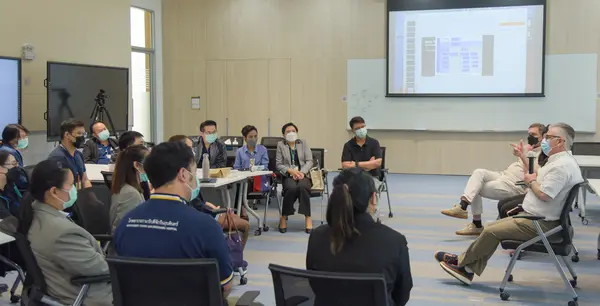
On location in Ramadhibodi Chakri Naruebodindra Hospital, Chakri Naruebodindra Medical Institute (CNMI), Faculty of medicine Ramathibodi Hospital, Mahidol University, Bangkok, Thailand; Amir Khorram-Manesh, Eric Carlström, Phatthranit Phattharapornjaroen.
Research in this area requires a pragmatic approach and therefore consists of both qualitative and quantitative methods.
Systematic literature reviews, qualitative and quantitative methods, using so-called collaborative factors and simulation exercises.
The overall project contains several sub-projects, therefore results and conclusions will be published continuously.
Evidence so far: Previous studies have been carried out in the Västra Götaland region in Sweden and in Bangkok, Thailand. In these studies the concept has been tested, a conceptual and theoretical framework has been created. Here, society and healthcare cooperation have been tested during the covid-19 pandemic, evacuation plans for hospitals in Thailand have been evaluated and a hospital evacuation simulation has been carried out with the help of multi-professional participants.
"Flexible Surge Capacity" is a new concept based on international guidelines. We know today that public health and public education play an important role in achieving such flexibility.
Khorram-Manesh, A. (2020). Flexible surge capacity–public health, public education, and disaster management. Health promotion perspectives, 10 (3), 175.
Phattharapornjaroen, P., Glantz, V., Carlström, E., Dahlén Holmqvist, L., & Khorram-Manesh, A. (2020). Alternative leadership in flexible surge capacity—The perceived impact of tabletop simulation exercises on Thai emergency physicians' capability to manage a major incident.Sustainability, 12(15), 6216.
Glantz, V., Phattharapornjaroen, P., Carlström, E., & Khorram-Manesh, A. (2020). Regional flexible surge capacity—A flexible response system. Sustainability, 12(15), 5984.
Phattharapornjaroen, P., Glantz, V., Carlström, E., Dahlén Holmqvist, L., Sittichanbuncha, Y., & Khorram-Manesh, A. (2021). The feasibility of implementing the flexible surge capacity concept in Bangkok: Willing participants and educational gaps.International Journal of Environmental Research and Public Health, 18(15), 7793.
Phattharapornjaroen, P., Carlström, E., & Khorram-Manesh, A. (2022). Developing a conceptual framework for flexible surge capacity based on complexity and collaborative theoretical frameworks. Public Health, 208, 46-51.
Phattharapornjaroen, P., Carlström, E., Sivarak, O., Tansuwannarat, P., Chalermdamrichai, P., Sittichanbuncha, Y., ... & Khorram-Manesh, A. (2022). Community-based response to the COVID-19 pandemic: a case study of a home isolation center using flexible surge capacity. Public Health, 211, 29-36.