Circular grassroots innovations for sustainable and inclusive urban transitions
Short description
The project examines the challenges and opportunities that urban circular grassroots innovations encounter to create, maintain and scale their solutions for sustainable and inclusive transitions from below. Researchers from six universities in the cities of Amsterdam, Barcelona, Nantes and Gothenburg participates together with grassroots organisations and initiatives from the cities.
Project contacts
- Maria Jose Zapata Campos, Professor of Management and Organization, Senior lecturer in Global Development Studies, PI Gothenburg
- Federico Savini, Associate Professor, PI Amsterdam
f.savini@uva.nl - Blanca Callén, Assistant Professor, PI Barcelona
blanca.callen@uvic.cat - Federico Demaria, Associate Professor, PI Barcelona
federico.demaria@ub.edu - Jean-Baptiste Bahers, Professor, PI Nantes
jeanbaptiste.Bahers@univ-nantes.fr
Symposium: Circular Grassroots - Infrastructures of Care and Postgrowth Urban Transformations
The research project will host a symposium at the School of Global Studies in Gothenburg on 7-8 December 2026. It will be a convivial gathering on circular grassroots initiatives, care, commoning, justice, and postgrowth urban transformations.
Over the last three years, the Circular Grassroots project has explored how grassroots initiatives create, sustain, and transform urban life through practices of repair, reuse, redistribution, sharing, and collective care. Drawing on research in Amsterdam, Barcelona, Gothenburg, and Nantes, we have examined how these initiatives navigate questions of space, governance, and inclusivity, while contributing to more socially and environmentally just urban futures.
Circular grassroots initiatives generate significant environmental, social, and democratic value. They reduce waste, extend the lifespan of materials, support livelihoods, create infrastructures of care, and foster participation and learning. Yet despite these contributions, they often remain invisible, under-supported, and poorly understood. Their everyday work reveals both the possibilities and the tensions of grassroots action: between autonomy and institutionalisation, inclusion and exclusion, experimentation and durability, subsistence and ideology, transformation and stabilisation.
The symposium aims to bring together scholars working on related themes, including material circularity, commons, care, grassroots initiatives, postgrowth, alternative economies, social and solidarity economy, repair and reuse cultures, and environmental justice.
We envision an informal gathering with a limited number of participants will present ongoing work, while others will act as discussants and conversation partners. We hope to create a space for collective reflection, intellectual exchange, and future collaborations around the challenges and possibilities of grassroots-led socio-ecological transformations.
Possible themes for discussion include, but are not limited to:
- Circular grassroots initiatives and postgrowth transformations
- Infrastructures of care and commoning
- Subsistence circularities and socio-metabolic inequalities
- Repair, reuse, and sharing cultures
- Grassroots governance and public-common partnerships
- Space, visibility, and the right to the city
- Intersectionality, inclusion, and environmental justice
- Grassroots valuation and alternative economies
- Grassroots paradoxes and the politics of transformation
The symposium will take place over one and a half days and will include presentations, collective discussions, shared meals, and opportunities for informal exchange.
More practical information and a provisional programme will follow shortly.
Please contact María José Zapata Campos and Patrik Zapata if you want to join.
Circular Grassroots Webinar Series
In the spring of 2026, the Circular Grassroots project convened a series of four webinars focusing on metabolic contributions, environmental conflicts and contestation, value creation beyond monetary valuation, and space governance regimes associated with grassroots initiatives for just post-growth cities.
The webinar series brought together insights from the Circular Grassroots research project, funded by the Driving Urban Transitions (DUT) programme, alongside perspectives from grassroots activists, municipal officers, politicians, and leading researchers in the field. Contributions draw on experiences from four European frontrunner cities, Amsterdam, Barcelona, Nantes, and Gothenburg, while also engaging a broader range of voices and expertise.
Take part in the webinars via the links below.
- Webinar 1: Grassroots metabolisms
Watch the film of the webinar (youtube) - Webinar 2: Environmental Conflicts and Grassroots Contestation
Book Launch Event: “Contested Waste: Environmental Conflicts and Waste Picker Resistance in the Global South”
Watch the film of the webinar (youtube) - Webinar 3: What Gets Valued? Circular Grassroots Beyond Monetary Value
Watch the film of the webinar (youtube) - Webinar 4: Grassroots Spatial Governance
Film of the webinar (youtube)
Background
The project aims at examining the challenges and opportunities that urban circular grassroots innovations encounter to create, maintain and scale their solutions for sustainable and inclusive transitions from below. Cities are spaces of overconsumption, waste-intensive production, and high environmental footprints, but also hubs for creativity and innovation. Citizens experiment with a wealth of innovations to address the challenge of a steady consumption growth and overuse of resources. Despite their contributions further research is necessary to investigate the challenges and opportunities to diffuse these practices in terms of:
a) space (in central/periurban city districts),
b) collaborative and democratic arenas among local government, urban planners and grassroots organizations,
c) inclusivity and scalability of the grassroots initiatives (challenges to meet their ambitions, grow, replicate and expand their sharing/circularity practices).
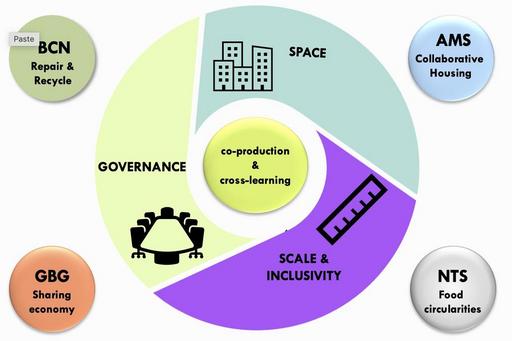
How we work
The project adopts an inter/transdisciplinary and participatory action-research approach in Amsterdam, Barcelona, Gothenburg and Nantes, building on our previous research from several disciplines (sociology, human geography, urban planning, social psychology, consumption, business and public administration) and areas (repairing, housing, food, recycling). The project supports the scaling of the innovations by facilitating knowledge co-production among activists, social enterprises, scholars and policymakers.