
Building bridges between the worlds of mathematics
Douglas Molin, a doctoral student in mathematical sciences, is adding new pieces to the puzzle of the prestigious Langlands program – and he is one of only a few researchers in Sweden within his field. His thesis brings together two mathematical worlds: number theory and geometry. It is based on a mathematical statement formulated almost 400 years ago.
IN 1637, THE FRENCH amateur mathematician Pierre de Fermat noted down a statement in the margin of a book. His apparently simple theorem – which states that there are no positive integer solutions to the equation xn+yn=zn if the integer n is greater than 2 – was of great significance to the development of number theory, and puzzled mathematicians for centuries. It was not until 1995 that the British mathematician Andrew Wiles succeeded in presenting a proof of the theorem, which by then had led to a whole host of new ideas and theories.
“The importance of Fermat’s Last Theorem cannot be overstated,” emphasises Douglas. “This question has guided much of today’s algebraic number theory. The proof and the work produced by Wiles and his colleagues were also the starting point for further mathematical offshoots.”
HOW WILES’S GROUNDBREAKING ideas can be used to prove other mathematical theorems is now a research field in its own right – and one that Douglas has devoted countless hours of research to exploring. The field is part of the so-called Langlands program, which links together number theory and geometry – two very different areas of mathematics.
“The Langlands program is about linking different forms of symmetries, and seeing how a problem in one mathematical world can be reinterpreted in a different mathematical world.”
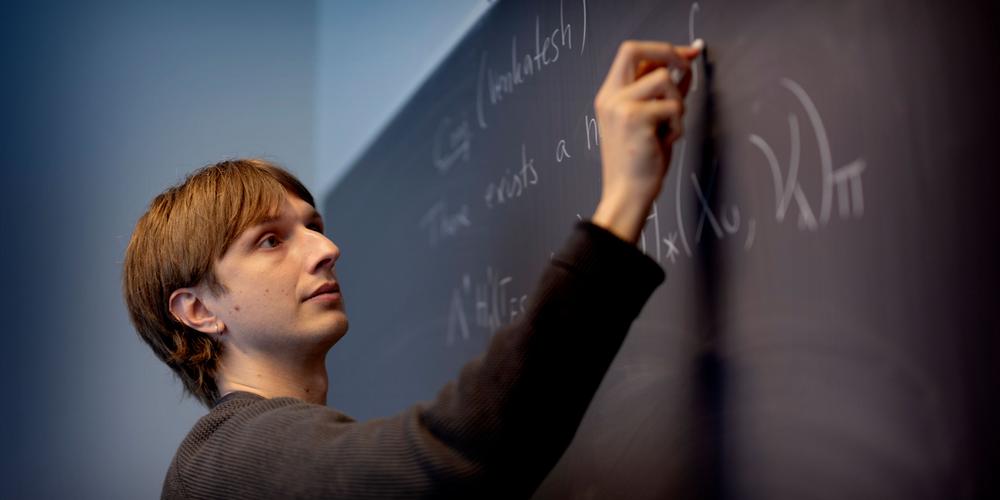
Douglas’s own research has already contributed towards theories within the Langlands program. The ambition of his thesis is to increase our understanding of some of the methods involved in Wiles’s proof of Fermat’s Last Theorem.
“In Wiles’s work, there is geometric reasoning where the geometry is understandable. But in other cases, the geometry becomes highly complex, and more sophisticated methods are needed to capture the more intricate geometry. That’s where my research comes in.”
IN ORDER TO DO SO, Douglas focuses on a mathematical statement by the Australian mathematician Akshay Venkatesh, which describes this complex geometry. Throughout his doctoral studies, he has attempted to prove that what Venkatesh claims in his thesis is true – with as much generality as possible. And he has taken important steps along the way.
“I’ve proved new things about Venkatesh’s problem that weren’t previously known. So yes, you could say that I’ve created something new within the theoretical framework of the Langlands program, and hopefully I’ve contributed towards new insights into complex geometry.”
Douglas’s path to the world of research was far from straightforward, although he has always been fascinated by mathematics. His upper secondary studies focused on his interest in music, after which he changed direction to work as a doctor. But when he took a basic science course at the University of Gothenburg and was reintroduced to mathematics, the pieces fell into place.
“I’m pretty stubborn, and I think I’m attracted by the fact that mathematics is so complex – it feels so good when you finally understand! For me, mathematics is a bit like a language with abstract logical reasoning. There’s a system of symbols, and there are patterns and rules, but there’s also room for creativity and multiple perspectives. And that appeals to me!”
MATHEMATICS CAN BE seen as an abstract field of study, and there are no immediate practical applications for the basic research that Douglas carries out. However, he believes that there is an intrinsic value in mathematical research, and the deepening of mathematical objects that it results in.
“Seeing new connections and gaining a deeper understanding of mathematical phenomena is important, not least because it precedes all applications. My thesis fits into a wider context within the Langlands program. But of course, I hope that what I do will find its way into an application, perhaps in an unexpected way that I can’t yet predict.”
As a doctoral student at the University of Gothenburg and Chalmers University of Technology, he works alone within his field, and there are only a handful of researchers working with the Langlands program in the whole of Sweden. This can be a tough challenge at times.
“It can be hard to stay motivated for five years of doctoral studies, without a social context to provide connection and inspiration. On the other hand, I’m working alone with a sensible supervisor, Christian Johansson, who has given me a lot of support.”
HE WILL DEFEND his thesis just before summer 2026, and a postdoctoral position at the University of Oxford awaits in the autumn. Here, there are a number of prominent mathematicians – especially within number theory – and several Langlands program researchers. He might also bump into Andrew Wiles in the corridors, as the University of Oxford is Wiles’s home university.
“In terms of research, it will make a huge difference. The Langlands program is represented in a completely different way, and there will be more seminars, more people to discuss my field with, and a highly stimulating environment.”
Douglas Molin
Work: Doctoral student in mathematical sciences.
Age: 30.
Leisure interests: Studying French and listening to death metal.
About Wiles’s proof: “My supervisor sometimes calls what we do ‘black magic’. We do some design work, but then we let go of control at a certain stage. It’s a bit like walking blindfolded: We take an unknown path, go from A to B, and eventually get what we want – but unusual things happen along the way.”
Text: Ulrika Ernström
THEN: Fermat’s Last Theorem, formulated by Pierre de Fermat in the 17th century, states that the equation xn+yn=zn has no positive integer solutions (x,y,z) when n is greater than 2. The puzzle remained unsolved for more than 350 years, until Andrew Wiles proved the claim in the 1990s. Wiles achieved this by confirming a small part of the assumptions included in Robert Langlands’ visionary research program linking two distinct branches of mathematics: number theory and geometry.
NOW: The groundbreaking ideas in Wiles’ proof of Fermat’s Last Theorem have since been further developed by other mathematicians, and have led to new results. At the same time, there are also major theoretical challenges in finding the right framework to tackle the elusive Langlands program. Researchers such as Peter Scholze and Akshay Venkatesh have been pioneers when it comes to introducing new concepts and tools.
THE FUTURE: Using the theoretical framework that has been ongoing for several decades, researchers hope to fill in more details of the map sketched out by Langlands. More concrete conclusions can be drawn from new abstract results within the program, in the same way that the answer to Fermat’s Last Theorem followed on from Langlands’ assumptions, as proven by Wiles.