West Sweden Asthma Study – advancing research in asthma, allergy and respiratory health
The West Sweden Asthma Study (WSAS) is a multidisciplinary, population-based longitudinal research program investigating asthma, chronic obstructive pulmonary disease (COPD), allergies, and respiratory health in adults of Western Sweden.
VBG group’s Herman Krefting Foundation for Allergy and Asthma Research, Swedish Heart-Lung Foundation, Wallenberg Foundation, ALF VG-region, Swedish Research Council
The West Sweden Asthma Study (WSAS) is a multidisciplinary, population-based longitudinal research program investigating asthma, chronic obstructive pulmonary disease (COPD), allergies, and respiratory health in adults of Western Sweden. Since its launch in 2008, WSAS has followed multiple cohorts to understand how these conditions develop, progress, and impact health over time. By combining epidemiological surveys, detailed clinical investigations, biological sampling, and linkage to Swedish national health registers, WSAS provides a unique platform for translational research. The knowledge generated through WSAS supports improved prevention, diagnosis, treatment, and public health strategies for respiratory and allergic diseases in Sweden and beyond.
Understanding respiratory health across the life course
Asthma, chronic obstructive pulmonary disease (COPD), and allergic diseases affect millions of people worldwide and remain among the leading causes of ill health. The West Sweden Asthma Study (WSAS) is a long-term, multidisciplinary research program dedicated to improving our understanding of these conditions and ultimately contributing to better prevention, diagnosis, and treatment.
Established in 2008, WSAS is one of Sweden's largest population-based studies of respiratory health in adults – based in Västra Götaland region of Sweden. By following participants over many years and combining epidemiological research with detailed clinical investigations and laboratory studies, WSAS provides unique insights into how respiratory diseases develop, progress, and affect people's lives.
Our research
WSAS investigates respiratory health from multiple perspectives. We study how common asthma, COPD, and allergic diseases are in the population, how these conditions change over time, and which environmental, lifestyle, genetic, and biological factors influence disease risk and outcomes. Our research spans the full translational spectrum—from population health and clinical phenotyping to molecular and cellular mechanisms—creating opportunities to translate scientific discoveries into improved patient care. Our main objectives are to:
Monitor trends in the prevalence, incidence, and remission of asthma, allergies, COPD, and other respiratory diseases.
Identify risk factors and prognostic factors that influence disease development and progression.
Characterize clinically meaningful disease phenotypes and their evolution over time.
Advance mechanistic, genetic, genomic, and translational research to improve prevention, diagnosis, and treatment.
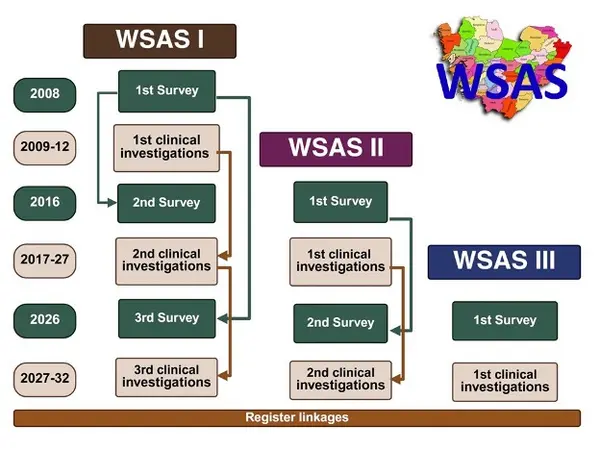
Phases and components of investigations in the West Sweden asthma study (Nwaru BI, et al. BMJ Open 2019;9:e027808, doi:10.1136/bmjopen-2018-027808). Click on the image to see a bigger version.
A unique longitudinal resource
WSAS was launched with the recruitment of its first population cohort in 2008, followed by re-examinations in 2016 and 2026. A second cohort was established in 2016 and followed up in 2026, and a third cohort was recruited in 2026. Together, these cohorts form a growing longitudinal resource that will continue to be followed through repeated population surveys and comprehensive clinical investigations. This design enables researchers to study changes in respiratory health over time, compare different generations, and identify factors associated with healthy ageing and disease development.
WSAS study flow, encompassing surveys, clinical investigations, and linkage to national registers.
Linking population, clinical, and register data
A major strength of WSAS is the integration of multiple sources of information. Participants contribute questionnaire data, clinical measurements, lung function testing, biological samples, and detailed phenotypic information. These data can also be linked to Swedish national health and social registers, enabling long-term follow-up of healthcare utilization, disease outcomes, medication use, comorbidities, and socioeconomic factors. Together, these resources provide an exceptional platform for high-quality epidemiological, clinical, and translational research.
Building knowledge for better respiratory health
Over nearly two decades, WSAS has become an internationally recognized research platform that supports collaborations across disciplines and institutions. By combining long-term follow-up with comprehensive clinical characterization and biological investigations, the study continues to generate new knowledge about asthma, COPD, allergies, and respiratory health. Our goal is to provide evidence that informs public health, improves clinical care, and contributes to better respiratory health for current and future generations.
Research Impact
Since its launch in 2008, WSAS has become one of Sweden's leading research platforms in respiratory health. The study has generated more than 120 peer-reviewed scientific publications and supported 20 completed doctoral theses, with several additional PhD projects currently underway. WSAS also serves as an important resource for national and international collaborative research. In addition to numerous collaborations worldwide, the study contributes to major Nordic and European initiatives, including EpiLung, FinEsS, and the European Respiratory Society's CADSET project.
Leading a National Research Network
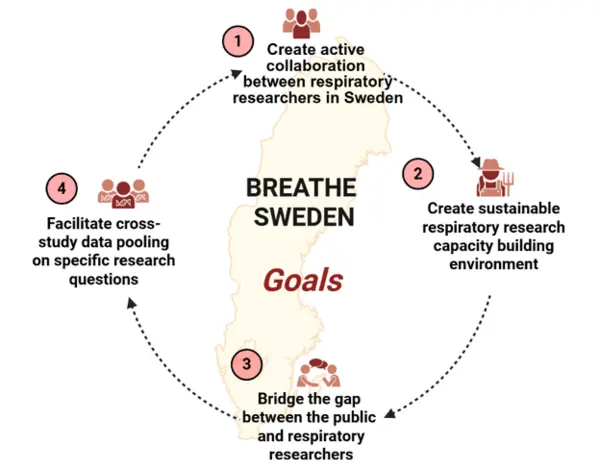
Through its host institution, the Krefting Research Centre, WSAS coordinates Breathe Sweden, Sweden's largest national consortium for respiratory research. The consortium brings together leading researchers, cohorts, and research infrastructures from across the country to strengthen collaboration, promote multidisciplinary research, and facilitate data sharing and joint analyses. Beyond advancing research, Breathe Sweden is committed to increasing public engagement and improving science communication. This mission led to the creation of Andas Sverige, a Swedish-language public outreach platform that communicates respiratory research in an accessible and engaging way. The platform connects researchers with patients, research participants, healthcare professionals, journalists, funders, and the general public, helping to bridge the gap between scientific discovery and society.
Goals of Breathe Sweden.
Ongoing Research Projects
WSAS provides a unique research platform spanning population health, clinical medicine, epidemiology, and translational science. Our research addresses the burden, causes, mechanisms, and outcomes of asthma, COPD, allergies, and related respiratory diseases.
WSAS conducts population-based surveys of asthma, respiratory conditions, and allergic diseases, generating both cross-sectional and longitudinal data. These data enable us to estimate prevalence, incidence, remission, and long-term trends, while also identifying environmental, lifestyle, and other factors associated with the development and natural history of these conditions. The 2026 survey, together with previous surveys conducted in 2008 and 2016, provides data from more than 45,000 individuals, enabling us to investigate long-term changes in respiratory health and the population burden of asthma and allergic diseases from multiple perspectives.
In addition to population survey data, WSAS conducts detailed clinical investigations in a large subsample of participants, currently comprising more than 4,000 individuals with detailed clinical data. These investigations include structured clinical interviews, anthropometric measurements, blood sampling, nasal lavage, skin prick testing, differential cell counts, body composition assessment, impulse oscillometry, spirometry, diffusion capacity, functional residual capacity, total lung capacity, and exhaled nitric oxide, among other measures. Together, these data support a broad range of clinical and translational research into asthma, respiratory diseases, allergic diseases, and severe asthma.
Asthma exhibits important sex-related differences across the life course. It is more common among boys during childhood but becomes more prevalent and often more severe among females from puberty onwards. Sex hormones are thought to contribute to these differences, although their precise roles remain incompletely understood. Female hormonal transitions—including menarche, menstruation, pregnancy, and menopause—as well as hormonal contraception and menopausal hormone therapy, may influence asthma risk and manifestations. Androgens, including testosterone, may also play a role in asthma among males. Using WSAS data, we investigate how sex hormones contribute to the development, clinical expression, and heterogeneity of asthma in females and males, with the aim of improving understanding of sex-specific mechanisms underlying asthma.
Obstructive respiratory diseases are heterogeneous, with substantial variation in clinical presentation, underlying characteristics, and disease severity. Understanding this heterogeneity is important for moving towards more individualized approaches to prevention and treatment. WSAS uses machine learning and other computational approaches to identify distinct phenotypes of obstructive airway diseases in adults. We then investigate the environmental and clinical characteristics associated with these phenotypes, as well as their healthcare-use trajectories and comorbidity patterns. This work aims to improve understanding of disease heterogeneity and provide evidence to support more personalized approaches to respiratory disease management.
Multimorbidity—the coexistence of two or more health conditions in an individual—is an increasingly important challenge, particularly as populations age and people live longer with chronic diseases. Despite substantial research on multimorbidity in conditions such as COPD, chronic bronchitis, and sleep apnoea, important gaps remain in our understanding of multimorbidity in asthma. WSAS investigates multimorbidity in asthma from a life-course and phenotype-specific perspective, including among people with adult-onset asthma. In collaboration with studies within the Breathe Sweden consortium, we characterize multimorbidity patterns and examine their implications for lung health, healthcare use, quality of life, and social outcomes across different asthma phenotypes.
WSAS investigates food intolerance and hypersensitivity in the population, with a particular focus on histamine, gluten, and lactose. One focus is histamine intolerance, for which the underlying mechanisms, prevalence, and clinical assessment remain uncertain. We investigate diamine oxidase (DAO) activity, including its normal range, factors influencing its activity, and its potential relevance to histamine-related symptoms. We also assess the prevalence of self- and physician-diagnosed gluten and lactose intolerance, characterize associated symptom patterns, and examine their relationships with other food sensitivities and allergies. This research is conducted in collaboration with the Allergy Clinic at Sahlgrenska University Hospital and dietitian Jenny van Odijk.
Through linkage with Swedish national health, medication, and social registers, WSAS enables long-term follow-up of participants and investigation of the real-world impact of asthma, respiratory diseases, and allergic conditions. These linked data complement survey and clinical information, enabling research on healthcare utilization—including primary care, specialist care, emergency visits, and hospitalizations—as well as medication use, disease outcomes, multimorbidity, comorbidities, and mortality. Socioeconomic register data further allow us to examine how education, occupation, income, employment, and other social factors influence disease trajectories, healthcare use, treatment patterns, and health outcomes.
By integrating longitudinal register data with detailed WSAS survey and clinical information, we investigate how clinical, biological, behavioural, environmental, and socioeconomic factors interact to shape long-term health outcomes across different asthma and respiratory disease phenotypes. This research provides real-world evidence to identify groups at increased risk of poor outcomes, improve clinical decision-making and healthcare planning, and inform prevention strategies and evidence-based public health policy.